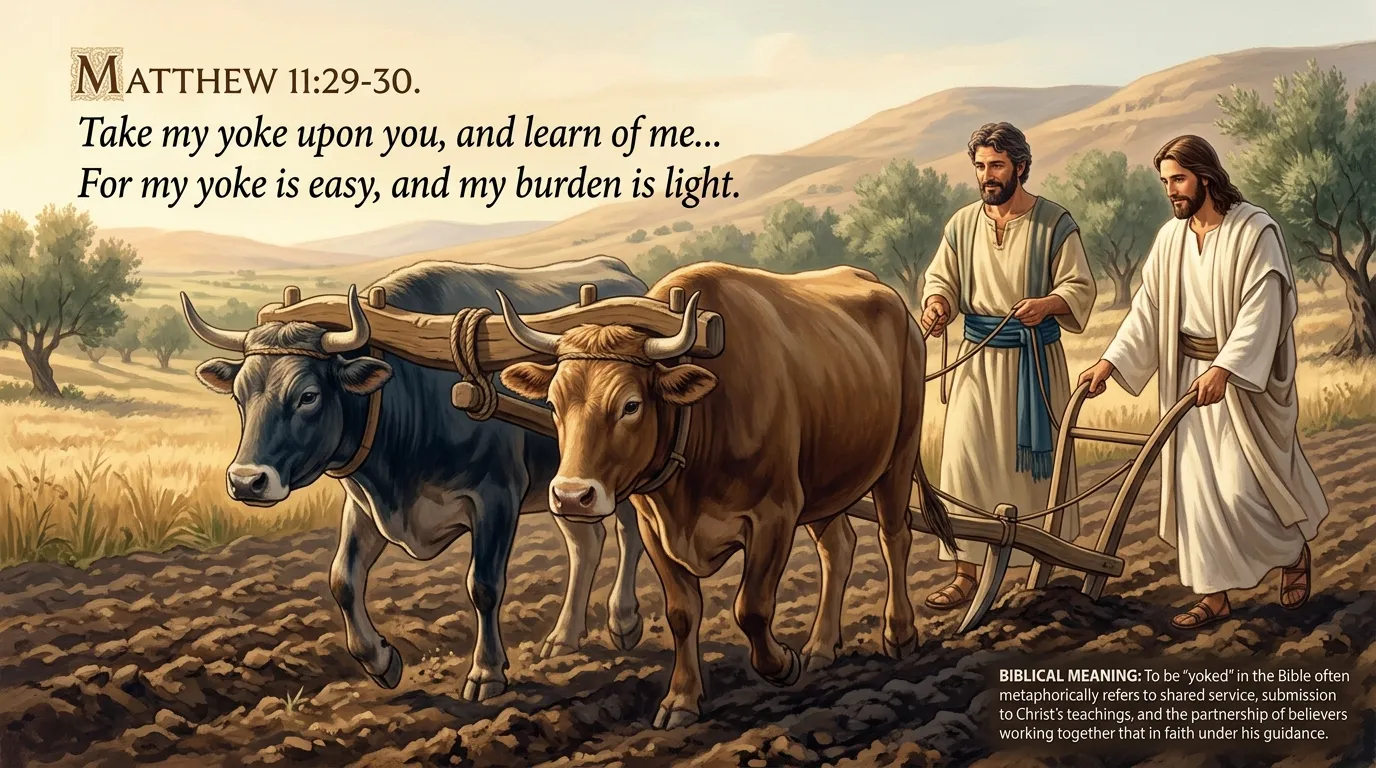
Picture a young ox, strong but untrained, wild-eyed and pulling in every direction. Now picture the farmer’s solution: he does not leave the young animal to figure out plowing on its own. He yokes it beside an older, steady ox — one that knows the furrow, keeps the pace, and will not be rattled. The young ox learns by being bound to maturity: step by step, row by row, the discipline of the yoke trains it into a worker. This is the image Scripture reaches for when it talks about being yoked — and while many readers know Jesus’ invitation to His “easy yoke” of rest (Matthew 11:28-30), the Bible’s yoke imagery runs deeper and more bracing than comfort alone. The yoke is also God’s training program: the discipline by which He shapes His people, and the partnerships by which He guards them.
How a Yoke Trains: The Discipline of Being Bound
A yoke is a wooden bar laid across the necks of two animals, joining them so they must walk together, pull together, and keep the same pace. The key insight is that the yoke restricts in order to train. The young ox would prefer to wander, sprint, or stop; the yoke says no — this furrow, this pace, this direction. Over time, the restriction becomes instinct. The trained ox no longer fights the yoke because the yoke has shaped its character. What felt like bondage has become second nature — the quiet mark of training completed, strength made useful.
Scripture applies this picture to God’s formative work in human lives. The yoke of God’s commandments is not arbitrary restriction; it is training in righteousness. “It is good for me that I was afflicted, that I might learn your statutes,” the psalmist writes (Psalm 119:71) — affliction as apprenticeship. The discipline of regular obedience — the daily furrow of prayer, Scripture, honesty, generosity — shapes the believer the way the yoke shapes the ox: slowly, resisted at first, then increasingly natural. Many Christians chafe at spiritual disciplines because they feel like restriction. The yoke reframes them: this is how God trains you to pull straight. The young ox hates the bar across its neck. The mature ox could not plow without it.
“Bear the Yoke in Youth”: Lamentations 3:27
The most striking yoke text in Scripture is also the most surprising: “It is good for a man that he bear the yoke in his youth” (Lamentations 3:27). Good. Not merely tolerable, not a necessary evil — good. Jeremiah wrote these words from the ruins of Jerusalem, in the Bible’s darkest book, and into that darkness he set this counterintuitive claim: learning discipline early is a gift.
Why youth? Because the young ox is the most trainable — and the young heart is the most shapeable. The habits formed early become the character carried for life. The young person who learns the yoke of God’s Word — who submits plans to prayer, who practices integrity when no one is watching, who learns to serve before being served — is being fitted for a lifetime of straight furrows. Conversely, the youth spent resisting every yoke often becomes the adulthood spent regretting it. This is not a text about crushing the young; it is about forming them. The farmer yokes the young ox because he believes in what it can become. God’s discipline of the young is the same: not punishment for being young, but preparation for being useful.
For parents and mentors, the verse is a mandate: do not spare the young the good yoke. The kindest thing you can do for a young person is not to remove every burden but to teach them to bear the right ones — responsibility, truthfulness, self-control, reverence. A youth without any yoke becomes an adult who cannot pull. A youth trained under God’s yoke becomes, in time, the steady older ox beside whom the next generation learns.
The Unequal Pairing: “Do Not Be Unequally Yoked”
The yoke also governs partnership — and here Scripture gives one of its most quoted warnings: “Do not be unequally yoked with unbelievers” (2 Corinthians 6:14). The agricultural logic is exact: yoke two animals of different strength, size, or temperament, and the plow goes crooked. The stronger drags the weaker, or the stubborn one fights the steady one, and the furrow — the work itself — is ruined. Paul applies this to the believer’s deepest alliances: marriage, first of all, but also close business partnerships and the intimate friendships that shape the soul’s direction.
Notice what the text does not say. It does not forbid friendship with unbelievers — Jesus ate with tax collectors and sinners, and Paul elsewhere assumes believers will have unbelieving spouses, neighbors, and colleagues (1 Corinthians 7:12-14). The prohibition concerns yoking: the binding partnerships where two lives must pull as one. Marriage is the clearest case — two people yoked for life, trying to plow the same furrow toward different horizons, will tear the field apart. The principle extends to any alliance that requires shared spiritual direction: the business partnership built on compromised ethics, the ministry alliance with those who deny the gospel. Choose your yoke-mates carefully, because the yoke determines the furrow.
The positive side of the warning is just as important: seek equal yoking. The believer yoked to a mature fellow believer — in marriage, in friendship, in ministry — experiences the yoke as the young ox does beside the steady one: training, steadiness, shared strength. This is why Christian community matters so much. We are not meant to pull alone, and we are not meant to pull beside those walking the opposite direction. Find the steady oxen. Walk in their furrow. In time, you will become one.
The Yoke That Gets Broken: Discerning Which Yoke You’re Under
Scripture also speaks of yokes that God breaks — and the contrast teaches discernment. “I will break the yoke from off their neck,” God promised Israel concerning Babylonian oppression (Jeremiah 30:8). “Now I will break his yoke from off you,” He said through Nahum concerning Assyria (Nahum 1:13). Egypt’s bondage was a yoke; God shattered it at the Red Sea. Here is the crucial distinction: God breaks the yokes that enslave and blesses the yoke that trains. Not every burden in your life is God’s discipline. Some are oppressions He intends to lift.
How do you tell the difference? Look at the fruit and the direction. God’s training yoke produces growth — patience, holiness, wisdom — and it always moves you toward Him. The psalmist’s affliction taught him God’s statutes; the discipline drew him closer. Oppressive yokes do the opposite: they produce despair, they isolate, they move you away from God and from people. The yoke of addiction, the yoke of an abusive relationship, the yoke of crushing legalism that denies grace — these are not Lamentations 3:27 yokes. These are Egypt yokes, and God’s posture toward them is liberation, not preservation.
This discernment matters because two opposite errors both invoke “bearing the yoke.” One error baptizes every suffering as God’s training and endures what God wants broken — staying in destructive patterns under the banner of patience. The other error treats every discipline as oppression and throws off what God wants kept — abandoning the hard furrow of obedience at the first chafing. Wisdom knows which yoke is which. Pray for that wisdom specifically: Lord, is this burden Your training or an oppression You want to break? Give me grace to bear the first and courage to leave the second. The young ox submits to the farmer’s yoke — and the farmer, in turn, would never yoke his animal to a plow that destroys it. Trust the Farmer to know the difference, and ask Him to teach it to you.
The Yoke You Choose Determines the Harvest
Everyone is yoked to something. The question is never whether you will bear a yoke but which one — the yoke of God’s training or the yoke of the world’s demands, the yoke of wise partnerships or the yoke of entangling ones. The world offers its own yokes: the yoke of others’ approval, the yoke of endless acquisition, the yoke of anxiety about tomorrow. Those yokes chafe and never train; they harness you to furrows that produce nothing eternal.
God’s yoke is different — not because it is weightless, but because it is purposeful. It restricts in order to form. It binds in order to free. The young ox, years later, pulls straight and strong — not despite the yoke but because of it. So with the believer: the disciplines learned in youth, the partnerships chosen wisely, the submission practiced daily — these are the wooden bar across the neck that shapes a life into something useful in the Master’s field. It is good to bear the yoke. Choose it early, choose your fellow oxen well, and pull straight. For background on the farming implement behind the metaphor, see the article on the yoke.










