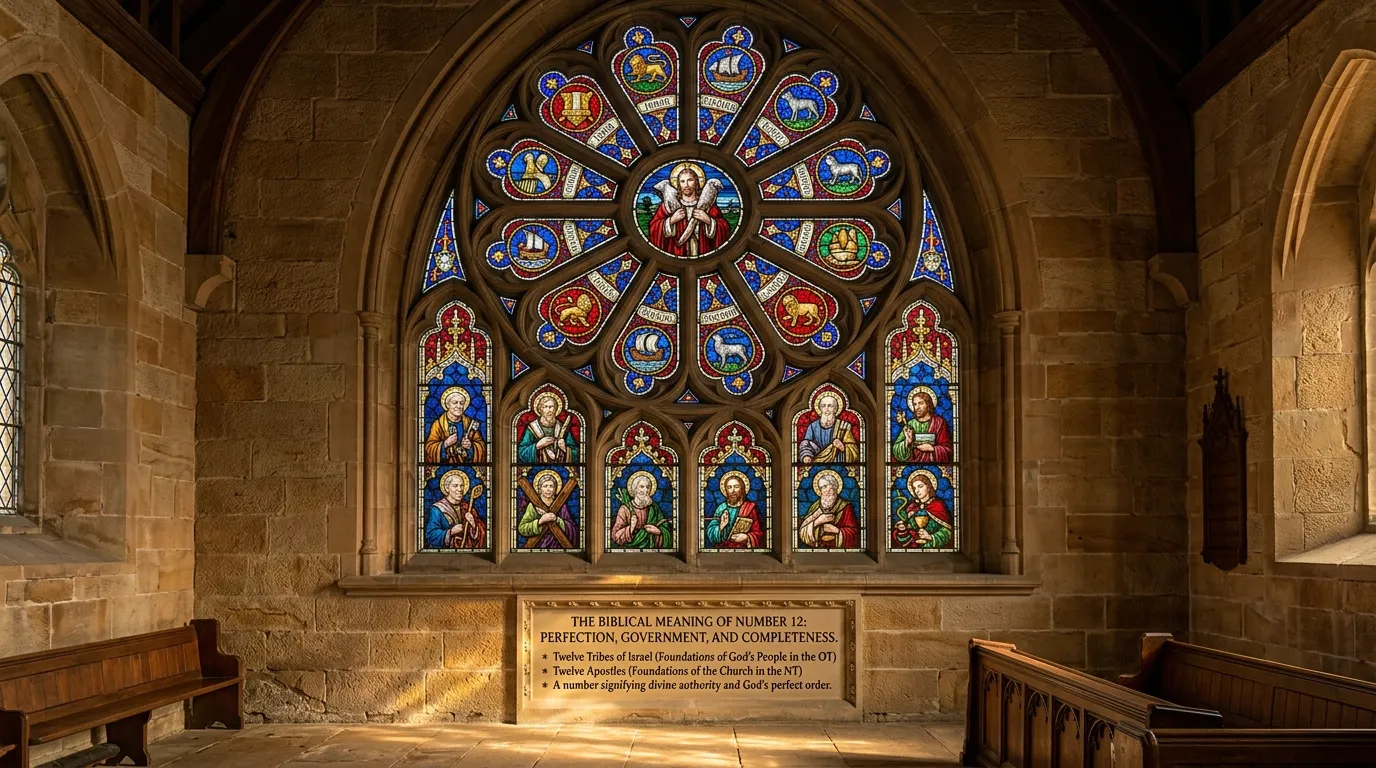
John’s vision of the New Jerusalem ends with a city measured in twelves: twelve gates, and at the gates twelve angels, and on the gates the names of the twelve tribes of Israel; the wall has twelve foundations, and on them the names of the twelve apostles of the Lamb (Revelation 21:12-14). It is the Bible’s final picture of God’s finished work — and it is built, everywhere you look, out of the number twelve. That is no accident. From the first pages of Israel’s story to the last page of Revelation, twelve is the number Scripture reaches for when it wants to talk about God’s people — the full, ordered, complete community He is gathering. Understanding the number’s meaning is less about decoding secret messages and more about recognizing a pattern: whenever twelves appear, God is saying something about His people.
Twelve Gates: Entering Through Israel’s Story
The twelve gates of the New Jerusalem carry the names of the twelve tribes of Israel — and the detail is theologically loaded. The tribes were the sons of Jacob, the flawed, fractious family through whom God chose to work His redemptive plan: Reuben the unstable, Judah the praise-bringer, Levi the priestly, Joseph the dreamer whose brothers sold him. Their story is one long demonstration that God builds His people out of unpromising material. That these names — this history, with all its dysfunction — are inscribed on the gates of the eternal city means the people of God enter their final home through Israel’s story, not around it. The Old Testament is not the discarded first draft; its people are written on the gates forever.
The gates face every direction — three on the east, three on the north, three on the south, three on the west (Revelation 21:13). The city’s openness is the point: access to God’s people was never meant for one tribe, one nation, one direction. And the gates are never shut: “its gates will never be shut by day — and there will be no night there” (Revelation 21:25). The twelve gates say that the people of God are complete and the invitation is universal. Whatever compass point you are coming from, there is a gate with a tribal name on it, and the way in runs through the covenant history of Israel. The number twelve here means fullness of access — nobody is left standing outside for lack of a door.
Twelve Foundations: The Apostles Underneath
If the gates are Israel, the foundations are the church: “the wall of the city had twelve foundations, and on them were the twelve names of the twelve apostles of the Lamb” (Revelation 21:14). The image is architectural and deliberate — the people of God rest on apostolic witness. Paul says the same thing in plainer prose: the church is “built on the foundation of the apostles and prophets, Christ Jesus himself being the cornerstone” (Ephesians 2:20). The twelve apostles — the eyewitnesses Jesus chose, trained, and sent — are the foundation stones of everything the church is.
Why twelve apostles? Jesus could have chosen ten or fifteen; the number was intentional. By choosing twelve, He was making a foundational claim about continuity: this new community He was forming stood in direct succession to the twelve tribes. The new Israel, built on the old. Their names are all recorded — Peter, James, John, and the rest (Matthew 10:2-4) — because foundations are meant to be known, not anonymous. When Judas’s betrayal left the number at eleven, the remaining apostles treated the gap as something that had to be filled — they chose Matthias, restoring the twelve (Acts 1:15-26). The completeness of the number mattered because the symbolism mattered: twelve apostles for a complete witness, twelve tribes for a complete people. Paul, the apostle “untimely born,” fits the pattern differently — his apostleship to the Gentiles extends the twelve’s witness rather than replacing it — but the foundation imagery stands: the church’s faith rests on the testimony of those Jesus personally sent.
Twelve Everywhere: The Pattern Through Scripture
Once you see the pattern, you see it everywhere. Twelve tribes. Twelve apostles. Twelve baskets of leftover bread after Jesus fed the five thousand (Matthew 14:20) — provision with abundance to spare, one basket per tribe, one per apostle: the God who feeds His people does so completely. Twelve stones taken from the Jordan as a memorial when Israel crossed into the land (Joshua 4) — one per tribe, a monument of the whole people’s deliverance. Twelve springs at Elim (Exodus 15:27) — water enough for every tribe in the wilderness. The pattern is consistent: when God provides for, organizes, or memorializes His people, He does it in twelves.
The organization of Israel in the wilderness shows the same logic at work. The twelve tribes camped in ordered formation around the tabernacle — three tribes on each side (Numbers 2) — with God’s presence at the center. The picture is deliberate: the complete people, ordered around the present God. And when Jesus sent out the twelve on their first mission, He sent them “two by two” (Mark 6:7) — six pairs, the whole witness going out together. The number keeps doing the same work: marking the people of God as complete, ordered, and sent.
Even the measurements of the New Jerusalem are twelves multiplied: the wall is 144 cubits — twelve times twelve (Revelation 21:17) — and the 144,000 of Revelation 7 and 14 are twelve thousand from each tribe, the number squared and multiplied by a thousand: completeness compounded. Interpreters have long noted the traditional symbolism: twelve as three (the divine number) multiplied by four (the number of the earth — four winds, four corners), yielding God’s people as heaven meets earth. That reading is ancient and widespread, and it captures something true about how Scripture uses the number — though it should be held as devotional insight rather than mathematical proof. The Bible never gives us a formula; it gives us a pattern, and the pattern is unmistakable.
Twelve in the Life of Jesus: The Number Follows Him
The pattern is not confined to visions and genealogies; it walks through the Gospels beside Jesus Himself. At twelve years old, He stays behind in the temple, astonishing the teachers — the age marking His emergence into the consciousness of His mission: “Did you not know that I must be in my Father’s house?” (Luke 2:49). When the soldiers come to arrest Him in Gethsemane, He tells Peter He could call twelve legions of angels (Matthew 26:53) — divine power, complete and at His disposal, deliberately not deployed. The number keeps signaling the same thing: fullness, completeness, nothing lacking.
Most striking is Mark’s famous intercalation — the story within the story in Mark 5. A synagogue ruler named Jairus begs Jesus to heal his twelve-year-old daughter, dying at home. On the way, a woman who has suffered a flow of blood for twelve years touches Jesus’ garment and is healed. By the time Jesus reaches the house, the girl has died — and He raises her. Two twelves, woven into one narrative: twelve years of suffering ended, twelve years of young life restored. The number frames a story about Jesus’ complete power over the full range of human brokenness — chronic affliction and sudden death alike. Mark did not arrange those details by accident; the twelves are signposts pointing to the sufficiency of Christ. Whatever the need, however long it has lasted, His power is complete.
A Word of Caution: Pattern, Not Code
Honesty requires a caution, because number-symbolism is one of the easiest biblical truths to misuse. The Bible uses twelve symbolically — but it never teaches that every twelve you encounter is a secret message. Seeing 12:12 on a clock is not necessarily God speaking; finding twelve of something in your day is not automatically significant. Scripture’s symbolism interprets Scripture; it does not turn daily life into a puzzle. The meaning of twelve is found in the tribes, the apostles, the gates, and the foundations — in the text, in context — not in numerology charts or in the anxious scanning of receipts and license plates.
The Reformers had a useful principle: let the clear interpret the unclear, and never build doctrine on speculation. The clear teaching about twelve is ecclesiological — it is about the people of God: their completeness, their continuity from Israel to church, their foundation in apostolic witness, their open gates facing every nation. That is rich enough without inventing hidden codes. When twelves appear in your Bible reading, let them remind you of the great truth they carry: God is building a complete people, and the gates are open. That is the message of the number — not a cipher to crack, but a people to join. For background on the number itself across cultures and history, see the encyclopedia article on the number 12.










