The vote was ten to two, and the ten won. Twelve spies had walked the length of Canaan for forty days; twelve had seen the same fortified cities, the same giant Anakim, the same valleys flowing with milk and honey. Ten came back with a report of despair: “We are not able.” Two came back with a report of faith: “We are well able.” The congregation believed the ten, wept all night, and talked of stoning Moses — and that night of weeping cost Israel forty years in the wilderness. But God had already rendered His own verdict on the minority of two, and His words about one of them have echoed for three thousand years: “My servant Caleb, because he has a different spirit and has followed me fully, I will bring into the land” (Numbers 14:24). This is the story of the man with the different spirit — Caleb, the spy of faith.
“A Different Spirit”: God’s Verdict First
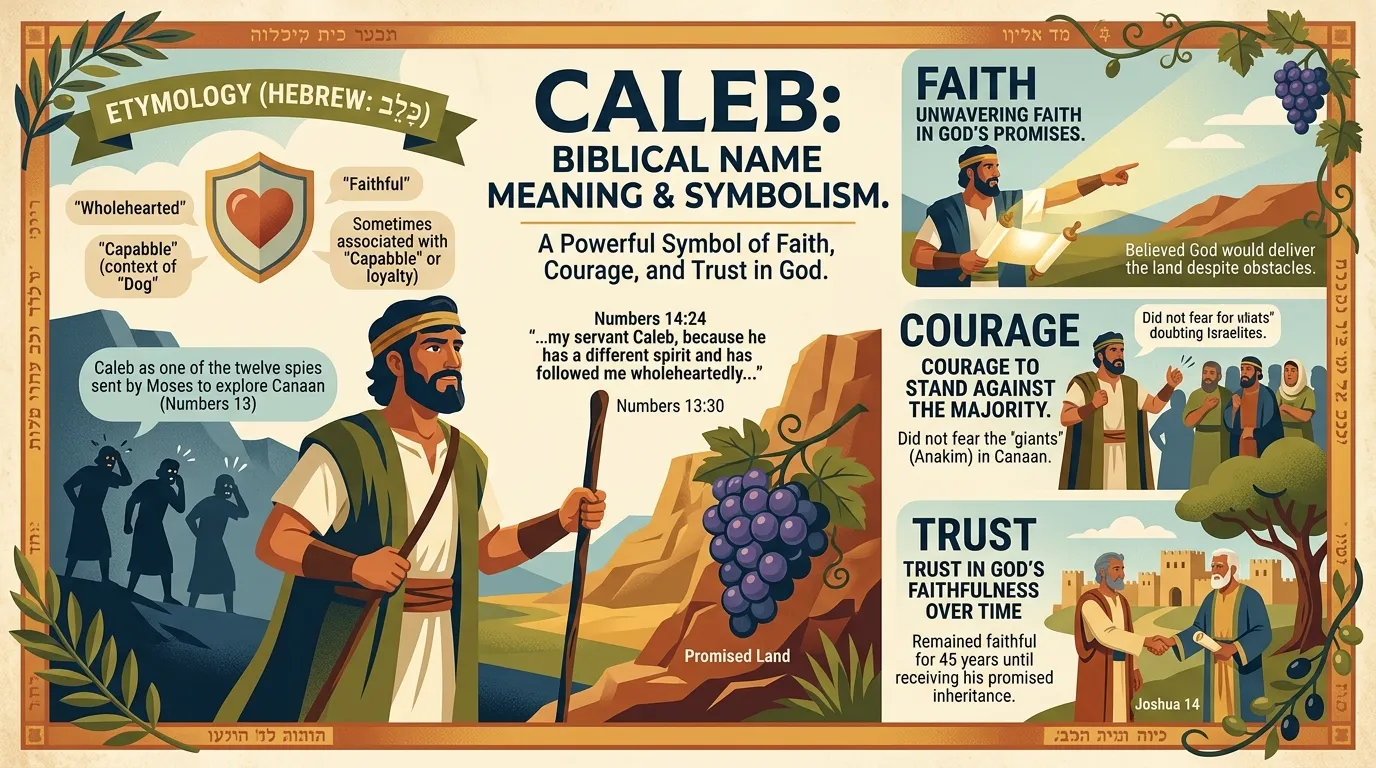
Start with the verdict rather than the biography, because the verdict explains everything. A different spirit. In a camp consumed by fear, Caleb’s inner life ran on different fuel. The Hebrew behind “followed me fully” suggests wholeheartedness — literally, he filled up his following of God, leaving no gaps for divided loyalty. While Israel hedged its bets — maybe God, maybe the giants, maybe we should go back to Egypt — Caleb’s allegiance had no remainder. He was all in.
Notice what God does not say about Caleb. He does not praise his strategy, his strength, or his résumé. He praises his spirit — the deep orientation of the man. Circumstances are largely outside our control; the ten spies and Caleb faced identical circumstances. What differed was the interior life brought to those circumstances. This is both the comfort and the challenge of Caleb’s story: you cannot control the giants in your land, but by God’s grace you can cultivate the spirit with which you face them. The different spirit is not a personality type reserved for heroes. It is a posture available to anyone who decides that God’s promise is bigger than the obstacles — and then refuses to un-decide it.
The name itself whispers the theme. Caleb (kalev) in Hebrew means “dog” — and before modern readers recoil, they should know that in the ancient world the dog was the emblem of loyalty, the creature that stays by its master through everything. “Faithful like a dog” may be the name’s lived sense: devoted, tenacious, unwilling to leave its master’s side. Whether or not Caleb’s parents intended the full meaning, the man grew into it completely. He was God’s faithful hound — he would not be driven off, not by giants, not by the majority, not by forty years of waiting.
The Spy Who Measured Giants Against God
Return now to Kadesh, to the moment that defined him. The ten spies gave what sounded like a responsible military assessment: the people are strong, the cities are fortified, the Anakim are there, “we seemed to ourselves like grasshoppers, and so we seemed to them” (Numbers 13:33). It was accurate — and faithless. Accuracy about obstacles is not the same as truth about the situation, because the situation included God, and the ten had edited Him out of the report. Caleb’s minority report was shorter and theologically loaded: “Let us go up at once and occupy it, for we are well able to overcome it” (Numbers 13:30). Well able — not because Israel was strong, but because God was with them.
Caleb made the same point more explicitly the next day, when the camp was in full rebellion: “The land… is an exceedingly good land. If the LORD delights in us, he will bring us into this land… Only do not rebel against the LORD. And do not fear the people of the land, for they are bread for us. Their protection is removed from them, and the LORD is with us; do not fear them” (Numbers 14:7-9). They are bread for us. The giants the ten saw as devourers, Caleb saw as dinner. Same giants. Same walls. The difference was never in the obstacles; it was in the God. The ten measured the giants against themselves and felt like grasshoppers. Caleb measured the giants against the LORD and felt like a well-fed man looking at lunch. This is the entire secret of faith in one contrast, and it is as relevant to a medical diagnosis or a financial crisis today as it was at Kadesh: giants look different depending on who stands beside you.
And note Caleb’s courage in voicing the minority report. He “quieted the people” — he stood up in a panicking crowd and spoke against the mood. Faith that stays silent in the committee meeting is not yet Caleb-faith. The different spirit speaks, even when the vote is ten to two, even when the crowd is picking up stones (Numbers 14:10). Courage is not the absence of trembling; it is the refusal to let trembling edit the truth.
The Wilderness He Didn’t Deserve: Forty-Five Years of Waiting
Here the story takes the turn that separates admirers of Caleb from imitators of him. Caleb was faithful at forty. His reward was forty-five years of wilderness wandering — marching in circles with the very generation whose unbelief he had opposed, burying his contemporaries one by one, watching the promise recede year after year. He had done everything right, and his prize was to share the punishment of those who had done everything wrong. There is no record that he complained. There is no hint of bitterness, no “I told you so” preserved in the text — though he had earned the right to say it daily.
This is the chapter for everyone whose obedience has not yet been rewarded. The faithful employee passed over for promotion. The praying parent with the prodigal still gone. The believer who did everything right and is still waiting. Caleb’s life declares what the instant-results culture cannot hear: faithfulness is not validated by speed. God’s “soon” and our “soon” are different words. The wilderness years were not wasted years; they were the proving of the different spirit — the long obedience that turned a moment of courage at Kadesh into a lifetime of character. Anyone can be brave for a day. Caleb was faithful for four and a half decades without a payoff in sight.
What did the waiting not do to him? It did not sour him, shrink him, or make him cynical. Bitterness is the wilderness’s most common souvenir; Caleb brought back faith instead. When your promise is delayed, the delay is doing something in you, not just to you: it is proving whether your faith was in God or merely in His timetable. Caleb’s was in God. The timetable could wait.
Eighty-Five and Still Asking for Giants
Then comes the scene that crowns the story. The conquest is largely complete, the land is being divided, and an eighty-five-year-old man walks up to Joshua: “I am still as strong today as I was in the day that Moses sent me… So now give me this hill country of which the LORD spoke on that day, for you heard on that day how the Anakim were there, with great fortified cities. It may be that the LORD will be with me, and I shall drive them out, just as the LORD said” (Joshua 14:11-12). Read it slowly. He does not ask for the easy valley land. He asks for the hill country — the very territory of the Anakim, the giants who terrified Israel when he was forty. He wants unfinished business with fear itself.
And he asks it with the humility of a veteran: “It may be that the LORD will be with me.” After a lifetime of God’s faithfulness — after the different spirit, the minority report, the forty-five patient years — still no presumption, still dependence. The strongest statement of faith in the passage wears the gentlest clothing. Joshua blessed him and gave him Hebron, and the text records the outcome with quiet triumph: the Anakim stronghold became Caleb’s inheritance, “because he wholly followed the LORD, the God of Israel” (Joshua 14:14). At eighty-five, Caleb finished what the ten spies had feared at forty. The giants fell to the man who never stopped believing they would.
Scripture gives Caleb’s epitaph three times, in three different books: he “wholly followed the LORD” (Numbers 32:12; Deuteronomy 1:36; Joshua 14:8). Repetition in the Bible is emphasis — God wanted the phrase remembered. Wholly. Not perfectly — Caleb was a sinner like the rest — but wholly: undivided, unreserved, complete. It is the highest praise a human being receives in the Old Testament, and it was given not to a king or a prophet but to a spy who believed God, waited without bitterness, and finished strong.
From the minority report at Kadesh to the hill country at eighty-five, Caleb’s life preaches one sermon across forty-five years: see the giants, see the bigger God, speak the truth when the crowd panics, wait without bitterness, and finish asking for hill country. The faithful hound never left his Master’s side — and the Master kept every promise. For the historical and traditional background on this figure, see the article on Caleb.