Every reader of the Gospels eventually collides with the same unavoidable question — the one Jesus Himself asked: “Who do you say that I am?” (Matthew 16:15). The answers on offer have always fallen into a few camps: a great teacher, a prophet, a revolutionary, a myth. But the New Testament insists on an answer in a category of its own: Jesus Christ is fully divine — true God as well as true man. The word “deity” in Christian theology names exactly this: the divine nature, the fullness of what it means to be God, possessed completely by Jesus Christ. This is not a philosophical abstraction or a later invention of theologians. It is the claim the apostles made, the claim the early church defended at great cost, and the claim on which the entire Christian faith either stands or falls.
Honesty requires saying at the outset where the lines are drawn. The English word “deity” and the word “Trinity” do not appear in the Bible. What does appear, repeatedly and unmistakably, is the substance those words were later coined to describe: the New Testament presents Jesus as sharing fully in the identity, attributes, and worship that the Old Testament reserves for God alone. The church’s later creeds did not invent this teaching; they articulated it, giving precise language to what the apostles had already proclaimed. That distinction — between the biblical testimony and the theological vocabulary developed to protect it — matters, and keeping it clear is the honest way to handle the doctrine.
The Claims in His Own Mouth
Start with Jesus’ own words, because the deity of Christ is not something His followers projected onto a modest teacher — it is something He claimed, repeatedly, in a first-century Jewish context where the claims were unmistakable. To the religious leaders He said, “Before Abraham was, I am” (John 8:58) — and they picked up stones, because they heard exactly what He meant: I am is the divine name revealed to Moses at the burning bush (Exodus 3:14). He said, “I and the Father are one” (John 10:30) — and again the stones came out, “because you, being a man, make yourself God” (John 10:33). His opponents never misunderstood Him on this point; they understood Him perfectly and tried to kill Him for it.
At His trial, the high priest put the question directly: “Are you the Christ, the Son of the Blessed?” Jesus answered, “I am, and you will see the Son of Man seated at the right hand of Power, and coming with the clouds of heaven” (Mark 14:61-62) — a deliberate weaving of Psalm 110:1 and Daniel 7:13, texts about divine authority and heavenly glory. The high priest tore his robes and declared it blasphemy. Jesus was condemned, by His own nation’s highest court, for claiming to be divine. Whatever else one concludes about Him, the “merely a good moral teacher” option collapses under the weight of His own testimony. As C. S. Lewis famously framed the trilemma: a man who said these things was either a liar, a lunatic, or exactly who He claimed to be.
His actions made the same claim His words did. He forgave sins directly — “your sins are forgiven” — and the scribes rightly asked, “Who can forgive sins but God alone?” (Mark 2:7). He received worship: Thomas fell before the risen Christ crying, “My Lord and my God!” (John 20:28), and Jesus did not correct him — He blessed the faith that would believe without seeing. He accepted the worship of the disciples after walking on water (Matthew 14:33). In a fiercely monotheistic culture, a merely human teacher who accepted worship would have been a blasphemer. Jesus accepted it as His due.
What the Apostles Saw: The Fullness of Deity
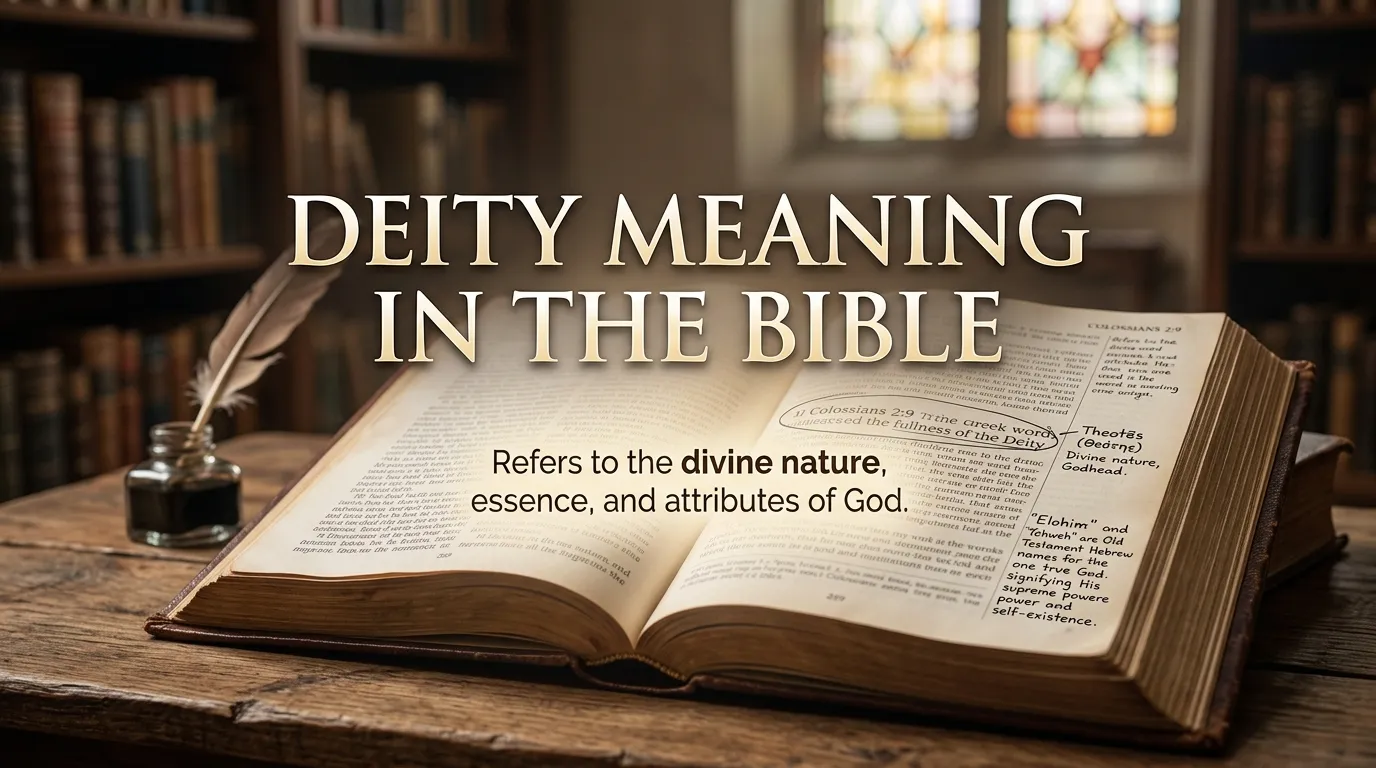
The apostolic writings take the claim and unfold it with theological precision. John’s Gospel opens with the most famous sentence in the New Testament: “In the beginning was the Word, and the Word was with God, and the Word was God” (John 1:1) — and then the identification: “the Word became flesh and dwelt among us” (John 1:14). Paul writes that “in him the whole fullness of deity dwells bodily” (Colossians 2:9). The whole fullness. Not a portion, not an emanation, not a lesser divine being — the complete, undiluted divine nature, dwelling in a human body. The same Paul who wrote “there is one God” also wrote that Christ is “our great God and Savior” (Titus 2:13).
The great Christ-hymn of Philippians 2 traces the arc: Christ Jesus, “though he was in the form of God, did not count equality with God a thing to be grasped, but emptied himself, by taking the form of a servant, being born in the likeness of men” (Philippians 2:6-7). The “emptying” was not the subtraction of deity but the addition of humanity — the eternal Son taking on a human nature without ceasing to be divine. Hebrews calls Him “the radiance of the glory of God and the exact imprint of his nature” (Hebrews 1:3): not a reflection at a distance, but the exact imprint, the way a seal’s image is exactly the seal’s own. The New Testament’s testimony is cumulative and consistent: everything that makes God God — eternity, creatorship, the right to receive worship, the authority to forgive sin — is predicated of Jesus Christ.
Why the Church Drew the Line: Nicaea and the Honest Record
In the fourth century, a presbyter named Arius taught that Christ was the highest of created beings but created — “there was when he was not.” The church convened at Nicaea (A.D. 325) and rejected this teaching, confessing Christ as “true God from true God, begotten not made, of one substance with the Father.” Here is the honest framing: Nicaea did not invent the deity of Christ; it defended the apostles’ teaching against a novel denial of it. The creed’s philosophical vocabulary (“of one substance”) was new; the conviction it protected was as old as Thomas’s cry in the upper room.
This matters because critics sometimes present the doctrine as a political construction of the fourth century. The historical record runs the other way: the denial was the innovation, and the church’s response was conservative — an attempt to say precisely what Scripture had always said, against a teaching that would have made Christ a creature. The earliest Christian writings outside the New Testament already worship Jesus as divine: Pliny the Younger, a Roman governor writing around A.D. 112, reported that Christians sang hymns “to Christ as to a god.” The worship preceded the creeds by centuries. The church did not vote Jesus into deity; it recognized the deity the apostles had proclaimed and the martyrs had died confessing.
Why Deity Changes Everything
This doctrine is not theological fine print. It is load-bearing — remove it and the whole structure of Christian faith collapses. First, salvation requires it. Only God can forgive sins against God; only an infinite person can offer a sacrifice of infinite worth. If Christ were merely a great man, His death would be a moving martyrdom — and utterly insufficient to bear the sins of the world. The cross saves precisely because the one on it is divine. Second, worship requires it. The first commandment forbids worshiping anyone but God; if Christ is not God, then Christian worship is idolatry. The church’s worship of Jesus is either the highest truth or the gravest blasphemy — there is no safe middle.
Third, it changes how we know God. “Whoever has seen me has seen the Father,” Jesus told Philip (John 14:9). The deity of Christ means God is not a distant inference or a philosophical postulate — He has a face, a voice, a set of hands that touched lepers and broke bread. Every question about what God is like finds its answer by looking at Jesus. Is God compassionate? Watch Him weep at Lazarus’s tomb. Is God holy? Watch Him cleanse the temple. Is God loving? Watch the cross. The doctrine of Christ’s deity is ultimately the doctrine that God wants to be known — and has made Himself known, fully and finally, in the Son.
Fourth, it means God understands human life from the inside. The deity of Christ is half the story; the other half is His true humanity, and the two belong together. Because the divine Son took on flesh, He knows hunger, weariness, grief, and temptation — “tempted as we are, yet without sin” (Hebrews 4:15). The God Christians worship is not a distant observer of suffering but one who has entered it. That is why believers can “with confidence draw near to the throne of grace” — the throne is occupied by one who both reigns in deity and sympathizes in humanity. Take away His deity and you lose salvation; take away His humanity and you lose sympathy. Christian faith refuses to surrender either.
From the “I am” sayings to Thomas’s confession, from Colossians’ “fullness of deity” to Nicaea’s defense of the apostolic faith, Scripture and history speak with one voice: Jesus Christ is true God — and everything Christians believe about salvation, worship, and the character of God stands on that confession. For the broader theological history of this central Christian claim, see the article on the divinity of Jesus.










