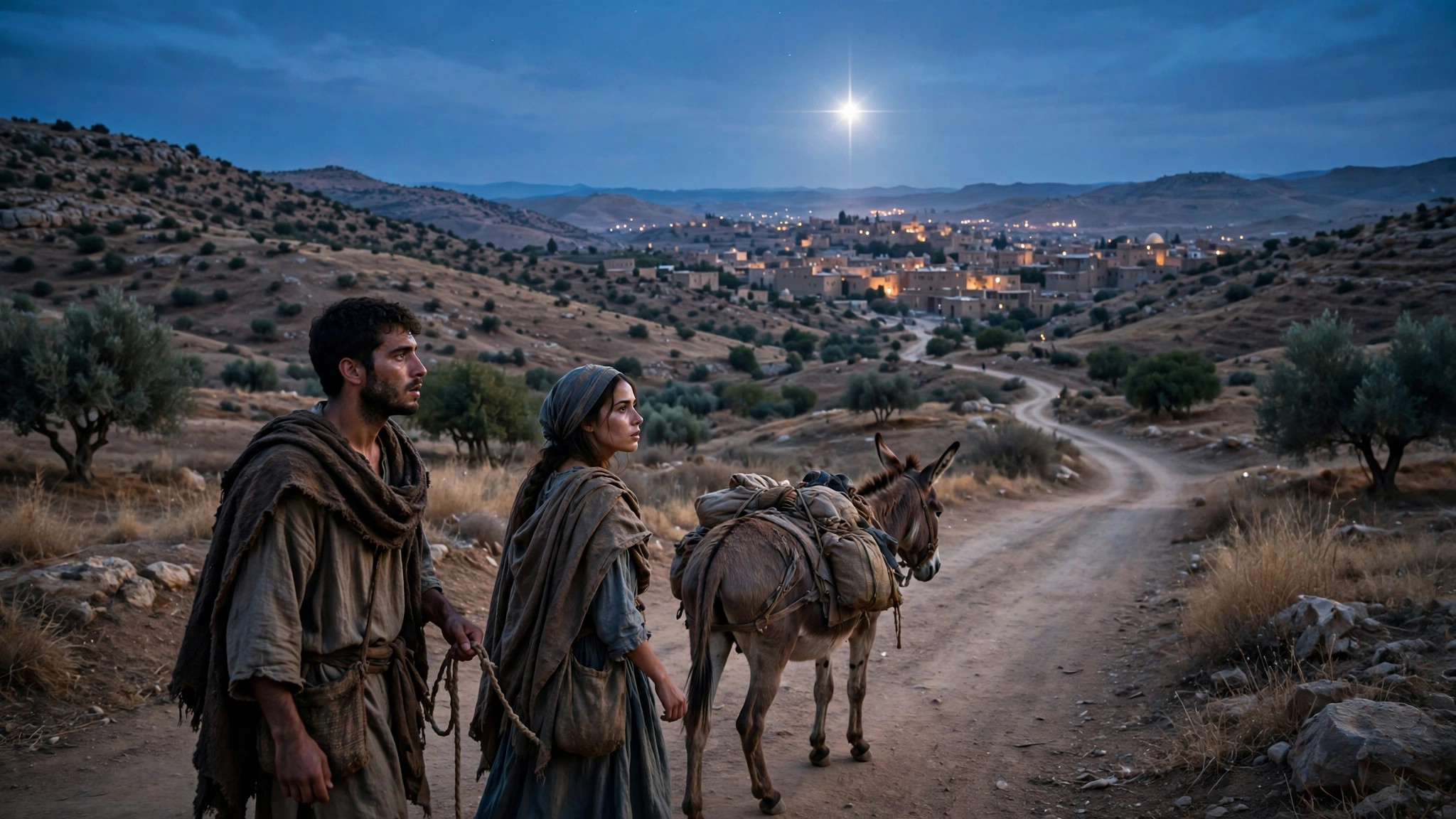
Imagine being nine months pregnant and told you must walk nearly a hundred miles over rough hills — not for a vacation, but because the government demanded it. This was Joseph and Mary’s journey to Bethlehem. If you have ever wondered about the Joseph and Mary journey in the Bible, you will find it is far more than a Christmas story detail. It is a profound picture of obedience, trust, and God’s perfect timing in the middle of life’s hardest roads.
Every December we see the peaceful nativity scene — but the real journey was anything but peaceful. It was dusty, dangerous, and deeply uncomfortable. And it was exactly where God wanted them.
The Road Before Bethlehem: Two Obediences
The journey to Bethlehem was not the first hard road Joseph and Mary walked. It was the second.
The first road was the road of surrender. When the angel announced to Mary that she would bear the Son of God, her answer was, “I am the Lord’s servant. May your word to me be fulfilled” (Luke 1:38). When Joseph learned of her pregnancy, he planned to divorce her quietly — until an angel told him in a dream, “Do not be afraid to take Mary home as your wife, because what is conceived in her is from the Holy Spirit” (Matthew 1:20). Joseph woke up and obeyed. “He did what the angel of the Lord had commanded him” (Matthew 1:24, in substance).
Both of them paid a price for obedience. Mary faced shame in a culture where an unwed pregnancy could mean stoning. Joseph faced gossip in a small town where everyone knew everyone’s business. Obedience to God is rarely free. It cost Joseph his reputation and Mary her comfort — and it was only the beginning.
The Decree: When God Uses an Emperor
“In those days Caesar Augustus issued a decree that a census should be taken of the entire Roman world” (Luke 2:1). Caesar wanted taxes and control. God wanted a prophecy fulfilled: “But you, Bethlehem Ephrathah, though you are small among the clans of Judah, out of you will come for me one who will be ruler over Israel” (Micah 5:2). The Messiah had to be born in Bethlehem. Mary and Joseph lived in Nazareth, ninety miles north. How would they get there?
God used an emperor’s decree to move them. Caesar thought he was counting his subjects. God was positioning his Son. “The king’s heart is in the hand of the Lord; he directs it like a watercourse wherever he pleases” (Proverbs 21:1). The most powerful man in the world became, unknowingly, God’s travel agent.
There is enormous comfort here. The forces that seem to control your life — the government, the economy, the boss, the diagnosis — are not outside God’s hand. He can use a census, a layoff, a move, a delay, to position you exactly where he wants you. The decree that disrupted Joseph and Mary’s life was the instrument of God’s prophecy. Your disruption may be the same.
The Journey: Ninety Miles of Dust and Trust
The road from Nazareth to Bethlehem was roughly ninety miles, through the hills of Samaria or along the Jordan Valley, then up through the Judean hills to Bethlehem. On foot, with a donkey carrying supplies, it would have taken four to seven days — through rough terrain, past bandits, with no hotels, no rest stops, and a heavily pregnant young woman.
We do not know the details. The Bible does not tell us whether Mary rode the donkey (tradition says she did) or walked. It does not tell us where they slept or what they ate. But we know this: every mile was an act of trust. Every night on the road was a night God provided. Every step was a step toward a promise they could not yet see.
The journey teaches us that God’s guidance is often not a map but a road. Joseph and Mary did not know what awaited them in Bethlehem — no room at the inn, a stable, a manger. They only knew they had to go. “Your word is a lamp for my feet, a light on my path” (Psalm 119:105, in substance) — a lamp, not a floodlight. God gave them light for the next step, not for the whole journey. That is usually how he guides us too.
The Arrival: No Room, but a Savior
When they arrived, “there was no guest room available for them” (Luke 2:7). The young couple, exhausted from the road, found shelter in a stable — and there, in the most unremarkable place imaginable, the most remarkable event in history took place: “She gave birth to her firstborn, a son. She wrapped him in cloths and placed him in a manger” (Luke 2:7).
The King of kings was born not in a palace but in a stable, not among the powerful but among the animals, not with a celebration but in obscurity. The journey that began with an emperor’s decree ended with a baby in a feeding trough. God has always worked this way: the greatest glory wrapped in the humblest circumstances.
And the first visitors were not dignitaries but shepherds — the outcasts of society, working the night shift — who heard angels sing: “Today in the town of David a Savior has been born to you; he is the Messiah, the Lord” (Luke 2:11). The journey to Bethlehem was not just Joseph and Mary’s journey. It was the beginning of God’s journey to us.
The Journey After: Egypt and Home
The journey did not end at Bethlehem. When the wise men had gone, an angel warned Joseph in a dream: “Get up, take the child and his mother and escape to Egypt. Stay there until I tell you, for Herod is going to search for the child to kill him” (Matthew 2:13). So Joseph got up, “took the child and his mother during the night and left for Egypt” (Matthew 2:14). The road to Bethlehem was hard; the road to Egypt was terrifying — a refugee’s flight in the dark, to a foreign land, with a king hunting their son.
They stayed in Egypt until Herod died. Then the angel came again: “Get up, take the child and his mother and go to the land of Israel, for those who were trying to take the child’s life are dead” (Matthew 2:19-20). They returned and settled in Nazareth. The journey had come full circle: Nazareth to Bethlehem to Egypt to Nazareth — hundreds of miles, years of displacement, all of it guided by dreams, angels, and God’s unseen hand.
Joseph and Mary’s whole life was a journey of obedience. They never had a settled, comfortable life. They had something better: the presence of God on the road. “The Lord himself goes before you and will be with you; he will never leave you nor forsake you” (Deuteronomy 31:8, in substance) — that was their experience, mile by mile.
Practical Lessons from the Road
First, obedience may cost you comfort. Joseph and Mary obeyed God and got a ninety-mile walk, a stable, and a flight to Egypt. Obedience is not a guarantee of ease. It is a guarantee of God’s presence.
Second, God works through the ordinary and the inconvenient. A census. A crowded inn. A donkey. A dream. God’s greatest work in history was carried out through the most ordinary means imaginable. Do not despise the ordinary days of your journey. God is in them.
Third, trust God’s timing. “When the set time had fully come, God sent his Son” (Galatians 4:4). The journey to Bethlehem happened at exactly the right moment — not a day early, not a day late. Your journey is on God’s timetable too, even when it feels delayed.
Fourth, keep walking. Joseph and Mary could not see the end of the road. They walked anyway. “Let us not become weary in doing good, for at the proper time we will reap a harvest if we do not give up” (Galatians 6:9, in substance). The road is hard, but the destination is glory.
God Speaks on the Road
One of the most striking features of Joseph and Mary’s journey is how often God spoke to them along the way. Joseph received guidance in dreams at every turning point: to take Mary as his wife (Matthew 1:20), to flee to Egypt (Matthew 2:13), and to return when Herod was dead (Matthew 2:19). God did not give them a map at the start. He gave them directions one step at a time — and each direction arrived exactly when it was needed.
That is how God still guides his people. We want the whole itinerary in advance; God gives us the next turn. The shepherds, watching their flocks at night, heard angels announce the Savior’s birth (Luke 2:8-11, in substance) — not because they were important, but because they were awake and listening. Guidance comes to those who are listening on the road, not to those who refuse to move until they have the full plan. If you are waiting for a map, stop waiting. Take the next obedient step, and listen for the next word.
Keep Walking — God Is on the Road
Joseph and Mary’s journey ended with a Savior in a manger, a refugee family in Egypt, and a quiet life in Nazareth. They never saw the full fruit of their obedience. They died before the cross, before the resurrection, before the church. But their faithfulness made it all possible. Your journey may feel the same — long, hard, and unfinished. Keep walking. The God who walked with Joseph and Mary walks with you, and he has never lost a traveler yet. For the broader background of the nativity story, the Wikipedia article on the Nativity of Jesus offers a helpful overview.










