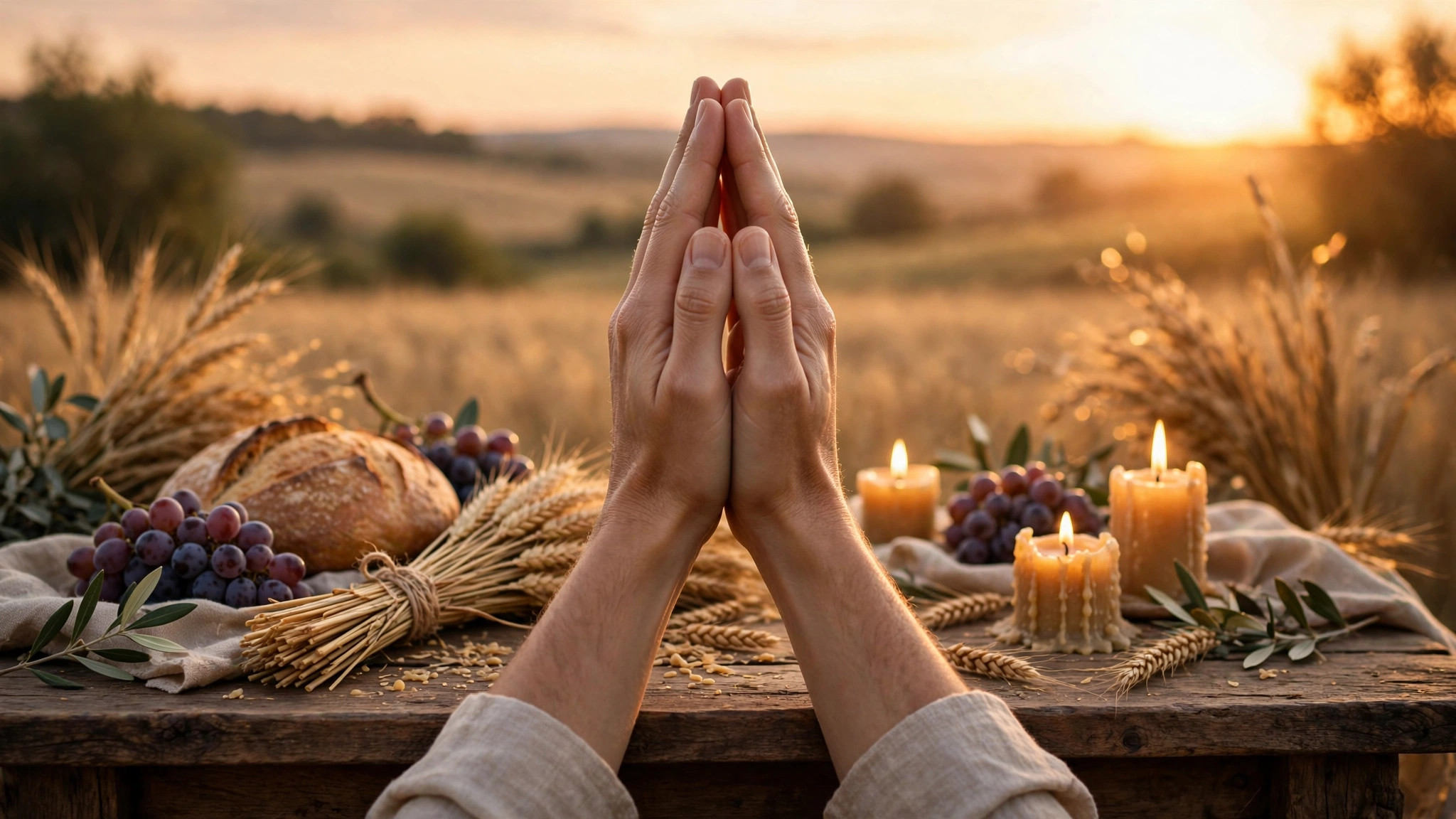
Long before Thanksgiving became a holiday with turkey and parades, it was a way of life commanded by God. The Bible mentions thanksgiving, gratitude, and giving thanks hundreds of times — not as a seasonal sentiment but as a spiritual discipline that reshapes our hearts, our prayers, and our witness.
What is the meaning of thanksgiving in the Bible? It is far richer than good manners. Biblical thanksgiving is the joyful acknowledgment of God’s goodness, grace, and faithfulness — expressed in worship, obedience, and everyday life, in every circumstance. It is not a feeling you wait for. It is a practice you choose.
Thanksgiving in the Old Testament: A Sacrifice of Praise
In the Old Testament, thanksgiving was woven into Israel’s worship. The law provided for a “fellowship offering of thanksgiving” (Leviticus 7:12) — a sacrifice offered not to earn God’s favor but to celebrate it. A person who had been delivered from danger, healed from sickness, or blessed with abundance brought an offering and shared a feast with family, friends, and the poor. Thanksgiving was not private. It was communal, generous, and edible.
The Psalms are the great school of thanksgiving. “Enter his gates with thanksgiving and his courts with praise; give thanks to him and praise his name” (Psalm 100:4). “Give thanks to the Lord, for he is good; his love endures forever” (Psalm 107:1; 136:1). Psalm 136 repeats the refrain twenty-six times — one for each verse — as if the psalmist knew we would need to hear it again and again before we believed it.
Thanksgiving in the Psalms is often tied to memory. Israel thanked God by remembering: the exodus from Egypt, the manna in the wilderness, the victories, the deliverances. “Give thanks to the Lord, for he is good” is almost always followed by “because” — because he delivered, because he provided, because he forgave. Biblical thanksgiving is never vague. It is specific. It names the gift and the Giver.
The Old Testament also shows thanksgiving in the darkest places. When Jehoshaphat’s army faced an overwhelming enemy, he appointed singers to go ahead of the soldiers, singing, “Give thanks to the Lord, for his love endures forever” (2 Chronicles 20:21). The battle was won before the army arrived. Jonah prayed a prayer of thanksgiving from inside the fish. Habakkuk sang of thanksgiving when the fields were empty. Thanksgiving in the Old Testament is not the applause of the comfortable. It is the weapon of the desperate.
Thanksgiving in the New Testament: Grace Upon Grace
The New Testament word for thanksgiving is eucharistia — the root of “Eucharist,” the Lord’s Supper. At the heart of Christian worship is a meal of thanksgiving, because at the heart of Christian faith is a gift: “Thanks be to God for his indescribable gift!” (2 Corinthians 9:15, in substance).
Jesus modeled thanksgiving constantly. He gave thanks before feeding the five thousand (John 6:11), before raising Lazarus (John 11:41), and at the Last Supper, when he took bread, “gave thanks and broke it” (Luke 22:19). Notice: he gave thanks the night before the cross. The most painful night of his life began with thanksgiving. If Jesus could give thanks on the eve of crucifixion, we can give thanks in our own dark nights.
Paul made thanksgiving the atmosphere of the Christian life. “Rejoice in the Lord always” (Philippians 4:4). “In every situation, by prayer and petition, with thanksgiving, present your requests to God” (Philippians 4:6). “Give thanks in all circumstances; for this is God’s will for you in Christ Jesus” (1 Thessalonians 5:18). “Give thanks in all circumstances” — not for all circumstances, but in them. Paul did not thank God for the prison; he thanked God in the prison, and his midnight songs shook the walls (Acts 16:25).
The one place Scripture shows thanksgiving withheld is sobering. “Although they knew God, they neither glorified him as God nor gave thanks to him” (Romans 1:21). Ingratitude is not a minor flaw in Paul’s diagnosis. It is the first step away from God. The refusal to give thanks is the root of idolatry: when we stop thanking the Giver, we start worshiping the gifts.
Why Thanksgiving Transforms Us
Thanksgiving is not just a duty. It is a medicine. Modern psychology confirms what Scripture has always taught: gratitude changes the brain, lowers anxiety, strengthens relationships, and increases joy. But the Bible’s reasons go deeper.
First, thanksgiving reorients us toward God. Complaint looks at what we lack; thanksgiving looks at who God is. “Give thanks to the Lord, for he is good” (Psalm 107:1) — the sentence begins with God, not with us. Thanksgiving is the discipline of looking up.
Second, thanksgiving rewrites our story. The ten lepers were all healed, but only one returned to give thanks — and Jesus said to him, “Your faith has made you well” (Luke 17:11-19, in substance). The other nine received healing; the one who thanked received wholeness. Gratitude takes a blessing and turns it into a relationship.
Third, thanksgiving guards against entitlement. “Every good and perfect gift is from above, coming down from the Father” (James 1:17). When we thank God, we remember that nothing is owed to us and everything is grace. The air we breathe, the food we eat, the people we love — all gifts.
Fourth, thanksgiving is warfare. “The weapons we fight with are not the weapons of the world” (2 Corinthians 10:4, in substance) — and thanksgiving is one of them. You cannot be anxious and grateful at the same time. You cannot be bitter and grateful at the same time. Thanksgiving drives out the darkness the way light drives out shadow. That is why Paul pairs it with prayer in Philippians 4:6: thanksgiving is the guard that stands at the door of the heart while prayer does its work.
Practicing Biblical Thanksgiving Every Day
Thanksgiving is not a holiday. It is a habit. Here is how to build it.
Start the day with thanks. Before you check your phone, name three gifts. “This is the day the Lord has made; let us rejoice and be glad in it” (Psalm 118:24, in substance). The first thoughts of the day set the temperature of the whole day.
Keep a gratitude record. The psalmists wrote their thanksgiving down, and so should we. A simple notebook, a note on your phone, a jar of slips — whatever works. Writing gratitude makes it concrete, and on dark days you can open the record and remember what God has done.
Thank people. Biblical thanksgiving is not only vertical. Paul’s letters overflow with thanks for people: “I thank my God every time I remember you” (Philippians 1:3). A thank-you note, a phone call, a spoken word of appreciation — these are acts of worship too.
Thank God in hard times. This is the hardest practice and the most powerful. Job, who lost everything, said, “The Lord gave and the Lord has taken away; may the name of the Lord be praised” (Job 1:21). You do not have to thank God for the cancer, the loss, the betrayal. You thank him in the midst of it — for his presence, his promises, his nearness — and the thanksgiving becomes the rope that pulls you through.
Make the table a place of thanks. The Jewish table blessing, the Christian grace before meals, the Lord’s Supper — all teach the same lesson: ordinary bread is a gift, and every meal is a small thanksgiving feast. “Whether you eat or drink or whatever you do, do it all for the glory of God” (1 Corinthians 10:31, in substance).
Questions People Often Ask
What is the difference between thanksgiving and gratitude? Gratitude is the feeling; thanksgiving is the expression. The Bible emphasizes thanksgiving — the spoken, sung, offered, lived-out thanks — because feelings fade but practices endure. You may not feel grateful, but you can still give thanks, and the giving often produces the feeling.
How can I give thanks in all circumstances when some circumstances are terrible? “Give thanks in all circumstances” (1 Thessalonians 5:18) does not mean thanking God for evil. It means finding God in the midst of evil — thanking him for his presence, his promises, and his power to redeem. The cross itself is the proof: the worst event in history became the greatest cause for thanksgiving.
Is Thanksgiving Day a Christian holiday? The American holiday grew out of harvest festivals and Pilgrim history, and it is not a biblical feast. But its theme — gratitude to God — is thoroughly biblical, and Christians can celebrate it wholeheartedly as an expression of a thanksgiving that should mark every day of the year.
A Final Word of Hope
The Bible ends with thanksgiving. Around the throne of God, the elders fall down and cry, “We give thanks to you, Lord God Almighty, the One who is and who was, because you have taken your great power and have begun to reign” (Revelation 11:17, in substance). “Blessing and glory and wisdom and thanksgiving and honor and power and might be to our God for ever and ever” (Revelation 7:12). Heaven is a thanksgiving service that never ends — and every act of thanksgiving on earth is a rehearsal for it. Start rehearsing today. For the history of the holiday itself, the Wikipedia article on Thanksgiving offers helpful background.










