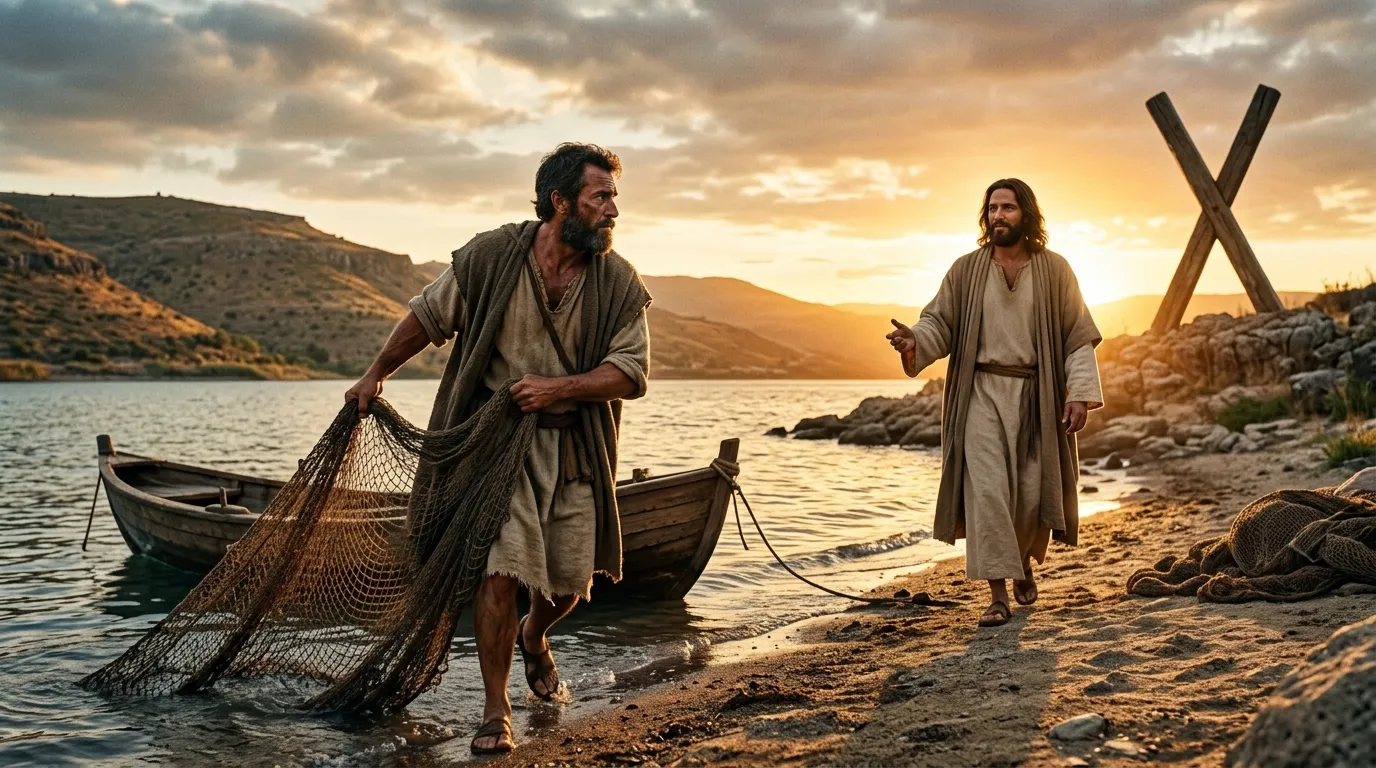
Every group has one: the person who does the crucial work and never gets the headline. In the Gospels, that person is Andrew. He was called before almost everyone, he brought the most famous apostle to Jesus, he appears at three hinge moments of the ministry — and history barely remembers his name. Which is ironic, because his name means “brave,” and his life quietly redefines what bravery looks like. If you carry the name Andrew, or you are considering it for a son, you are not just choosing a classic. You are choosing a character study in the power of being second.
The Name on the Birth Certificate
Andrew comes from the Greek Andreas, derived from aner, “man” — carrying the sense of “manly,” “strong,” or “courageous.” Here is the first surprise: Andrew was a Galilean fisherman, a Jew, with a Greek name. That detail is a small window into his world — Galilee was a cultural crossroads, and a Jewish family giving a son a Greek name suggests openness, adaptability, a household not afraid of the wider world. It is fitting: the man with the cross-cultural name would become the disciple who kept bringing outsiders to Jesus.
But Scripture never lets a name’s dictionary meaning have the last word. “Brave” in the world’s sense means prominent, forceful, first. Andrew’s life will show us bravery of another kind entirely: the courage to be the bridge rather than the destination.
The First Follower You Keep Overlooking
Chronology matters. According to John 1, Andrew was a disciple of John the Baptist before he ever met Jesus. When the Baptist pointed at Jesus and said, “Look, the Lamb of God!” (John 1:36), two of his disciples — Andrew and an unnamed companion, likely John — walked away from their teacher and followed Jesus. Jesus turned, saw them, and asked the first question He ever asks in John’s Gospel: “What do you want?” (John 1:38). They answered with a question of their own — “Where are you staying?” — and Jesus gave the invitation that has echoed ever since: “Come and see.”
Andrew spent that day with Jesus. We are not told what was said. But whatever happened in those hours rearranged Andrew’s universe, because of what he did the next morning — the act that defines his entire biblical portrait.
The Man Who Brought Peter
“Andrew, Simon Peter’s brother, was one of the two who heard what John had said and who had followed Jesus. The first thing Andrew did was to find his brother Simon and tell him, ‘We have found the Messiah’ (that is, the Christ). And he brought him to Jesus” (John 1:40-42).
Read that with the weight it deserves. Simon Peter — the rock, the preacher of Pentecost, the man whose shadow healed the sick (Acts 5:15), the apostle to whom tradition ascribes the founding of the church at Rome — was brought to Jesus by his little brother. Andrew is forever introduced as “Simon Peter’s brother,” as if his identity were a footnote to Peter’s. But without the footnote, there is no headline. Every sermon Peter ever preached, every soul converted at Pentecost, every line of 1 and 2 Peter traces back to one morning when Andrew went and found his brother.
This is Andrew’s spiritual signature, and John will stamp it on every appearance: Andrew brings people to Jesus. He never brings people to himself. He never builds a following. He is the friend who makes the introduction and then steps out of the photograph. Ask yourself: how many kingdom stories are like this — one obscure obedience, one quiet invitation, with eternity compounding the interest?
The Boy’s Lunch and the Five Thousand
Andrew’s second great moment comes at the feeding of the five thousand. The crowd is massive, the hour is late, the disciples are calculating impossibility. Philip does the math: eight months’ wages would not buy enough bread (John 6:7). Then Andrew speaks up: “Here is a boy with five small barley loaves and two small fish, but how far will they go among so many?” (John 6:9).
Do not miss the texture of this. Andrew is the one who noticed the boy. In a crowd of thousands, amid a logistical crisis, Andrew saw a child with a lunch. And he did what Andrew always does: he brought what he found to Jesus. His faith is gloriously imperfect — “but how far will they go among so many?” — honest doubt in the same breath as faithful action. Jesus does not rebuke the doubt. He takes the loaves, gives thanks, and feeds the multitude with twelve baskets left over.
The lesson is pure Andrew: bring what is small, bring it to Jesus, and let Him do the multiplying. You do not need enough. You need to notice and to bring. Most of us disqualify our five loaves before Jesus ever sees them. Andrew’s whole ministry says: hand them over anyway.
The Greeks Who Asked for Jesus
Andrew’s final appearance in John’s Gospel is his most symbolic. Some Greeks — Gentile God-fearers — come to Philip saying, “Sir, we would like to see Jesus” (John 12:21). Philip tells Andrew. Andrew and Philip together tell Jesus. Once again, Andrew is the bridge — this time between the Jewish Messiah and the Gentile world.
The placement is deliberate. This scene occurs just before Jesus’ hour of glorification, and His response is cosmic: “The hour has come for the Son of Man to be glorified” (John 12:23). The Greeks’ arrival signals that the gospel is about to break its ethnic banks and flood the nations. And standing at that hinge of redemptive history, doing what he always does, is Andrew — bringing outsiders in.
Remember his Greek name? The boy from cross-cultural Galilee, named Andreas, becomes the apostle through whom Greeks meet Jesus. God writes straight with crooked-looking lines, and sometimes He writes them decades in advance, in a name.
The Quiet Pattern: Andrew the Bridge
Put the three scenes together and the pattern is unmistakable:
- John 1: Andrew brings his brother — the insider, the family member, the one closest to him.
- John 6: Andrew brings a boy’s lunch — the overlooked resource, the small thing, the inadequate offering.
- John 12: Andrew brings the Greeks — the outsiders, the foreigners, the ones nobody expected.
Brother, boy, Greeks. Family, smallness, strangeness. Andrew’s ministry had no demographics it would not cross and no offering it considered too small. He is the patron saint of introductions — the believer whose greatness is measured entirely in who he brought to Jesus.
The Synoptic Gospels add the quieter details: Andrew was one of the four fishermen first called (Mark 1:16-18), present at the Olivet Discourse asking about the end times (Mark 13:3-4), listed among the Twelve (Matthew 10:2). Tradition — not Scripture, so hold it lightly — says he preached in Greece and was martyred on an X-shaped cross. Whether or not the details are exact, the shape of the tradition fits the man: still bridging, still pointing away from himself, to the end.
Andrew in the Lists: The Quiet Apostle’s Resume
It is worth noting how little the rest of the New Testament says about Andrew — because the silence is the sermon. He appears in the apostolic lists (Matthew 10:2; Mark 3:18; Luke 6:14; Acts 1:13), always near the top as one of the first-called, and then recedes. He asks a question at the Olivet Discourse alongside Peter, James, and John (Mark 13:3) — present at the most important private briefing Jesus ever gave, and we never hear his voice in it. Tradition, held lightly as tradition should be, sends him preaching in Greece and martyred on an X-shaped cross, still pointing away from himself to the end.
Compare the biblical footprint: Peter gets two epistles, a central role in Acts, and the most ink of any apostle. Andrew gets three introductions. And yet — without Andrew’s first introduction, there is no Peter at all. Heaven’s accounting and earth’s are different ledgers. Earth measures platform; heaven measures bringing. By heaven’s ledger, Andrew’s three verses outweigh most ministries.
What Andrew Teaches About Greatness
Jesus said the greatest in the kingdom is the servant of all (Mark 10:43-44). Andrew is the case study. He never wrote an epistle. He never preached at Pentecost. He never walked on water or denied Christ and was restored — the dramatic arcs belong to his brother. Andrew simply brought: a brother, a lunch, some Greeks. And heaven counts it greatness.
So what does the name Andrew mean, biblically? Not “manly” in the world’s sense — loud, first, dominant. It means brave enough to be second. Brave enough to introduce and disappear. Brave enough to believe your small loaves matter. If you name a son Andrew, pray this over him: Lord, make him a bringer. Give him eyes for the overlooked brother, the small offering, the outsider at the gate — and the humility to point them all to You and step aside. That is the courage of Andreas. That is the meaning the Bible writes over the name.
For the historical traditions surrounding this apostle’s later ministry and martyrdom, the article on Andrew the Apostle gathers the ancient sources in one place — but the portrait that matters most is John’s, where the bravest thing Andrew ever did was also the simplest: he found his brother, and brought him to Jesus.










