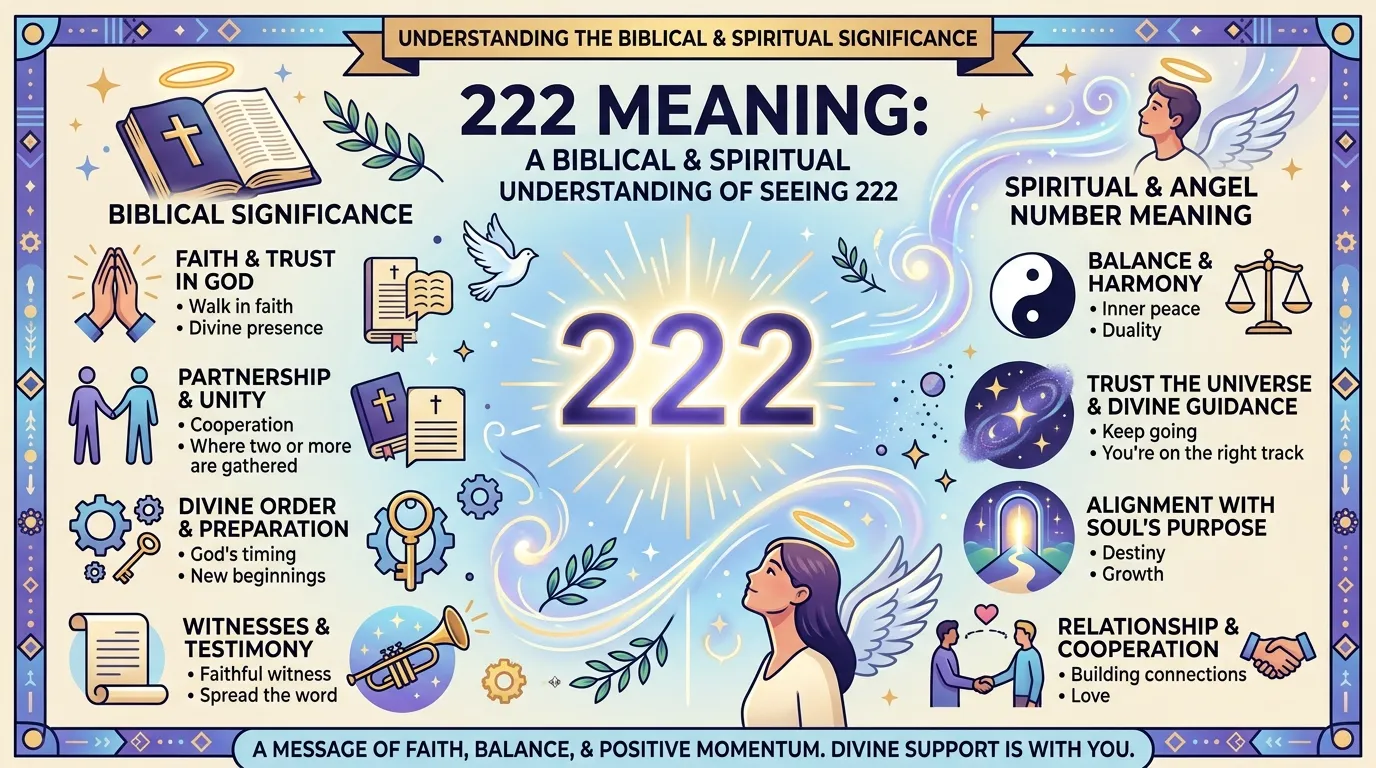
2:22 on the microwave. 222 on a license plate. $2.22 in change. When a number starts following you around, the human brain does what it was designed to do: it looks for a pattern, and then it looks for a meaning. If you are a Christian, the next question comes naturally — does the Bible say anything about 222? You deserve a straight answer, not a sales pitch. So here it is, up front: the Bible never mentions the number 222 as a sign, a code, or an “angel number.” What it does do is far better — it gives you the tools to think clearly about numbers, so you never have to be bullied by them again.
Let’s Start With What the Bible Doesn’t Say
This matters more than it sounds, because the internet is full of confident claims about 222 — that it means “alignment,” “twin flame union,” “manifestation,” or that angels are sending you a message. None of that comes from Scripture. It comes from New Age numerology dressed in Christian vocabulary, and the distinction is not academic: the Bible treats attempts to decode hidden messages from numbers, stars, and omens as divination, something God explicitly forbade His people to practice (Deuteronomy 18:10-12).
That does not mean noticing 222 is sinful. It means the number itself carries no divine memo. The Bible’s numbers work differently than numerology’s: in Scripture, numbers usually count things (forty days, twelve tribes, seventy elders) or symbolize things in broad strokes (seven for completeness, twelve for God’s people) — they are never a secret hotline where God bypasses His Word to whisper through your odometer. When we treat a repeated number as a message, we subtly downgrade Scripture from “God’s clear speech” to “God’s backup plan.” The Bible will not accept the demotion.
So if you came here hoping for the hidden meaning of 222, here is the liberating truth: there isn’t one to decode — but there is wisdom to receive, and it starts with the number two.
What the Bible Actually Says About the Number Two
Unlike 222, the number two is everywhere in Scripture, and its themes are rich enough to meditate on for a lifetime.
Two means confirmed truth. “A matter must be established by the testimony of two or three witnesses” (Deuteronomy 19:15). Jesus sends His disciples out two by two (Mark 6:7). Revelation’s two witnesses prophesy in the last days (Revelation 11:3). The pattern: God does not ask you to build your life on a single impression. Truth comes with corroboration. If you think 222 is “confirming” something, the biblical response is to seek confirmation the biblical way — through Scripture, wise counsel, and the Spirit’s witness (Proverbs 11:14; 1 John 4:1) — not through the number itself.
Two means companionship. “Two are better than one… If either of them falls down, one can help the other up” (Ecclesiastes 4:9-10). Marriage itself is founded on two becoming one flesh (Genesis 2:24). The Christian life was never designed as a solo project; it is two-by-two by divine architecture.
Two means witness under pressure. The two tablets of the Law (Exodus 31:18), the two great commandments that sum up everything (Matthew 22:37-40) — twos in Scripture tend to show up where testimony matters most. There is a quiet steadiness to the number: not the loneliness of one, not the crowd of many, but the faithful pair.
Notice what none of this does: it does not turn 2:22 on your clock into a telegram. It turns your attention toward themes — confirmation, companionship, faithful witness — that you can then test against God’s Word and your actual life. That is devotion, not divination.
The “2:22” Verses Worth Reading Anyway
Here is a healthier game than numerology: when you see 2:22, open your Bible to chapter 2, verse 22 in a few books and read actual sentences. You may be surprised how nourishing this is — not because the numbers are magic, but because Scripture is.
Daniel 2:22 — “He reveals deep and hidden things; he knows what lies in darkness, and light dwells with him.” If you are anxious about an unknown future, this is pure medicine: the God who sees in the dark.
Genesis 2:22 — “Then the LORD God made a woman from the rib he had taken out of the man, and he brought her to the man.” The first marriage, fashioned by God’s own hand — a verse about companionship, fitting for the number two.
Exodus 2:22 — Moses names his son Gershom, saying, “I have become a foreigner in a foreign land.” A verse for anyone feeling out of place — and a reminder that God met Moses precisely in exile.
Matthew 2:22 — Joseph, warned in a dream, withdraws to Galilee instead of Judea. Divine guidance through ordinary caution — a model for how God actually leads: not through number patterns, but through His Spirit, His Word, and circumstance.
Read them as what they are — verses, in context, with authors and audiences — and they will feed you. Read them as coded messages about your life, and you have left exegesis for astrology.
The Angel-Number Trap
We need to name the danger plainly, because it is real and growing. “Angel numbers” — the idea that angels communicate through repeating digit sequences — is a New Age concept with no biblical support. The Bible’s angels do not do numerology. When angels have messages in Scripture, they speak: “Do not be afraid” (Luke 1:30), “He is not here; he has risen” (Luke 24:6). They do not hide meaning in clocks and receipts and hope you guess correctly. God’s revelation is not a puzzle box; it is a proclamation.
The trap works like this: you notice 222 during a hard season, you Google it, you find a meaning that feels comforting (“everything is aligning!”), and you feel better — without ever opening Scripture, praying honestly, or changing anything. It is spiritual junk food: sweet, quick, and nutritionally empty. Worse, it trains you to look for God’s voice in patterns rather than in His Word, which is exactly backwards from how He designed things: “Your word is a lamp for my feet, a light on my path” (Psalm 119:105) — a lamp, not a license plate.
There is also a subtler bondage: once you believe numbers carry messages, every number becomes a potential omen. Did 2:22 mean blessing, but 2:23 means warning? The anxiety multiplies. Scripture’s response is rest: “God has not given us a spirit of fear” (2 Timothy 1:7). A faith that needs constant numeric reassurance is not faith; it is superstition wearing a cross necklace.
But What If God Is Nudging Me? Discerning the Difference
A fair objection deserves an honest answer: but what if God really is getting my attention through 222? It is possible — God has used donkeys (Numbers 22:28), lots (Acts 1:26), and dreams (Matthew 2:12) to get attention. The question is never whether God can use a number. It is how you verify the nudge, because feelings are unreliable narrators.
Scripture gives a threefold test. First, the Word test: does the impression align with what God has already clearly said? “Your word is a lamp” (Psalm 119:105) — the lamp, not the number, is the authority. Any nudge that contradicts or bypasses Scripture fails immediately. Second, the fruit test: does following the impression produce “love, joy, peace” (Galatians 5:22) or anxiety, obsession, and bondage? God’s nudges lead to rest, even when they lead through hard things; superstition leads to compulsive number-watching. Third, the counsel test: “in the multitude of counselors there is safety” (Proverbs 11:14). Tell a mature believer what you think the number means and watch their face. If you feel defensive about the idea being tested, that defensiveness is data.
Notice what this test does: it honors the possibility of divine nudges while refusing to let the nudge become the norm. If 222 prompts you to pray, read Daniel 2:22, and seek counsel — wonderful; the nudge passed all three tests. If it prompts you to rearrange your life around digit patterns — it failed, and you are free to let it go.
A Better Way to Read Repeated Numbers
So what should you do when 222 keeps appearing? Treat it as a doorbell, not a doctrine. Here is the biblical playbook:
Let it prompt prayer, not interpretation. If the number catches your eye, use the moment: pause, pray, thank God He is present. The number did its job if it turned your thoughts toward Him — no decoding required.
Let it prompt Scripture, not speculation. Open to one of the 2:22 verses above. Read the chapter. Ask what God is saying through His actual words. This honors both the nudge and the Word.
Test every impression. If noticing 222 coincides with a decision you are weighing, do not ask the number for guidance — ask God, in prayer, through Scripture, with counselors (Proverbs 15:22). “Test everything; hold fast to what is good” (1 Thessalonians 5:21).
Rest in what is clear. You do not need a number to know that God is with you (Matthew 28:20), that He works all things for good for those who love Him (Romans 8:28), and that His mercies are new every morning (Lamentations 3:22-23) — a passage whose address even contains the number. The clear promises of God outshine every pattern.
The next time 2:22 lights up your screen, smile, say a quick prayer, and get on with the day God actually gave you. He has not hidden His will in your clock; He has published it in His book. For background on where the “angel number” idea actually comes from — a modern esoteric movement, not historic Christianity — the article on angel numbers traces its recent origins clearly. Then close the tab, open your Bible, and listen to the voice that never needed a number to speak.










