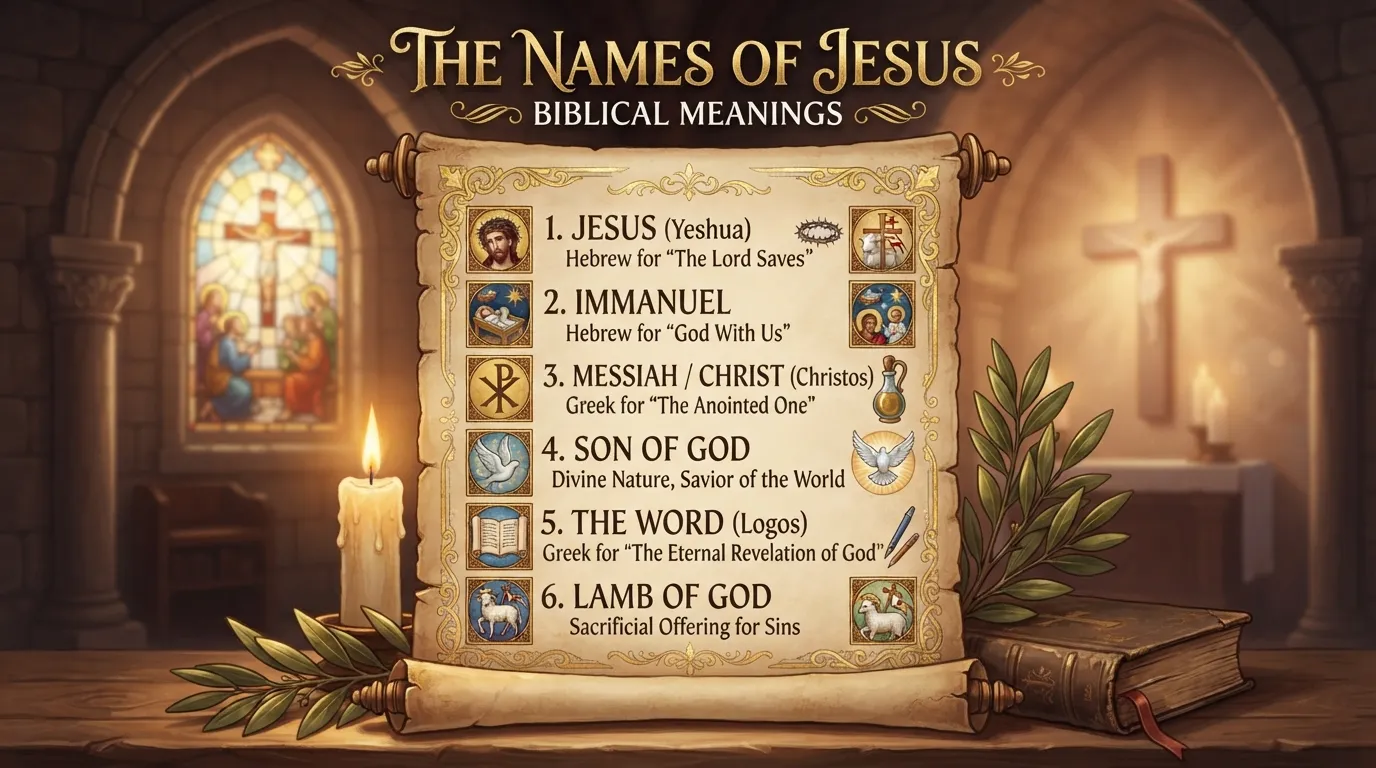
There are moments when a name means more than a name. When a mother whispers her child’s name, when a friend calls us by name, or when we hear the name of someone we love, that name can carry memories, identity, and hope. The Bible gives Jesus many names and titles, and each one reveals something important about who He is, what He came to do, and how He relates to God and humanity. Understanding the names of Jesus meaning in the Bible can help Christians see the character, mission, authority, mercy, and saving work of Christ more clearly. The Bible does not present these names as magical words. Instead, they point toward biblical truths about Christ — and as we study them, we can grow in faith, find encouragement during difficult seasons, and better understand the person Christians worship and follow.
The Name Above the Names: Jesus
Begin with the personal name itself. Jesus comes from the Hebrew name Yeshua, related to Yehoshua — commonly rendered Joshua in English — and it carries the idea of salvation, “the LORD saves.” This meaning is directly connected to the angel’s message to Joseph: Mary would give birth to a son, and Joseph was to call Him Jesus “because he will save his people from their sins” (Matthew 1:21). The name and the mission belong together. Jesus did not come merely to be a teacher or moral example. According to the New Testament, His mission included bringing salvation from sin and reconciliation with God.
In Luke 2:30–32, Simeon holds the infant Jesus and describes Him as God’s salvation prepared for the peoples. That gives the name Jesus a deeply hopeful meaning. When Christians pray in the name of Jesus, they are not simply repeating a special phrase. They are turning toward the person whose life, death, and resurrection stand at the center of the Christian message. Jesus reminds believers that salvation comes from God.
Closely tied to it is the title Christ — not Jesus’ last name, but a title. The Greek word Christos corresponds to the Hebrew idea of the Messiah, meaning the Anointed One. In the Old Testament, anointing was associated with special roles and appointments; kings and other leaders could be anointed for service. Peter declares in Matthew 16:16, “You are the Christ, the Son of the living God,” and Jesus then speaks about His coming suffering, death, and resurrection. Being the Messiah involved more than earthly political power. Jesus fulfilled His mission through suffering, sacrifice, resurrection, and God’s kingdom. For Christians today, the title Christ points to Jesus as God’s promised and appointed Savior.
Names of Nearness: Immanuel, Son of God, Son of Man
One of the most comforting names connected with Jesus is Immanuel, meaning “God with us.” Matthew 1:23 connects Jesus’ birth with Isaiah’s prophecy and explains the name. This does not mean every Christian will always feel God’s presence emotionally. It expresses a biblical truth about Jesus’ identity. Matthew begins with this promise and ends with Jesus telling His disciples, “I am with you always” (Matthew 28:20). When a Christian feels lonely, uncertain, or afraid, the name Immanuel serves as a reminder of God’s promise rather than a guarantee that life will always be easy.
Son of God appears throughout the New Testament. At Jesus’ baptism, a voice from heaven declares, “This is my beloved Son” (Matthew 3:17). The title also appears in Peter’s confession. John’s Gospel strongly emphasizes Jesus’ unique relationship with the Father: John 1:1 identifies the Word as being with God and being God, while John 1:14 says the Word became flesh. Son of God is not simply another way of saying Jesus was a good person who belonged to God. In the New Testament, the title carries a much deeper meaning concerning His unique relationship with the Father.
Son of Man is the title Jesus most frequently used for Himself. It has an important background in Daniel 7:13–14, where Daniel sees “one like a son of man” receiving authority, glory, and a kingdom. Jesus applies this language to Himself in several places. In Mark 2:10, He calls Himself the Son of Man while demonstrating His authority to forgive sins. In Matthew 26:64, He connects the Son of Man with the heavenly figure described in Daniel. The title brings together humanity, suffering, authority, and future glory: Jesus was truly human, experienced suffering, and yet the New Testament presents Him as possessing divine authority.
Names of Care: Shepherd, Light, Bread, Word
In John 10:11, Jesus says, “I am the good shepherd.” A shepherd protects, leads, feeds, and cares for sheep — and Jesus says the good shepherd lays down his life for the sheep. Psalm 23 provides the famous Old Testament picture of the LORD as shepherd, while John 10 presents Jesus as the Good Shepherd. A shepherd does not simply point toward a destination and disappear. The image emphasizes personal care and guidance, and it is especially meaningful for people walking through uncertain seasons.
Jesus also says, “I am the light of the world” (John 8:12). Light is a major biblical symbol — truth, holiness, revelation, life, God’s presence — while darkness can describe sin, ignorance, suffering, or separation from God. John’s Gospel begins with similar imagery: life was in the Word, and this life was the light of humanity (John 1:4). Jesus tells His followers in Matthew 5:14 that they are the light of the world. Believers are called to reflect His truth and goodness rather than hiding the light they received from Christ.
In John 6:35, Jesus says, “I am the bread of life.” The statement comes after the feeding of the five thousand. The crowd was interested in physical bread, but Jesus directed their attention deeper: the true bread from heaven gives life to the world. Physical needs are not unimportant — but human beings have a deeper spiritual need that earthly things cannot permanently satisfy. Money, success, relationships, possessions, and achievements can be valuable in their proper place, but they cannot replace God. Jesus as the Bread of Life points believers toward dependence on Him.
And John 1:1 begins with one of the New Testament’s most important descriptions: “In the beginning was the Word.” John later says the Word became flesh and lived among humanity (John 1:14). The title Word communicates God’s self-expression and revelation. Through Jesus, Christians understand God not merely through abstract ideas but through the life and teaching of Christ. Hebrews 1:1–3 similarly describes the Son as the one through whom God has spoken and as the radiance of God’s glory. Jesus makes God’s character known.
Names of Sacrifice and Majesty: Lamb, King, Prince, Counselor, Alpha and Omega
John the Baptist gave Jesus another powerful title: “the Lamb of God” (John 1:29), pointing toward His role in dealing with sin. The imagery connects with the sacrificial themes of the Old Testament — Passover, sacrifices, the shedding of blood. First Peter 1:18–19 describes believers as redeemed with the precious blood of Christ, comparing Him to a lamb without blemish or defect. Revelation repeatedly uses the image of the Lamb. The central message is sacrifice, redemption, forgiveness, and victory — and Revelation presents the Lamb not merely as suffering but as victorious.
Revelation 19:16 describes Jesus as “King of kings and Lord of lords,” emphasizing His supreme authority. The Christian hope is not based on the idea that Jesus is one spiritual teacher among many. The New Testament presents Him as the risen Lord who reigns with authority — a perspective that steadies believers when the world feels unstable. Human leaders change. Circumstances change. Our plans change. Christ’s authority ultimately stands above every earthly authority.
Isaiah 9:6 describes the promised child with several names, including Prince of Peace and Wonderful Counselor. Jesus does not promise His followers will never experience conflict, grief, or hardship — He warns His disciples they will face trouble (John 16:33) — yet He offers peace rooted in relationship with God. Through Christ, believers receive reconciliation with God and are called to live as peacemakers. As Wonderful Counselor, He points to wisdom and guidance: Jesus repeatedly teaches His followers how to live with faith, humility, forgiveness, love, prayer, and wisdom. For someone facing a difficult decision, this name encourages a return to Scripture rather than relying only on emotion. Christian guidance does not mean every personal decision has a hidden biblical answer; believers are called to seek wisdom, prayer, Scripture, godly counsel, and careful judgment.
Finally, in Revelation 22:13, Jesus says, “I am the Alpha and the Omega, the first and the last, the beginning and the end.” Alpha and Omega are the first and last letters of the Greek alphabet, and the imagery communicates completeness and ultimate authority. Jesus stands at the beginning and end of God’s purposes — a strong reason for hope. When life feels uncertain, believers do not need to understand every detail of the future to trust the One who holds history in His hands.
Living by His Names
The names of Jesus are not merely interesting biblical vocabulary. They can shape everyday faith. He is Savior when we need forgiveness and redemption. Immanuel when we feel alone. Good Shepherd when we need guidance. Light of the World when confusion surrounds us. Bread of Life when earthly things leave us spiritually empty. Prince of Peace when our hearts are troubled. Wonderful Counselor when we need wisdom. King of Kings when the world feels unstable. Lamb of God when we need to remember the seriousness of sin and the depth of God’s grace. Alpha and Omega when the future feels uncertain.
These truths become part of ordinary Christian life. A parent praying over a child can remember Jesus as the Good Shepherd. A person facing temptation can remember Him as Savior and Lord. Someone struggling with fear can meditate on God’s presence in Christ. The names can also naturally become part of prayer: “Jesus, my Savior, help me trust Your grace.” “Good Shepherd, guide me when I do not know which way to go.” “Prince of Peace, help me respond with patience instead of fear.” These prayers are not magical formulas. They simply help believers focus their hearts on biblical truths about Christ — and prayer deepens when we move beyond asking God to change circumstances and also ask Him to shape our hearts, character, wisdom, and faith.
Sometimes a particular name may stand out during prayer or a difficult season — Prince of Peace in fear, Good Shepherd in uncertainty. That does not automatically mean God has given a supernatural message. But it can be a useful invitation to open Scripture and consider what that biblical name actually teaches. Instead of asking only, “What secret message is this name giving me?” a better question is: “What does Scripture already teach me about Jesus through this name?” That approach keeps Christian reflection grounded in God’s revealed Word.
As you study the names of Jesus, take time to read the passages where each name appears. Pray over what you discover. Ask God to help you know Christ more deeply rather than simply collecting biblical information. When you are uncertain, remember the Good Shepherd. When you are burdened by sin, remember the Savior. When you are afraid, remember Immanuel. When you need peace, look to the Prince of Peace. And when you cannot see what tomorrow holds, remember that Jesus is the Alpha and Omega. You may not understand every part of your journey, but you can keep walking with the One whose character is revealed throughout Scripture. Let His names lead you back to His truth, His grace, His love, and His unfailing hope. And if the word “hope” itself draws your curiosity — what it has meant to philosophers, theologians, and ordinary people across history — the Wikipedia article on hope offers a broad and thoughtful survey.










