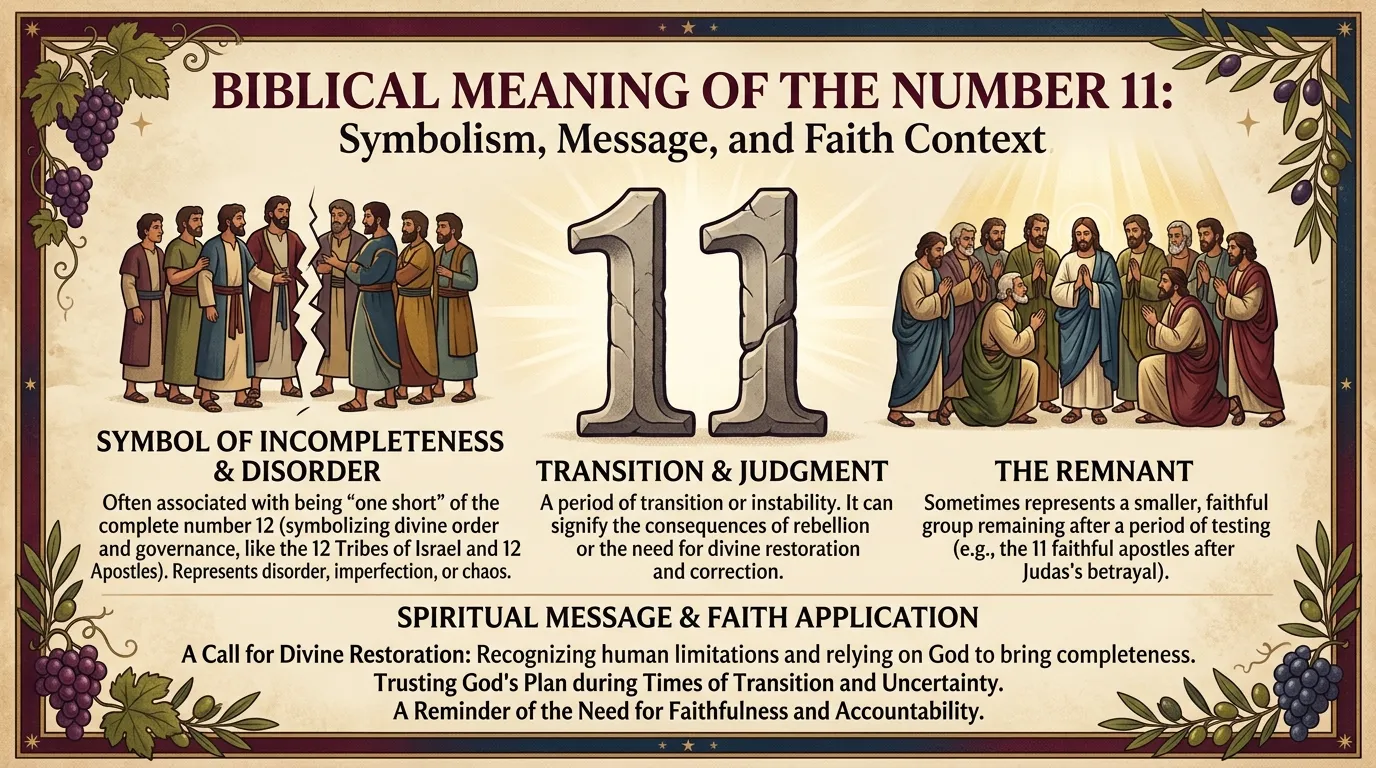
Let us begin with the sentence most articles on this topic will not give you: the Bible never assigns a meaning to the number 11. Not once does Scripture pause to explain what eleven signifies. There is no “eleven means X” verse. Anyone who tells you otherwise is building on inference, tradition, or imagination — not on the text.
That is not the end of the discussion, though. It is the honest beginning. Because while the Bible does not define eleven, it does use eleven, in a handful of striking places. And tracing those uses — carefully, without forcing them into a system Scripture never endorses — turns up a pattern worth noticing: eleven keeps showing up at moments of incompleteness, waiting, and transition. Not as a code. As a circumstance.
Where Eleven Actually Appears
Joseph’s eleven stars. In the dream that got Joseph hated, “the sun and the moon and the eleven stars made obeisance to me” (Genesis 37:9). The eleven stars are his eleven brothers — the family is almost the complete twelve tribes, but not yet. Joseph himself is the twelfth. Eleven here is the number of a family not yet whole, a promise not yet fulfilled. The dream’s tension is precisely the gap between eleven and twelve.
The eleven disciples. After Judas’s betrayal and death, the apostolic company is reduced to eleven — and the church’s first order of business is to repair the number. Peter stands up and insists the twelfth place must be filled: “one must be ordained to be a witness with us of his resurrection” (Acts 1:22). Matthias is chosen, and the twelve are twelve again before Pentecost (Acts 1:26; 2:14). Eleven is the number of a wounded, incomplete leadership — a gap the early church refused to leave open.
The eleventh hour. In the parable of the workers in the vineyard, the master hires laborers “about the eleventh hour” (Matthew 20:6, 9) — the last possible moment of the workday — and pays them a full day’s wage. The eleventh hour is the edge of the day, the final opportunity. The parable’s shock is grace: God is generous even at the last minute, and the first-hour workers’ grumbling exposes how little they understand that generosity.
Eleven days that became forty years. Deuteronomy 1:2 notes that the journey from Horeb to Kadesh-barnea was “eleven days’ journey” — a trip of less than two weeks that, through unbelief, stretched into forty years of wilderness wandering (Deuteronomy 1:3; Numbers 14:33-34). Eleven days of potential; forty years of consequence. The number marks how short the road could have been.
Why We Must Be Careful Here
Now the necessary caution. The Bible does invest some numbers with clear symbolic weight, and the contrast is instructive. Seven signals completeness — seven days of creation, seven seals, seven churches (Genesis 2:2; Revelation 1:4). Twelve signals God’s people organized — twelve tribes, twelve apostles (Genesis 49:28; Revelation 21:14). Forty signals testing — forty days of rain, forty years in the wilderness, forty days of temptation (Genesis 7:12; Numbers 14:33; Matthew 4:2). Three signals divine fullness — the Trinity’s shadow falls across resurrection on the third day (1 Corinthians 15:4).
These meanings are not imposed by readers; they emerge from repeated, deliberate biblical use. Eleven has no such treatment. To declare “eleven means disorder” or “eleven means revelation” as though it were doctrine is to speak where Scripture is silent — and Scripture’s silence is itself instructive. God did not give us a biblical numerology chart. He gave us a story.
This matters pastorally. Many people today keep noticing 11:11 on clocks and wonder if God is sending a message. Here is the honest pastoral answer: God speaks through Scripture, through His Spirit, through providence — not through a private code He never published. If seeing eleven prompts you to pray, to open your Bible, to examine your life — that prompting may be God’s kindness using an ordinary coincidence. But the number itself is not a telegram from heaven. Do not build doctrine, or decisions, on a pattern the Bible never establishes.
The Real Pattern: Incompleteness on the Way to Wholeness
That said, the circumstances of eleven are genuinely suggestive, and a careful reader may notice the thread: eleven stars waiting for the twelfth; eleven disciples waiting for Matthias; the eleventh hour waiting for the day’s end; eleven days’ journey waiting — tragically — for a faith that never came.
Eleven is, in its biblical settings, the number of not yet. It is one short of the complete twelve, one step from the finish, the almost that aches. And that ache has a name in Christian theology: it is the already-and-not-yet of the whole Christian life. We are forgiven but not yet glorified, indwelt but not yet perfected, citizens of heaven still walking the earth (Philippians 3:20).
If eleven preaches anything, it preaches this: God finishes what He starts. The eleven stars became twelve tribes. The eleven disciples became twelve apostles. The eleventh-hour workers still got paid. “He which hath begun a good work in you will perform it until the day of Jesus Christ” (Philippians 1:6). Incompleteness is not the final state of God’s people. It is the middle of the story.
What To Do When You Keep Seeing Eleven
So here is practical counsel instead of a secret decoder:
- Let it prompt, not govern. If the number catches your eye, let it catch your heart toward prayer — then make decisions from Scripture and wisdom, not from sightings.
- Ask the “not yet” question. Is there an area of your life stuck at eleven — almost obedient, almost surrendered, almost whole? The biblical elevens invite you to let God complete the number.
- Rest in the Finisher. You do not complete yourself. The God who turned eleven disciples into the foundation of the church (Ephesians 2:20) is the God completing you.
- Stay in the Word. “Thy word is a lamp unto my feet” (Psalm 119:105) — a lamp, not a license plate. God’s guidance comes through His revealed Word, not through numeric coincidences.
Why Twelve Had to Be Twelve Again
The urgency of replacing Judas deserves a closer look, because it reveals why eleven felt so wrong to the early church. Peter’s argument in Acts 1 cites the Psalms: “his bishoprick let another take” (Acts 1:20, quoting Psalm 109:8). The apostleship is an office — a defined seat — not merely a personal following. An empty seat in the foundation is a structural problem.
And the qualification Peter sets is revealing: the replacement must be “one of these men which have companied with us all the time that the Lord Jesus went in and out among us, beginning from the baptism of John, unto that same day that he was taken up from us” (Acts 1:21-22). The twelfth must be a witness of the resurrection — someone who saw the whole story, from Jordan to Olivet. Matthias is chosen by lot after prayer (Acts 1:24-26), and the last glimpse of the eleven-as-eleven is also the last glimpse of incompleteness: “Peter, standing up with the eleven” (Acts 2:14) — preached once, at Pentecost, and then the number is whole again.
Paul would later describe the church as “built upon the foundation of the apostles and prophets, Jesus Christ himself being the chief corner stone” (Ephesians 2:20). Foundations come in full sets. Eleven apostles would have been a foundation with a missing stone — and the early church, guided by the Spirit, refused to build on a gap. There is a lesson for every believer in an “eleven” season: do not normalize the missing piece. Pray, seek, and let God complete the number.
Questions About 11 in the Bible
Does 11:11 have a biblical meaning?
No. The Bible never mentions 11:11 as a time or a sign. The modern fascination with 11:11 comes from contemporary spiritual culture, not from Scripture. God is not limited in how He gets our attention, but He has not appointed this number as a signal.
Is eleven a bad or unlucky number in the Bible?
The Bible has no concept of unlucky numbers. Eleven appears in contexts of incompleteness (the disciples after Judas), but also in contexts of grace (the eleventh-hour workers). Assigning it a fixed moral value goes beyond the text.
Why do some teachers say eleven means disorder or judgment?
Usually by inference: eleven is one more than ten (the number of the commandments, suggesting transgression) and one less than twelve (suggesting incompleteness). This is reasoning about the number, not revelation from Scripture. Treat it as interesting speculation, not doctrine.
The honest study of eleven ends where it began: with a Bible that uses the number sparingly, suggestively, and without ever defining it — and with a God who does not need codes to speak to His children, because He has already spoken, clearly, in His Word. For the purely mathematical side of eleven — its properties and curiosities — the Wikipedia article on the number 11 is a good reference; for its meaning, the Bible’s own pages on completeness, waiting, and finishing are the better guide.










