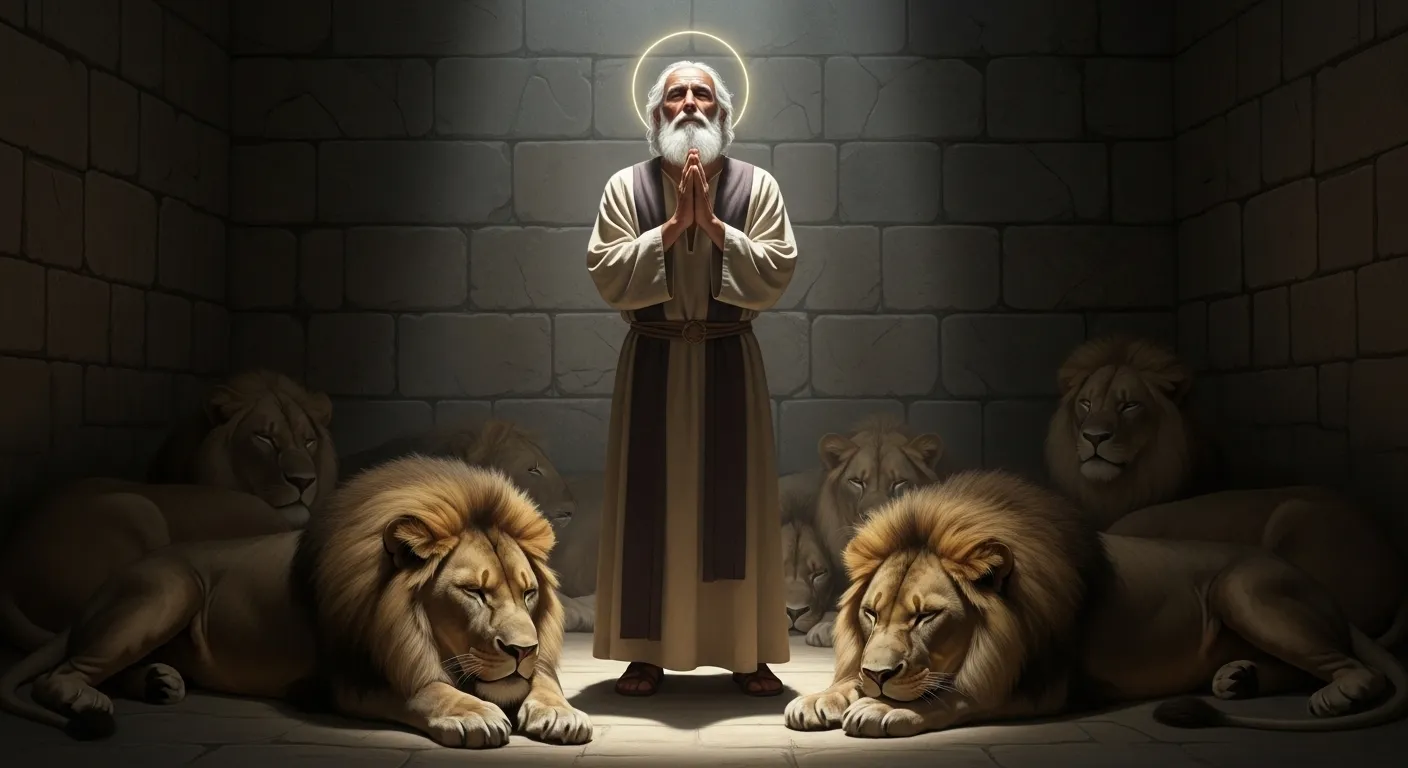
He was probably a teenager when the Babylonians took him. Daniel — a young nobleman of Judah, handsome, gifted, “without any physical defect” (Daniel 1:4) — was marched to Babylon in the first deportation, given a Babylonian name (Belteshazzar), enrolled in a Babylonian university, and slated for a Babylonian career. The empire’s plan was assimilation: erase his identity, reprogram his loyalties, and turn a Hebrew captive into a Chaldean courtier. The plan failed for seventy years. Daniel served under Nebuchadnezzar, Belshazzar, Darius, and Cyrus — he outlasted the empire that captured him. His name meant “God is my judge,” and he lived as though it were true: when every earthly power claimed the right to define him, he answered to a higher court.
Resolve in the King’s Kitchen
The first test came not in a lions’ den but in a dining hall. The king assigned Daniel and his friends food and wine from the royal table — rich fare, likely including meat sacrificed to idols and forbidden by the law. “But Daniel resolved not to defile himself with the royal food and wine” (Daniel 1:8). The Hebrew says he purposed in his heart — the decision was made in advance, in the quiet, before the pressure arrived.
That is the whole secret of Daniel’s life in one verse: decide before the crisis. He did not wait until the meat was served to figure out his convictions. He settled them beforehand, and then negotiated with courtesy — proposing a ten-day vegetable test to the official (Daniel 1:11–13), respectful to authority while unyielding on principle. God honored it: the four young men looked healthier, and “God gave knowledge and understanding” beyond their peers (Daniel 1:17). The kitchen was the first battlefield, and Daniel won it the way every believer must win theirs — by deciding who he was before anyone asked him to prove it.
The Nightmare No One Could Interpret
Nebuchadnezzar’s nightmare in Daniel 2 set up the book’s great theme. The king demanded not just an interpretation but the dream itself — “tell me what my dream was and interpret it” — on pain of death for the entire wise-men guild (Daniel 2:5). It was an impossible demand, designed to expose frauds. Daniel’s response was prayer: he went home, gathered his friends, “urged them to plead for mercy from the God of heaven” (Daniel 2:18), and that night God revealed the mystery.
Standing before the most powerful man on earth, Daniel refused the credit with words that define his entire ministry: “No wise man, enchanter, magician or diviner can explain to the king the mystery he has asked about, but there is a God in heaven who reveals mysteries” (Daniel 2:27–28). Then he described the great statue — head of gold, chest of silver, belly of bronze, legs of iron — and the stone “cut out, but not by human hands” that smashed it and “became a huge mountain and filled the whole earth” (Daniel 2:34–35). Empires rise and fall by God’s appointment; God’s kingdom, the stone, outlasts them all and fills everything. Nebuchadnezzar fell facedown and promoted Daniel — but Daniel had already made his point: the God of heaven, not the king of Babylon, runs history.
The Furnace and the Den
Daniel’s three friends get chapter 3, and Daniel gets chapter 6, and the two stories are twins. Shadrach, Meshach, and Abednego refused the golden image — “our God is able to save us… but even if he does not, we will not serve your gods” (Daniel 3:17–18), the noblest sentence of defiance in Scripture — and walked in the furnace with a fourth figure “like a son of the gods” (Daniel 3:25). Decades later, Daniel himself, now an old man under Darius, refused to stop praying when prayer was outlawed, and spent a night in the lions’ den. “My God sent his angel, and he shut the mouths of the lions” (Daniel 6:22).
Two details deserve attention. First, God did not always prevent the suffering — He joined them in it. The friends went into the fire; Daniel went into the den. Deliverance came inside the trial, not instead of it. That is the Bible’s honest pattern: “When you pass through the waters, I will be with you” (Isaiah 43:2) — when, not if, and with you, not instead of you. Second, both stories ended with pagan kings confessing God’s supremacy — Nebuchadnezzar’s decree (Daniel 3:28–29) and Darius’s (Daniel 6:25–27). Faithfulness under pressure is evangelism; the empire watched, and the empire learned.
The Visions: History Written in Advance
The second half of Daniel shifts from stories to visions — beasts rising from the sea (Daniel 7), the ram and the goat (Daniel 8), the seventy weeks (Daniel 9), the great war of kings (Daniel 10–11). These chapters have generated libraries of interpretation, and humility is in order: godly scholars differ on details. But the main lines are clear and were clear to the first readers. The four beasts of Daniel 7 retell the statue’s story as a nightmare — Babylon, Medo-Persia, Greece, Rome — and then “one like a son of man” approaches the Ancient of Days and receives “authority, glory and sovereign power” over an everlasting kingdom (Daniel 7:13–14). Jesus took “Son of Man” as His favorite title for Himself — Daniel’s vision is where He got it.
Daniel 9’s seventy weeks times the coming of “the Anointed One” with startling precision — the prophecy that led many in Jesus’ generation to expect the Messiah on schedule (and still convinces careful readers today). A word of caution belongs here: Daniel’s numbers are given to assure God’s people that history is on schedule, not to authorize date-setting. Jesus Himself said the day and hour are the Father’s business (Matthew 24:36). Read Daniel’s visions for what they were meant to give: confidence that empires are temporary, that “the Most High is sovereign over all kingdoms on earth” (Daniel 4:17), and that the Son of Man’s kingdom is the only one that lasts.
The Handwriting on the Wall
Between the furnace and the den comes the most dramatic night in Daniel’s book — Belshazzar’s feast (Daniel 5). Babylon’s new king threw a banquet for a thousand nobles, and in a fit of drunken arrogance ordered the sacred vessels looted from Jerusalem’s temple to be brought out — so he and his guests could drink wine from them while praising “the gods of gold and silver” (Daniel 5:4). It was deliberate desecration: using God’s holy things as party cups.
Then the fingers appeared. A human hand, writing on the plaster of the palace wall — no body, just fingers, tracing words no one could read. The king’s “face turned pale and he was so frightened that his legs became weak and his knees were knocking” (Daniel 5:6). The queen mother remembered the old Hebrew: “There is a man in your kingdom who has the spirit of the holy gods in him” (Daniel 5:11). Daniel came, refused the gifts — “You may keep your gifts for yourself” (Daniel 5:17), the independence of a man who cannot be bought — and read the inscription: MENE, MENE, TEKEL, PARSIN. “God has numbered the days of your reign and brought it to an end… You have been weighed on the scales and found wanting… your kingdom is divided and given to the Medes and Persians” (Daniel 5:26–28).
“That very night Belshazzar, king of the Babylonians, was slain, and Darius the Mede took over the kingdom” (Daniel 5:30). The empire that had carried Daniel into exile fell while its king was partying. Two truths stand in the rubble. First, God is not mocked in His holiness — the vessels were sacred, and treating them as common brought the hand to the wall. What we do with holy things matters. Second, empires end on God’s schedule, not their own — Babylon looked invincible at the banquet and was gone by morning. “He changes times and seasons; he deposes kings and raises up others” (Daniel 2:21). Every Belshazzar since — every power that toasts itself while desecrating what is sacred — is living on numbered days. The writing is always on the wall; the wise learn to read it before the knees start knocking.
Prayer Three Times a Day
Behind all of it — the kitchen resolve, the dream interpretations, the den, the visions — was a habit so ordinary it barely gets noticed: “Three times a day he got down on his knees and prayed, giving thanks to his God, just as he had done before” (Daniel 6:10). Just as he had done before. When prayer was criminalized, Daniel didn’t start praying; he continued praying. The habit predated the crisis by decades. Windows open toward Jerusalem, knees on the floor, three times daily — through regime changes, promotions, conspiracies, and seventy years of exile.
That is Daniel’s meaning in the Bible, distilled: a private devotion that produces public courage. The lions’ den was won in the prayer room, years earlier. The king’s court was conquered on the knees before it was ever addressed standing. For believers in hostile workplaces, skeptical universities, or cultures that criminalize conviction — softly or loudly — Daniel’s life is both strategy and comfort: decide beforehand, pray continually, speak truthfully, and trust the God who is your Judge. Empires draft you; only God defines you. For the historical and critical background of the book, see the Wikipedia article on Daniel; for the life that outlasted Babylon, read the book itself — and resolve, in advance, not to defile yourself.










