Imagine reading a short passage in the Bible and suddenly meeting a person who seems to appear from nowhere. He blesses Abraham, receives a tenth of what Abraham has, and then disappears from the story. Centuries later, the Bible brings his name back again in connection with Jesus. This mysterious person is Melchizedek. Understanding the Melchizedek meaning in the Bible can help us see important truths about priesthood, righteousness, God’s promises, and the unique role of Jesus Christ. Melchizedek appears briefly in the Old Testament, but his story becomes important in the New Testament. Hebrews explains his significance when describing Christ as the perfect and eternal High Priest. At the same time, Scripture leaves some questions about Melchizedek unanswered. So, what does the Bible actually say about him? And what can Christians learn from his story today?
First Appearance: Genesis 14
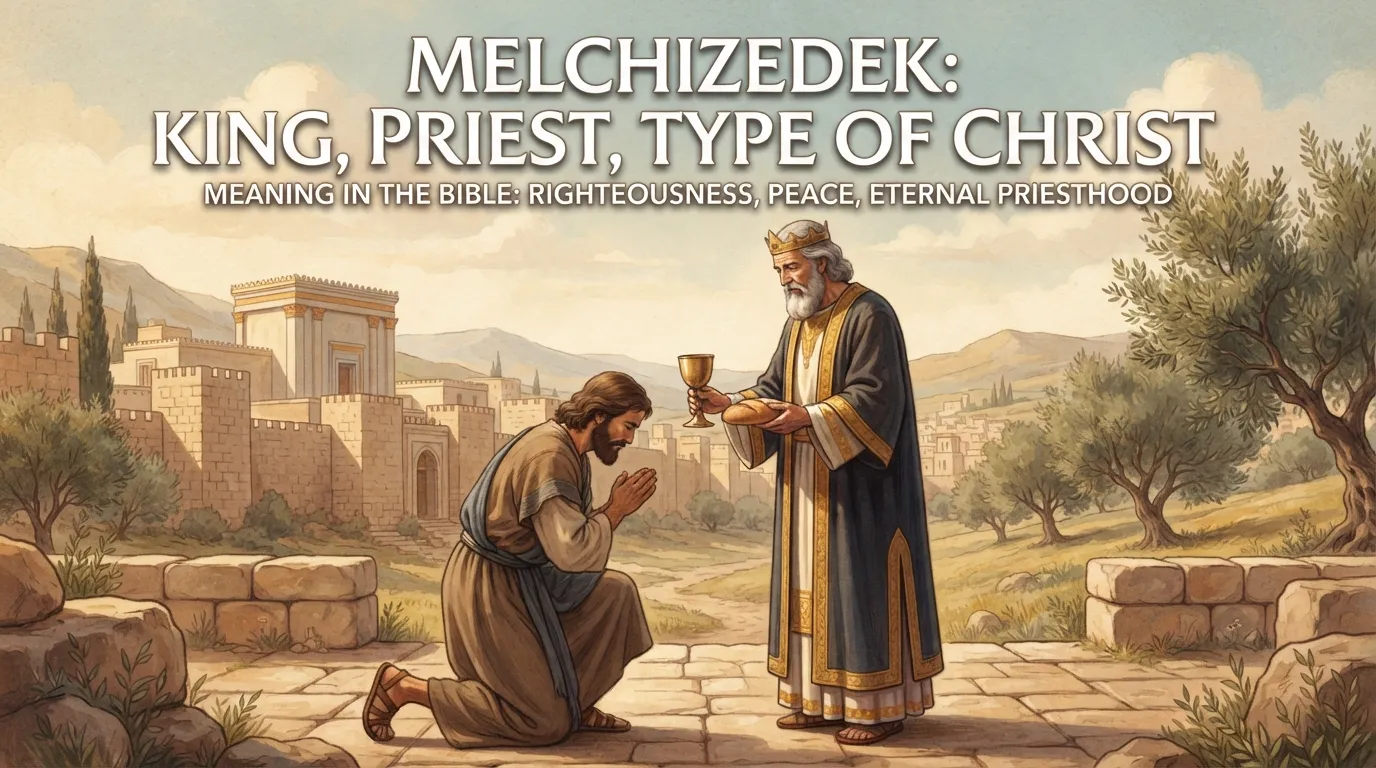
Melchizedek first appears in Genesis 14:18–20. Abraham had just returned from rescuing his nephew Lot and defeating several kings. At that moment, Melchizedek, the king of Salem and priest of God Most High, came to meet Abraham. Genesis says that Melchizedek brought bread and wine and blessed Abraham. Abraham then gave him a tenth of everything.
This short account gives us several important facts. Melchizedek was both a king and a priest — king of Salem and priest of God Most High. He blessed Abraham, the man through whom God had promised to bless the nations. The passage says: “Blessed be Abram by God Most High, Possessor of heaven and earth” (Genesis 14:19). Melchizedek recognized that Abraham’s victory came from God. He did not point attention to human strength alone. This is one of the first important lessons from his story: God is the true source of victory and blessing.
The setting matters. Abraham had gone to rescue Lot after Lot was taken captive during a conflict between kings. Abraham and his trained men pursued the attackers and recovered Lot and the others. After Abraham returned, Melchizedek met him. He brought bread and wine, blessed Abraham, and praised God Most High. Abraham responded by giving Melchizedek a tenth of everything. The encounter shows Abraham responding with honor — recognizing God’s authority and giving a tenth to Melchizedek. The story reminds Christians that success should not cause us to forget the One who gives us strength.
Why did Melchizedek bless Abraham? Because he recognized God’s work in Abraham’s victory. Genesis 14:20 says that God had delivered Abraham’s enemies into his hand. Melchizedek’s blessing directed attention toward God as the Possessor of heaven and earth. Abraham could have focused entirely on his own courage, strategy, or military success. Instead, the encounter highlights God’s sovereignty. In everyday Christian life, the same principle is easy to forget. When a prayer is answered, a difficult season ends, or an opportunity comes, we may quickly focus on our own effort. Melchizedek’s blessing encourages us to pause and remember: God deserves the glory for every good thing He provides.
His Name: King of Righteousness, King of Peace
The Melchizedek meaning in the Bible is closely connected with righteousness, kingship, priesthood, blessing, and peace. His name is traditionally understood from Hebrew elements meaning “king of righteousness.” The name Malki-Tzedek is commonly understood as “king of righteousness” — the first part related to melek, meaning king, while tsedeq is associated with righteousness. Genesis also calls him the king of Salem. Hebrews 7:2 connects Salem with peace, giving the name an additional symbolic connection to peace and righteousness.
This is significant because righteousness and peace are major themes throughout Scripture. The Bible repeatedly presents God as righteous and just. It also points toward the peace that comes through God’s saving work. Melchizedek’s name therefore fits the role Scripture gives him: a king who is also a priest and who blesses Abraham in the name of God Most High. Hebrews 7:2 specifically explains the meaning of his name and connects Salem with peace, saying that Melchizedek was king of righteousness, king of peace, priest of God Most High, a person who blessed Abraham, and someone who received a tenth from Abraham. These descriptions become especially meaningful because Hebrews uses Melchizedek as a picture that helps explain the priesthood of Jesus Christ. Christians should be careful about going beyond what Scripture says. The Bible does not give us every detail about Melchizedek’s life, family, or death. His mystery is part of the biblical account.
Second Appearance: Psalm 110
Melchizedek becomes even more important in Psalm 110, a royal psalm that speaks about a coming king. In verse 4, God declares: “You are a priest forever after the order of Melchizedek.” This statement is important because Israel’s normal priesthood was connected with the descendants of Aaron and the tribe of Levi. The promise in Psalm 110 points to a priesthood described as “forever.” The New Testament identifies this promise with Jesus. This connection is central to understanding why Melchizedek matters so much in Christian theology.
Third Appearance: Hebrews 5–7
The fullest discussion of Melchizedek appears in Hebrews 5–7. Hebrews uses Psalm 110 to explain that Jesus is the great High Priest, but His priesthood is not based on descent from Aaron. Instead, Jesus is described as a priest “after the order of Melchizedek.” Hebrews 5:6 quotes Psalm 110 and says that Christ is a priest forever according to the order of Melchizedek. Hebrews 6:20 again describes Jesus as a High Priest according to the order of Melchizedek. Hebrews 7 provides the most detailed explanation.
Hebrews 7 explains that Melchizedek was greater than Abraham in the sense that Abraham gave him a tenth and received his blessing. Hebrews 7:7 says: “And without doubt the lesser is blessed by the greater.” This does not mean Melchizedek was greater than Abraham in every possible way. The point is focused on the priestly relationship described in the passage. Hebrews uses this encounter to establish the superiority of the priesthood associated with Melchizedek and ultimately fulfilled in Christ.
The writer then explains that Jesus’ priesthood is superior because Christ lives forever. Hebrews 7:24 says: “But because Jesus lives forever, his priesthood lasts forever.” This is one of the most important truths connected with Melchizedek. Melchizedek points us toward the unique and lasting priesthood of Jesus Christ.
Why is Melchizedek important to Jesus? Under the Old Covenant, priests came from the tribe of Levi. Their service continued from generation to generation, and individual priests eventually died. Jesus was different. Jesus came from the tribe of Judah, not Levi. Hebrews explains that His priesthood rests on God’s appointment and His indestructible life. This means Jesus does not need a replacement. Christ’s priesthood is permanent. Hebrews 7:25 gives great comfort to believers: “He is able to save completely those who come to God through him, because he always lives to intercede for them.” Jesus is not a temporary spiritual helper. He is the living High Priest who intercedes for His people.
Hebrews 7:27 explains that Christ does not need to offer sacrifices repeatedly like the priests under the old system. He offered Himself once. This points directly to the heart of the gospel: Jesus is enough. His sacrifice does not need to be repeated. His priesthood does not expire. His work does not depend on another priest taking His place. That truth gives Christians a reason to approach God with confidence.
Was Melchizedek Jesus?
One common Christian question is whether Melchizedek was actually Jesus appearing in the Old Testament. Some Christians have understood Melchizedek as a pre-incarnate appearance of Christ. This interpretation is sometimes called a Christophany. However, Scripture does not directly say, “Melchizedek was Jesus.” Hebrews instead compares Christ’s priesthood with the order of Melchizedek. The wording is important. Christians should distinguish between what Scripture explicitly teaches and theological interpretations. The Bible clearly teaches that Jesus is the eternal High Priest according to the order of Melchizedek. Whether Melchizedek himself was a pre-incarnate appearance of Christ is an interpretation rather than a statement Scripture directly makes.
What His Story Teaches
The Bible gives us a strong foundation for understanding the spiritual significance of Melchizedek. His story points Christians toward several biblical truths. Righteousness: his name is connected with righteousness, and the New Testament repeatedly connects righteousness with Christ. Believers are not called to create their own righteousness apart from God. They are called to trust God’s saving work. Peace: Melchizedek was king of Salem, and Hebrews connects Salem with peace. Peace is central to the Christian message — through Christ, believers can have peace with God and hope even during difficult circumstances. Priesthood: Melchizedek’s priestly role points forward to the greater priesthood of Christ. Jesus does not merely teach people about God. He stands as the perfect mediator and High Priest. Blessing: Melchizedek blessed Abraham, reminding Christians that God’s blessings should lead us toward gratitude rather than pride. Worship: Abraham’s response included giving a tenth. The passage shows an attitude of honor toward God and His servant. It can encourage believers to respond to God’s provision with gratitude, generosity, and worship.
Melchizedek’s story is short, but it contains lessons that can shape everyday faith. First, God is greater than human strength. Abraham had won a difficult battle, but Melchizedek reminded him that God had delivered his enemies into his hands. Second, God works through people and situations we may not fully understand. Melchizedek appears suddenly in Genesis, and Scripture does not tell us everything about him. Not every unanswered question needs to be solved before we can trust God. Third, Jesus is greater than every earthly priest or spiritual leader. The purpose of Hebrews is not to make Melchizedek the center of Christian faith. Instead, Melchizedek helps point us to Christ. Fourth, God’s promises are bigger than one generation. Psalm 110 looks forward to a priesthood that lasts forever. Hebrews identifies its fulfillment in Jesus.
One beautiful part of the story is that Melchizedek appears before Israel’s priesthood was established. Abraham lived long before Moses and the giving of the Law. Yet Melchizedek is already described as a priest of God Most High. This reminds us that God’s work is not limited to the structures humans can see. God was working in His plan long before the events of the New Testament became visible. For Christians, this can bring hope during seasons when God’s plan seems unclear. You may not see how everything will work out. You may not understand why a certain door has closed or why an answer to prayer has taken so long. Melchizedek reminds us that God’s purposes are often larger than the moment we can see.
Melchizedek in Real Life
You do not need to understand every mystery about Melchizedek to benefit from his story. Imagine that you have just received a promotion after months of hard work. It is good to celebrate your effort, but Melchizedek’s story reminds you to recognize God’s provision too. Or perhaps you are facing a situation where you feel powerless. Abraham had just experienced a major conflict. Yet his encounter with Melchizedek redirected his attention toward God Most High. You can do the same through prayer. Instead of only asking, “How can I fix this?” you can also ask, “God, what are You teaching me about trust, wisdom, righteousness, and dependence on You?” That kind of reflection can turn an ordinary situation into an opportunity for spiritual growth.
The story of Melchizedek begins with only a few verses in Genesis, yet those verses become part of one of the Bible’s richest explanations of Christ’s priesthood. Melchizedek was a king and priest of God Most High. His name points to righteousness, his city is connected with peace, and his blessing of Abraham directs attention toward God’s power and provision. Yet the story ultimately points beyond Melchizedek. It points to Jesus Christ, the eternal High Priest who lives forever and intercedes for His people. You may not have answers to every question about Melchizedek. Scripture does not tell us everything. But the central message is clear: God is faithful, Christ is sufficient, and God’s saving plan is greater than what we can see in one moment. When life feels uncertain, you can bring your questions to God without fear. Pray for wisdom, search the Scriptures, and trust the One who sees the beginning and the end. Let the mystery of Melchizedek lead you not into speculation, but into deeper wonder at Jesus Christ and greater trust in God. For a broader survey of this figure — his biblical appearances, the ancient traditions about him, and the scholarly debates — the Wikipedia article on Melchizedek collects the evidence and interpretations in one place.










