When David’s infant son died, the king did something that surprised his servants. While the child was still alive, David had fasted, wept, and lain on the ground pleading with God. But once the child was gone, David washed, changed his clothes, worshiped, and ate. His servants were baffled. David’s answer has comforted grieving parents for three thousand years: “Can I bring him back again? I shall go to him, but he shall not return to me” (2 Samuel 12:23). David did not claim to understand every mystery of God’s judgment. He expressed a quiet confidence that death had not ended the relationship forever — he would go to his child one day.
That scene frames everything the Bible says about children and salvation. Scripture never gives parents a single proof-text that settles every question about the eternal destiny of every child. What it does give is something richer: a portrait of a God who notices children, welcomes them, holds parents responsible for teaching them, and judges with perfect mercy and perfect justice at the same time.
David’s Quiet Confidence
The story in 2 Samuel 12 begins with failure. David had committed adultery with Bathsheba and arranged the death of her husband Uriah. The prophet Nathan confronted him, David repented, and God forgave him — but the child born of that union died. David’s response is instructive precisely because he did not presume upon God while the child lived. He prayed earnestly, knowing God might still show mercy. And when the child died, David stopped fasting — not because he stopped caring, but because he accepted God’s decision and trusted God’s character.
Notice what David did not say. He did not announce a doctrine of automatic salvation for all children. He did not claim a vision of heaven. He said, in effect: I trust God with my child, and I believe we will meet again. That combination — grief honestly felt, sovereignty humbly accepted, hope quietly held — is the pattern Scripture offers parents who face the hardest loss imaginable.
Other passages reinforce the idea that God deals with children according to their capacity and His mercy. Deuteronomy 1:39 describes the children of Israel in the wilderness as those “who have no knowledge of good or evil,” and God distinguished them from the adults whose rebellion kept them from the land. Isaiah 7:15–16 speaks of a child reaching the age of knowing “to refuse the evil and choose the good.” The Bible recognizes stages of moral understanding, and God’s judgment is never portrayed as careless or arbitrary.
The Children Jesus Welcomed
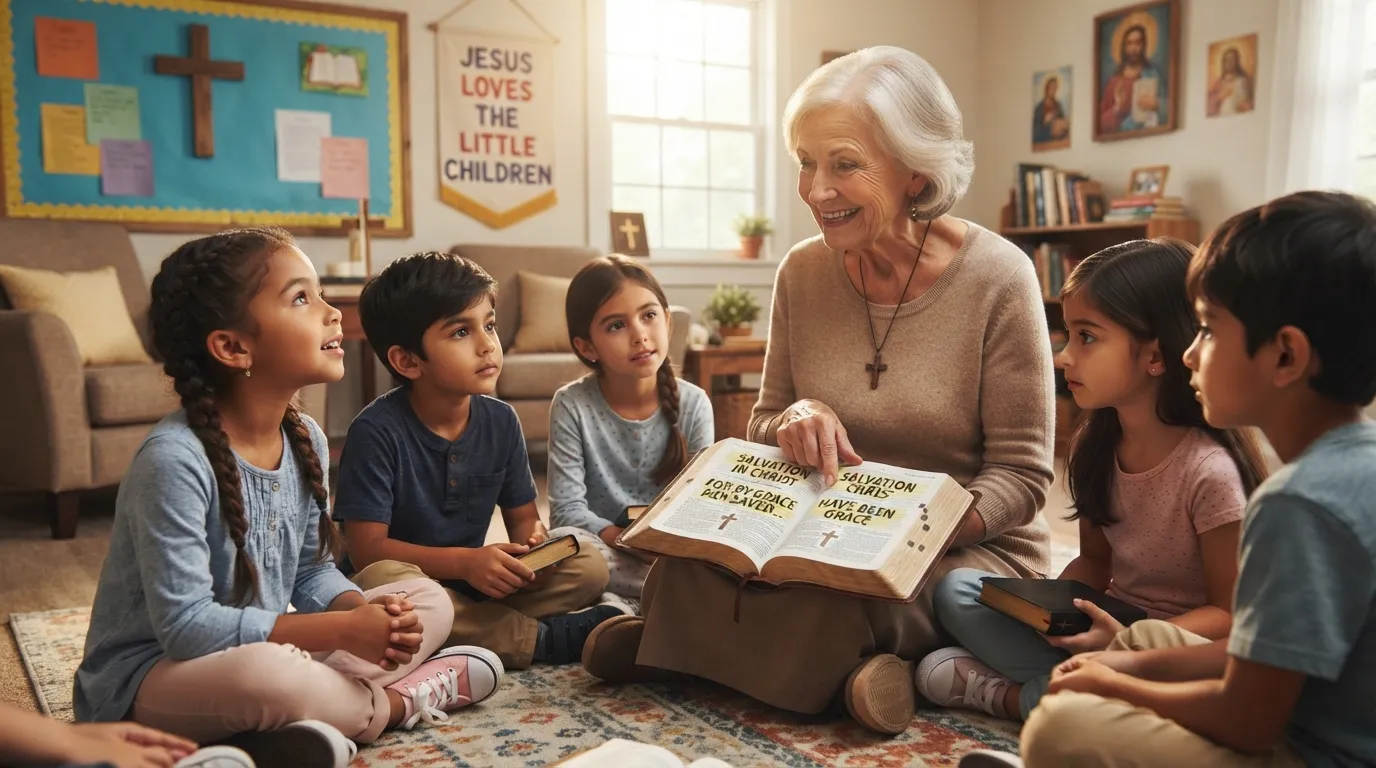
When parents brought their children to Jesus, the disciples tried to turn them away — perhaps thinking the teacher had more important matters. Jesus was indignant. “Let the little children come to me, and do not hinder them, for the kingdom of God belongs to such as these,” He said (Mark 10:14). Then He took the children in His arms, laid His hands on them, and blessed them.
That scene appears in Matthew, Mark, and Luke, and it is worth slowing down over the details. Jesus did not merely tolerate the children. He embraced them. He did not use them as an illustration and then send them away; He blessed them individually, with touch. In a culture where children had little status, Jesus gave them a place at the center of His ministry.
Then He turned the lesson on the adults: “Truly, I say to you, whoever does not receive the kingdom of God like a child shall not enter it” (Mark 10:15). Childlike faith is not childish faith. It is trust without pretense, dependence without self-sufficiency, openness without cynicism. Adults come to God with resumes, arguments, and bargaining. Children come with empty hands. Jesus says the kingdom belongs to the empty-handed.
Matthew 18 adds a sharp warning. After placing a child in the middle of His disciples, Jesus said, “Whoever causes one of these little ones who believe in me to sin, it would be better for him to have a great millstone fastened around his neck and to be drowned in the depth of the sea” (Matthew 18:6). God takes children seriously — and He takes seriously anyone who harms them, exploits them, or leads them away from truth.
Sin, Innocence, and the Need for Grace
It would be comforting to conclude that children are simply innocent and therefore need no salvation. The Bible does not quite say that. Psalm 51:5 records David’s confession: “Behold, I was brought forth in iniquity, and in sin did my mother conceive me.” Romans 3:23 states plainly that “all have sinned and fall short of the glory of God.” Human nature is fallen from the start; no one inherits a sinless record.
At the same time, Scripture distinguishes between inherited sin nature and willful, accountable rebellion. Romans 5 explains that sin entered through Adam, yet personal guilt in the fullest sense is tied to knowing God’s law and transgressing it. Children are born into a fallen world and a fallen nature, but they are not yet capable of the deliberate, knowing rejection of God that characterizes adult unbelief.
This is why many Christians speak of an “age of accountability” — not a phrase found in Scripture, but a summary of the biblical pattern: God judges people according to what they know and what they have done with that knowledge (see Luke 12:47–48, where degrees of punishment correspond to degrees of knowledge). The Bible never sets that age at a number. It varies by child, by mind, by opportunity. What Scripture does insist on is that the Judge of all the earth will do right (Genesis 18:25).
Salvation, for children as for adults, is never earned by innocence. If children are saved, they are saved the same way everyone is saved: by the grace of God through the work of Jesus Christ. The blood of Christ is sufficient for them. Their salvation rests on His merit, not on their record — which is precisely why parents can trust God with children who die before they can consciously believe.
Raising Children Toward Faith
For children who are living and growing, the Bible’s emphasis shifts from speculation to responsibility. Deuteronomy 6:6–7 commands parents: “These words that I command you today shall be on your heart. You shall teach them diligently to your children, and shall talk of them when you sit in your house, and when you walk by the way, and when you lie down, and when you rise.”
Notice the setting. Faith is not taught only in formal lessons; it is woven into meals, walks, bedtime, and mornings. Proverbs 22:6 adds, “Train up a child in the way he should go; even when he is old he will not depart from it.” That is a proverb — a general principle, not an ironclad guarantee — but it captures a real pattern: early formation shapes lifelong direction.
Parents should also note what Jesus did not do with children. He did not pressure them into adult-style confessions. He did not demand theological precision. He welcomed them, blessed them, and taught the adults around them. The practical lesson is clear: create a home where children hear Scripture naturally, see prayer modeled honestly, witness repentance and forgiveness in real life, and learn that God is not a distant judge but a Father who welcomes them.
Churches share this task. The baptism and dedication practices of different traditions vary, and Christians disagree about infant baptism. What all traditions agree on is that children belong in the community of faith, that they should be taught the gospel early, and that no child is too young to be prayed for, blessed, and pointed toward Christ.
For Grieving Parents
Few passages are quoted more often at a child’s funeral than Jesus’ words, “Let the little children come to me.” They are quoted because they are true. The God who welcomed children in Galilee is the same God who receives them in eternity. The God who wept at Lazarus’s tomb is not indifferent to a parent’s tears.
Grief for a child is different from other grief. It grieves not only what was, but what would have been — first steps never taken, birthdays never celebrated, a whole unlived life. Scripture does not rush grieving parents past that pain. David grieved. Job grieved. Mary, standing at the cross, watched her own son die. The Bible’s comfort is not “stop feeling this.” It is “God is with you in this, and His judgment is trustworthy.”
Parents who lose a child often wrestle with guilt: Did I pray enough? Did I do enough? The gospel answers that salvation — yours and your child’s — never depended on the perfection of your performance. It depends on the perfection of Christ. You can entrust your child to a God whose mercy is wider than your understanding and whose justice is more precise than your fears.
And for parents still raising children, the call is urgent but not frantic: pray daily, teach patiently, model faith honestly, and trust God with the outcome. You cannot save your children by your own effort. You can place them, again and again, into the arms of the One who said, “Let them come.”
The Bible’s message about children and salvation is ultimately a message about God. He is the God who formed children in the womb, who numbered their days, who welcomed them in His Son’s arms, and who judges with a mercy that never contradicts His justice. Parents can rest in that character — and children, in life and in death, are safe in His hands. For a broader look at how Christians have historically understood the age at which children become morally accountable, the Wikipedia article on the age of accountability traces the development of the idea across traditions.










