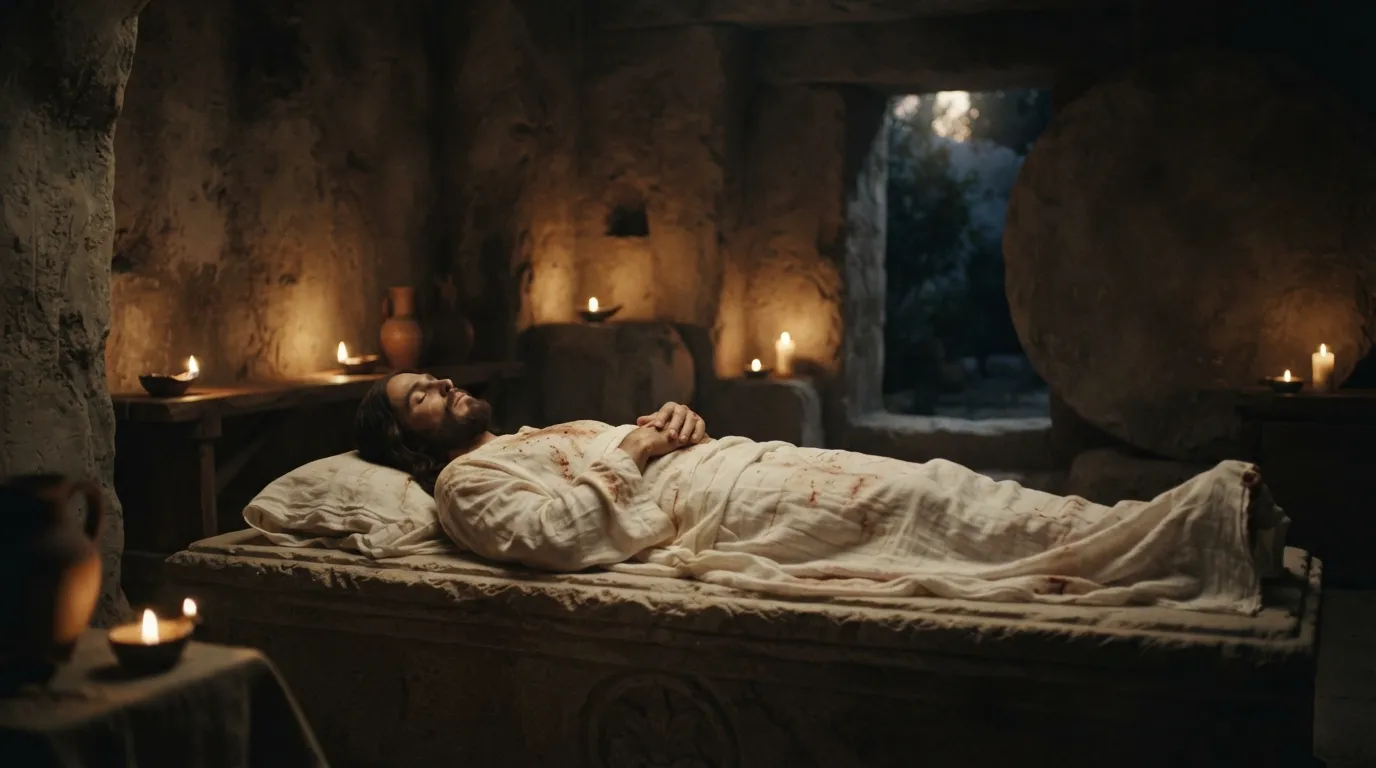
Friday evening in Jerusalem was quiet in the worst way. The crowds had gone home. The shouting had stopped. In a garden tomb cut from rock, a body lay wrapped in linen, and a great stone sealed the entrance. The disciples were scattered, hiding, grieving. For them, everything had ended. What none of them could see was that the silence of Saturday was not the absence of God. It was the pause before the loudest morning in history.
The burial of Jesus is one of the most easily overlooked parts of the gospel. Christians rush from the cross to the empty tomb, and understandably so. But the New Testament insists on the burial as a fact of the gospel, not a footnote. “Christ died for our sins in accordance with the Scriptures, that he was buried, that he was raised on the third day in accordance with the Scriptures” (1 Corinthians 15:3–4). Died. Buried. Raised. All three matter, and the middle one — buried — is what makes the other two real.
Friday Evening: A Borrowed Tomb
After Jesus died, Joseph of Arimathea, a respected member of the council who had become a disciple, went boldly to Pilate and asked for the body (Mark 15:43). Pilate was surprised Jesus was already dead; crucifixion usually took much longer. After confirming the death with the centurion, he released the body to Joseph.
Joseph was joined by Nicodemus, the Pharisee who had once come to Jesus by night. Together they took the body down, wrapped it in linen cloths with about seventy-five pounds of myrrh and aloes, and laid it in a new tomb Joseph had cut from rock in a nearby garden. A great stone was rolled against the entrance. The women who had followed Jesus watched where He was laid (Mark 15:47).
The details matter. Jesus was not buried in a common pit for criminals, which was the usual fate of the crucified. He was buried honorably, in a rich man’s tomb — just as Isaiah had prophesied seven centuries earlier: “They made his grave with the wicked and with a rich man in his death” (Isaiah 53:9). Even in death, the prophecies kept coming true.
The burial also mattered legally and historically. Roman executioners were professionals at confirming death. A spear had pierced His side. The body had been handled, wrapped, and sealed in a tomb guarded at the chief priests’ request. Nobody in the first century — friend or enemy — doubted that Jesus had actually died. The tomb closed that question forever.
Saturday: The Day Nothing Seemed to Happen
What happened on Saturday? The Gospels are almost entirely silent. The disciples hid. The women rested, because it was the Sabbath. The guards stood watch. From every human vantage point, God was doing nothing.
Yet Christians have long called this day Holy Saturday, and its silence carries its own lesson. Much of the Christian life is lived on Saturday — between the promise and the fulfillment, between the prayer and the answer, between the diagnosis and the healing. The disciples did not know Sunday was coming. They had heard Jesus predict His resurrection, but grief has a way of burying memory along with hope.
Two debated passages touch on this interval. First Peter 3:18–20 says Christ, “being put to death in the flesh but made alive in the spirit,” went and proclaimed to “the spirits in prison.” First Peter 4:6 says the gospel was preached “even to those who are dead.” Christians have interpreted these verses in different ways — some see a proclamation of victory to fallen spirits, others a reference to the preaching of Noah’s generation, others a statement about believers who heard the gospel before dying. What is clear is that Christ’s death reached beyond the grave; what is not clear is the exact mechanics. Honest Bible study admits the debate rather than pretending certainty.
Ephesians 4:9 adds that Christ “descended into the lower regions, the earth,” which many understand as a reference to His incarnation and burial. The Apostles’ Creed summarizes this with the phrase “he descended to the dead” (or “descended into hell”). Whatever the precise interpretation, the theological point is the same: there is no depth of human experience — not even death itself — where Christ has not gone.
Why the Burial Matters Theologically
First, the burial proves the death was real. A religion built on a swoon, a coma, or a spiritual metaphor would collapse under scrutiny. The New Testament will not allow that escape. Jesus was buried because He had died, and the tomb was the receipt.
Second, the burial proves the resurrection was bodily. The same body that was wrapped and laid in the tomb was the body that left it. The empty tomb, the folded grave clothes, the wounds Thomas touched — all of it points to a resurrection of the body, not merely a survival of the spirit. Christianity does not teach that death is an illusion or that the soul escapes the body. It teaches that the body itself will be raised, transformed, and glorified (1 Corinthians 15:42–44).
Third, the burial fulfills the sign of Jonah. Jesus had said, “For just as Jonah was three days and three nights in the belly of the great fish, so will the Son of Man be three days and three nights in the heart of the earth” (Matthew 12:40). The phrase “three days” follows the Jewish way of counting any part of a day as a day: Friday afternoon, all of Saturday, and Sunday morning. The sign was not a riddle for scholars; it was a promise that the grave would hold Him only on loan.
Fourth, the burial identifies Christ with every human burial. Everyone who has stood at a grave has stood where Jesus stood. He was not spared the cold stone, the linen, or the silence. The author of Hebrews says He shared in flesh and blood so that “through death he might destroy the one who has the power of death” (Hebrews 2:14). He defeated death from the inside.
The Guard at the Tomb
Matthew records a detail the other Gospels omit: the chief priests and Pharisees went to Pilate and asked for a guard at the tomb. “Sir, we remember how that impostor said, while he was still alive, ‘After three days I will rise.’ Therefore order the tomb to be made secure until the third day, lest his disciples go and steal him away” (Matthew 27:63–64). Pilate agreed, and the tomb was sealed and guarded by Roman soldiers. The irony is delicious: the enemies of Jesus provided the best possible witnesses to His resurrection. A sealed, guarded tomb cannot be explained away as a mistake or a quiet theft. When the stone was rolled away, the guards themselves became the first to report the empty tomb — and the chief priests bribed them to say the disciples had stolen the body while they slept (Matthew 28:11–15). The guard that was meant to prevent a resurrection story became the strongest evidence that the resurrection really happened.
Sunday Morning: The Stone That Moved
When the women arrived at dawn on the first day of the week, the stone was already rolled away. An angel announced, “He is not here, for he has risen, as he said” (Matthew 28:6). The tomb was not opened to let Jesus out — the risen Christ had no need of an open door. It was opened to let the witnesses in.
The grave clothes told their own story. John records that Peter saw the linen cloths lying there, and the face cloth folded up in a place by itself (John 20:6–7). Grave robbers do not fold. This was not a theft; it was a departure. The One who had been wrapped for burial had left the wrappings behind the way a sleeper leaves blankets.
That empty tomb is why Christians can face their own graves without despair. Paul taunts death itself: “O death, where is your victory? O death, where is your sting?” (1 Corinthians 15:55). The sting of death is sin, Paul says, and the power of sin is the law — but God gives victory through Jesus Christ. The grave of Jesus is the one grave in history that guarantees the rest will one day be emptied too.
What the Grave Means for Waiting Believers
If you are living in a Saturday season — grieving, waiting, praying without visible answers — the burial of Jesus speaks directly to you. God’s apparent inactivity is not evidence of His absence. The disciples thought Friday was the end of the story. They were wrong by exactly one day.
The burial also teaches patience with God’s timing. The resurrection did not happen on Friday night, when everyone wanted it. It happened on the third day, according to the Scriptures, according to the Father’s schedule. Faith learns to wait in the tomb’s shadow without concluding the story is over.
Finally, the grave teaches hope for the body. Christian hope is not that souls float free forever. It is that bodies will rise, creation will be renewed, and the world that buried Jesus will be remade by Him. The tomb in the garden — the first tomb that could not hold its occupant — was the firstfruits of a harvest that includes everyone who belongs to Christ.
The grave looked like the end. It was the middle. And because Jesus passed through it, no grave is ever the end again. For the historical background on burial customs, tombs, and the events surrounding the entombment, see the Wikipedia article on the burial of Jesus.










