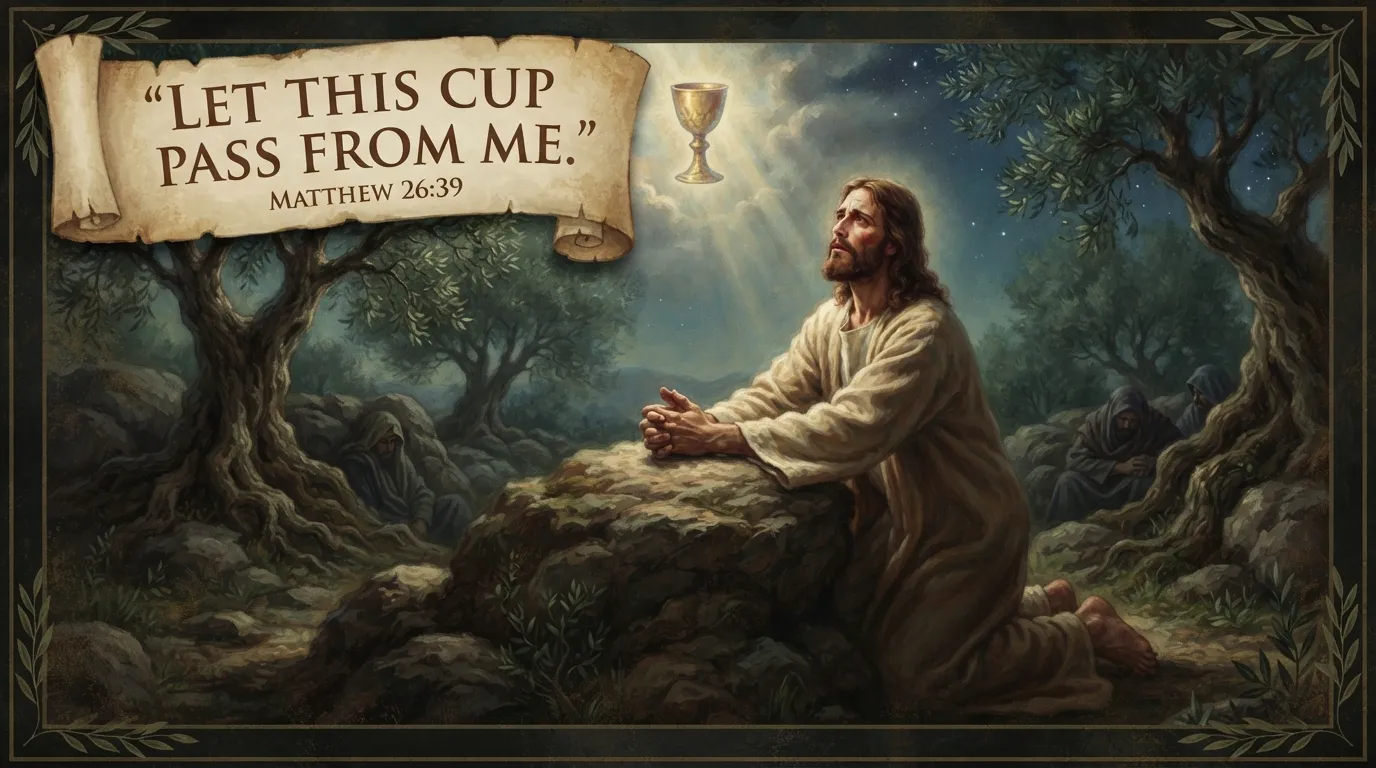
In the Old Testament, a “cup” is rarely just a cup. When the psalmist says, “You prepare a table before me in the presence of my enemies; you anoint my head with oil; my cup overflows” (Psalm 23:5), the cup is blessing — full, running over, more than enough. But when the prophets speak of a cup, it is usually the opposite: “Take from my hand this cup of the wine of wrath, and make all the nations to whom I send you drink it” (Jeremiah 25:15). The cup is judgment. The cup is what a guilty world deserves to drink.
Hold both images in mind, because in the Garden of Gethsemane, Jesus picked up the second one. “My Father, if it be possible, let this cup pass from me; nevertheless, not as I will, but as you will” (Matthew 26:39). In one sentence, Jesus showed us what honest prayer sounds like, what the cross would cost, and what surrender actually means.
The Cup in the Prophets
To understand Gethsemane, you have to hear the word “cup” the way Jesus’ listeners heard it. Throughout the Old Testament, the cup is the standard metaphor for a person’s allotted portion from God — whether blessing or judgment.
Psalm 75:8 pictures God holding a cup: “For in the hand of the LORD there is a cup with foaming wine, well mixed, and he pours out from it, and all the wicked of the earth shall drain it down to the dregs.” Isaiah 51:17 speaks of Jerusalem having “drunk from the hand of the LORD the cup of his wrath” and having drained “the bowl, the cup of staggering.” Ezekiel, Habakkuk, and Zechariah use the same image. The cup of wrath is not a sip; it is drained to the dregs.
There is also the cup of blessing. Psalm 116:13 says, “I will lift up the cup of salvation and call on the name of the LORD.” At the Last Supper, only hours before Gethsemane, Jesus had lifted a literal cup and said, “Drink of it, all of you, for this is my blood of the covenant, which is poured out for many for the forgiveness of sins” (Matthew 26:27–28). The cup of blessing and the cup of wrath meet at the same table: Jesus would drink the cup of wrath so that His people could drink the cup of blessing.
When Jesus asked for the cup to pass, then, He was not merely dreading physical pain — though the pain would be real and horrific. He was facing the prospect of bearing the judgment for the sins of the world, of being “made sin” for us (2 Corinthians 5:21), of experiencing the forsakenness He would cry out about on the cross: “My God, my God, why have you forsaken me?” (Matthew 27:46). The cup was not the nails. The cup was the wrath.
Gethsemane: The Garden of the Oil Press
The name Gethsemane means “oil press.” Olive gardens in the Kidron Valley had stone presses where olives were crushed to release their oil. It is a fitting name for the place where Jesus was crushed under the weight of what was coming — and where His obedience released salvation for the world.
After the Last Supper, Jesus crossed the Kidron Valley with His disciples to a familiar garden. John notes that Judas knew the place, because Jesus had often met there with His disciples (John 18:2). Jesus took Peter, James, and John further in — the same three who had witnessed the Transfiguration — and told them, “My soul is very sorrowful, even to death; remain here, and watch with me” (Matthew 26:38).
Then He went a stone’s throw further, fell on His face, and prayed. Luke, the physician, records a detail no one else does: Jesus was in such agony that “his sweat became like great drops of blood falling down to the ground” (Luke 22:44). Medical literature describes a rare condition called hematidrosis, in which extreme stress ruptures capillaries into the sweat glands. Whether or not that is the precise explanation, Luke’s point is clear: this was no calm, detached resignation. This was anguish at the edge of human endurance.
An angel appeared and strengthened Him (Luke 22:43). Heaven did not remove the cup — but heaven did send help to drink it. That is often how God answers the hardest prayers: not by removing the trial, but by supplying strength to endure it.
Three Prayers, One Surrender
Jesus prayed the same prayer three times. The repetition is not a sign of weak faith; it is a portrait of persevering prayer. Each time, the prayer moved through the same two movements: honest desire, then total surrender.
The first prayer: “My Father, if it be possible, let this cup pass from me; nevertheless, not as I will, but as you will” (Matthew 26:39). The second: “My Father, if this cannot pass unless I drink it, your will be done” (Matthew 26:42). The third repeats the same words (Matthew 26:44). Notice the shift between the first and second prayers. In the first, Jesus asks if there is another way. In the second, He accepts that there is not — and submits anyway. Surrender is not a single moment; it is a process, prayed through layer by layer until the will is fully yielded.
Between the prayers, Jesus found His closest friends asleep. “So, could you not watch with me one hour?” He asked Peter (Matthew 26:40). “Watch and pray that you may not enter into temptation. The spirit indeed is willing, but the flesh is weak” (Matthew 26:41). The disciples’ failure is part of the story’s honesty. At the very moment Jesus was fighting the greatest spiritual battle in history, His support system was snoring. Anyone who has ever felt abandoned in a crisis knows that loneliness. Jesus knows it too — He lived it.
Mark’s account preserves Jesus’ Aramaic word for Father: “Abba, Father, all things are possible for you. Remove this cup from me. Yet not what I will, but what you will” (Mark 14:36). “Abba” is the intimate word of a child — the word a small son uses for his father. Even in the darkest hour, Jesus prayed to a Father, not to a distant force. The intimacy held, even when the answer was no.
Was Jesus Afraid? Was His Faith Weak?
Some readers worry that Jesus’ prayer shows doubt or weakness. It shows neither. It shows His true humanity. Hebrews 4:15 says we have a high priest who was “tempted as we are, yet without sin,” and who can “sympathize with our weaknesses.” If Jesus had faced the cross without dread, His courage would be irrelevant to us — the courage of someone who cannot feel pain means nothing to people who can.
The prayer also shows that asking God for another way is not unfaithful. Jesus asked. He asked three times. The Father’s answer was not, “How dare you ask?” The Father’s answer was silence — and then strength through an angel, and then the resurrection on the other side of the cross. An unanswered prayer for deliverance is not always a refusal of love. Sometimes it is the road to a greater deliverance.
Nor did Jesus’ surrender mean He was a passive victim. John 10:18 records His words: “No one takes my life from me, but I lay it down of my own accord.” Gethsemane is where that voluntary laying-down happened. The cross was the execution; the garden was the decision. Judas, the soldiers, and Pilate were instruments. The choice was made on Jesus’ face in the dirt of Gethsemane.
What Gethsemane Teaches About Our Own Prayers
First, bring God your honest desire. Jesus did not dress up His prayer in pious resignation. He said what He wanted: let this cup pass. Faith does not require pretending. The Psalms are full of raw, desperate prayers, and God welcomed them all. You can tell God you do not want the surgery, the loss, the hardship. He already knows. Saying it is not faithlessness; it is relationship.
Second, end with surrender. “Nevertheless, not as I will, but as you will” is the hardest sentence in the Bible to pray and mean. It does not mean giving up on God. It means trusting that the Father’s wisdom is greater than your view of the situation. Jesus modeled a prayer that holds desire and submission together without letting either cancel the other.
Third, watch and pray. Jesus’ warning to Peter applies to every believer facing temptation or trial: the spirit is willing, but the flesh is weak. The disciples slept because they were sorrowful (Luke 22:45) — their failure was human, not malicious. But it left them unprepared for what came next, and within hours Peter would deny Jesus three times. Prayer is not a ritual before the battle; it is the preparation for it.
Fourth, remember that God strengthens those He does not spare. The angel did not remove the cup. The Father did not change the plan. But Jesus was strengthened to walk the road. Paul would later learn the same lesson: God’s grace is sufficient, and His power is made perfect in weakness (2 Corinthians 12:9).
The garden ended with Jesus rising from prayer, waking His disciples, and walking toward the torches of the arrest party. “Rise, let us be going; see, my betrayer is at hand” (Matthew 26:46). He did not run. He did not hide. The prayer was over, the cup was accepted, and the Savior went to drink it — so that we would never have to. For more on the garden’s location, name, and place in the Passion narrative, see the Wikipedia article on Gethsemane.










