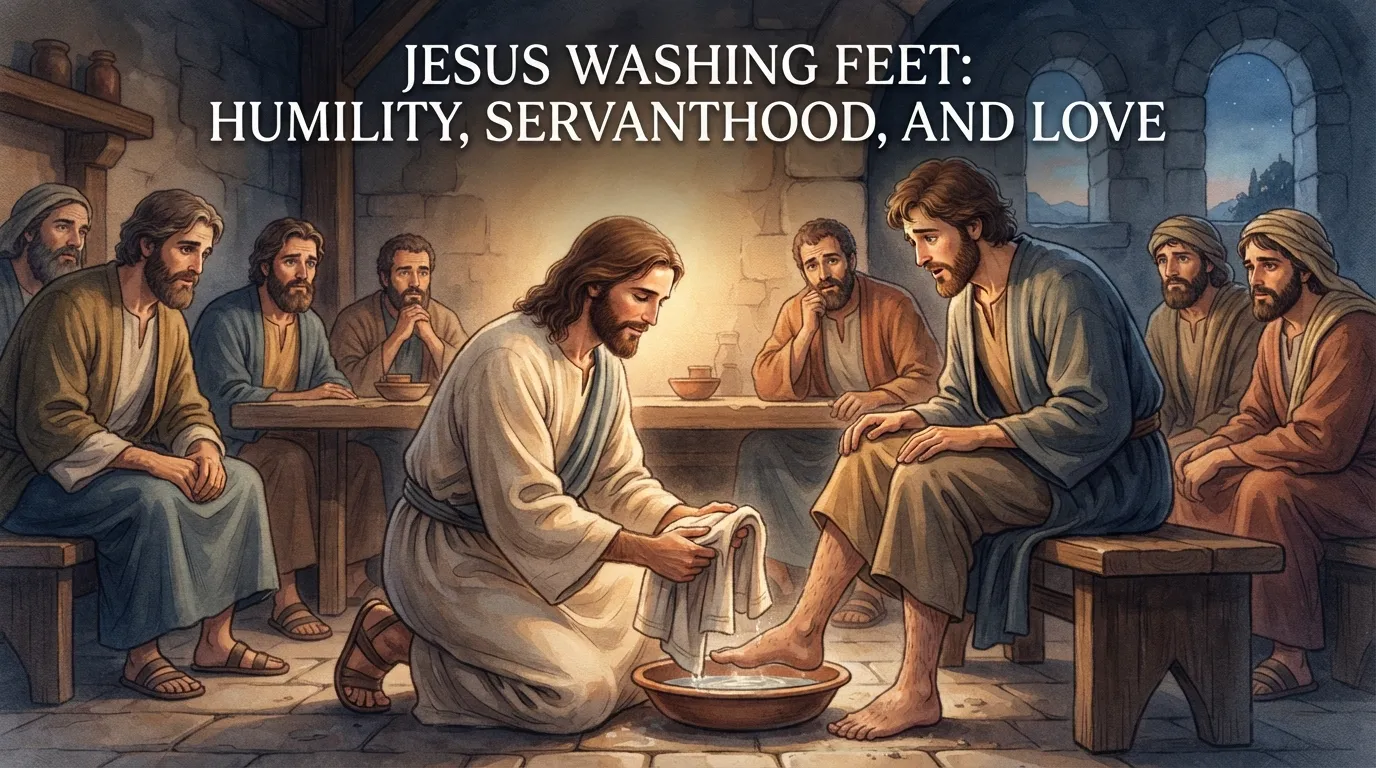
Imagine sitting at a table with Jesus, sharing a meal with Him and the people you love. Then something unexpected happens. Jesus gets up, takes a towel, pours water into a basin, and begins washing the dusty feet of His disciples. This is the powerful picture behind the Jesus washing feet meaning in the Bible. It is not simply a story about cleaning dirty feet. It reveals the heart of Jesus. He shows His followers what humility, servant leadership, love, forgiveness, and obedience look like in real life. The story appears mainly in John 13:1–17, during the Last Supper. Jesus knew His death was near, yet He chose that moment to teach His disciples a lesson they would never forget. He did not use His position to demand attention. He used His position to serve.
The Towel and the Basin
The central meaning of Jesus washing the disciples’ feet is humble service motivated by love. In biblical times, people commonly walked on dusty roads wearing sandals. Washing feet was a practical act of hospitality, normally performed by a servant or by someone willing to take the lowest place in the household. Yet Jesus, their Lord and Teacher, took the servant’s position.
John 13:3–5 describes Jesus knowing that the Father had given all things into His hands. Knowing His authority, Jesus still got up, took a towel, poured water into a basin, and washed the disciples’ feet. This is important. Jesus did not serve because He lacked authority. He served because He understood what godly authority looks like. The passage teaches that greatness in God’s kingdom is not about making others serve you. It is about being willing to serve others in love.
The Old Testament often uses washing with water as part of ceremonial cleansing and purification, and the Hebrew Bible contains many examples of washing as part of hospitality and ritual practice. For the specific story in John 13, the Greek language is especially important. John uses the Greek verb niptō, meaning to wash a part of the body, such as the hands or feet — which fits the practical action Jesus performed. The passage also uses language connected with feet, or pous in Greek. The biblical meaning does not depend on a secret Hebrew code. The meaning comes from the story, the words of Jesus, and the wider teaching of Scripture. Jesus took a humble task and turned it into a lesson about love, cleansing, service, and discipleship.
“You Should Do as I Have Done”
Jesus washed their feet to give them an example of humble service. After finishing, He asked whether they understood what He had done. He reminded them that they called Him Teacher and Lord, and He accepted those titles. Then He explained that if their Lord and Teacher had washed their feet, they should also serve one another. Jesus said in John 13:14–15 that His followers should wash one another’s feet because He had given them an example.
The immediate lesson was not simply, “Wash feet.” The deeper lesson was, “Be willing to humble yourself and serve others.” A Christian may never literally wash someone’s feet, yet still live out the principle every day: helping someone who is struggling, caring for an elderly family member, serving at church without seeking praise, forgiving someone, or doing an ordinary task that nobody notices.
One of the clearest lessons in this passage is humility. Jesus had every reason to be honored. He was the Messiah and Lord. Yet He willingly performed a task associated with the lowest position. Philippians 2:5–8 gives a similar picture of Christ’s humility. Paul teaches believers to have the same mindset as Christ, who humbled Himself and became obedient. Christian humility does not mean believing that you have no value. It means putting love and God’s will above pride and personal status. A humble Christian can have gifts, leadership, education, success, or influence and still serve others.
Jesus also showed that leadership and servanthood belong together. The world often connects leadership with power, recognition, and control. Jesus presents another model. His followers are called to use their position and abilities to bless others. This principle appears throughout the New Testament. Jesus taught His disciples that whoever wants to become great among them must become a servant. He also said that the Son of Man came not to be served but to serve and give His life for others in Mark 10:42–45. Servanthood is not a small part of Christian discipleship. It is central to following Jesus. A church leader, parent, teacher, business owner, or ministry worker can apply this lesson by asking: How can I use my position to help others? Am I serving only when people notice? Can I do difficult work without receiving praise? Do I treat people with dignity regardless of their position? These questions bring the lesson of John 13 into everyday life.
Love in Action — Even for a Betrayer
Jesus did not only talk about love. He demonstrated it. John 13 begins by saying that Jesus loved His own who were in the world and loved them to the end. The foot washing happened within that setting of love. Biblical love is not merely an emotion. It expresses itself through humble action. Jesus knew His disciples were imperfect. He knew one of them would betray Him. Yet He still served them.
That does not mean Christians should ignore evil or allow people to abuse them. Rather, it shows that Christian love is not based only on whether another person deserves kindness. Sometimes love looks like helping. Sometimes it looks like forgiving. Sometimes it looks like telling the truth gently. Sometimes it means serving someone who cannot repay you.
Peter’s Protest: “Unless I Wash You”
Peter strongly reacted when Jesus came to wash his feet. John 13:6 records Peter asking Jesus, “Lord, are you washing my feet?” Peter struggled to accept Jesus taking such a low position. When Jesus told Peter that he would not understand fully at that moment, Peter responded by saying that Jesus should never wash his feet. Jesus then explained that without being washed by Him, Peter could not share in Him.
This conversation points beyond ordinary physical washing. Jesus was teaching about the need for cleansing and dependence on Him. John 13:8 contains an important spiritual truth: Jesus told Peter that unless He washed him, Peter would have no share with Him. The immediate context includes physical foot washing, but Jesus uses the moment to teach a deeper lesson about spiritual cleansing. Later, in John 13:10, Jesus makes a distinction between being washed and having one’s feet washed. Christians have interpreted this in different ways, but the passage clearly points toward the believer’s continuing need to depend on Christ. The broader New Testament teaches that forgiveness and cleansing come through Christ. First John 1:9 teaches that God is faithful and just to forgive believers who confess their sins. So the lesson is not that physical water saves a person. The deeper Christian hope is that Christ cleanses and restores the person who comes to Him in faith.
Four Spiritual Themes
Christians have commonly understood several spiritual themes in Jesus washing the disciples’ feet. Humility before God: Jesus demonstrates that pride has no place in Christian service. A person may know much about the Bible and still need to learn humility. True spiritual maturity should make us more willing to love and serve, not more eager to look important. Cleansing from sin: the conversation with Peter points toward spiritual cleansing through Christ. The Bible repeatedly uses washing as an image connected with purification. Christians should distinguish between the symbolic meaning of the passage and the physical act itself. Water does not replace faith in Christ. Love for others: Jesus connected the foot-washing lesson with how His disciples should treat one another. Christian love becomes visible through actions. Willingness to take the low place: Jesus chose a task that others might have considered beneath them. That challenges believers to stop measuring every act of service by its visibility or prestige.
Do Christians Have to Wash Feet Literally?
Christian traditions understand this passage differently. Some Christian groups practice literal foot washing as an act of obedience and remembrance. Other churches understand Jesus’ command primarily as a call to humble service rather than requiring the physical practice. John 13:14–15 clearly presents foot washing as an example Jesus gave His disciples. Christians may differ on whether the physical practice itself is an ongoing church ordinance. What should not be missed is the central lesson Jesus emphasized: His followers should be willing to humble themselves and serve one another. The physical action and the spiritual principle should not be separated carelessly.
Everyday Lessons From the Basin
The story remains deeply practical. You may not have a basin of water and dusty feet in front of you, but you have opportunities to serve every day. You might wash dishes when someone else is tired. You might listen patiently to a hurting friend. You might help someone at church without announcing it. You might care for a child, parent, spouse, neighbor, or stranger. You might apologize first when pride tells you to wait. These simple actions can reflect the servant-hearted attitude Jesus taught. Following Jesus often means doing ordinary things with extraordinary love.
The story gives Christians several practical lessons. Serve without needing attention: not every act of love needs an audience. Jesus did not wash the disciples’ feet to create a public display of His greatness. Do not let status control your service: your job title, education, income, or position does not make humble service beneath you. Receive help with humility: Peter initially struggled to let Jesus serve him. Sometimes humility means serving others. At other times, humility means admitting that you need Christ and need help from others. Let love become practical: saying “I love you” matters, but actions often communicate love more clearly. Follow Christ’s example: the goal is not simply to admire Jesus’ humility. The goal is to let His example shape our behavior.
The foot-washing scene happens shortly before the crucifixion. Jesus knew suffering was coming, yet He focused on teaching His disciples how to love and serve. That makes the scene especially powerful. The One who would soon give His life for others was already demonstrating self-giving love. John 13 therefore connects naturally with the greater message of the Gospel. Jesus did not merely tell people to serve. He lived a life of self-giving love. The cross would become the greatest expression of that love.
Christian leadership should look different from leadership based only on power. Jesus had authority, yet He served. This does not mean Christian leaders should avoid responsibility. Instead, their authority should be used to protect, teach, guide, encourage, and serve others. A healthy Christian leader can ask: “Am I using my position to make myself important, or am I using it to help people grow?” That question reflects the heart of John 13. Leadership in the Christian sense is not about being above everyone else. It is about being responsible for the good of those God has placed in your care.
The main lesson is simple but powerful: Jesus calls His followers to humble themselves, love others, and serve without pride. The passage also reminds Christians that they continually depend on Christ for spiritual cleansing. Jesus’ actions challenge our natural desire for recognition. They ask us to look at the people around us and say: “How can I serve?” That question can change a family, church, friendship, workplace, or community. When you feel that a task is too small for you, remember Jesus with the towel. When you want recognition, remember Jesus kneeling before His disciples. When you struggle to love someone, remember that Christian love is meant to become action. And when you feel spiritually unclean or unworthy, remember that the Gospel points you back to Christ, whose grace cleanses and restores. You do not need to become important in the eyes of the world to live an important life before God. Pray for a humble heart. Ask God to help you notice people who need kindness. Ask Him for strength to serve when nobody applauds. And above all, keep your eyes on Jesus. His example reminds us that true greatness is found in humble love, faithful service, and complete dependence on God. For readers who want to see how churches across history have practiced this command — from Maundy Thursday liturgies to Anabaptist ordinances — the Wikipedia article on foot washing traces the practice and its meanings.










