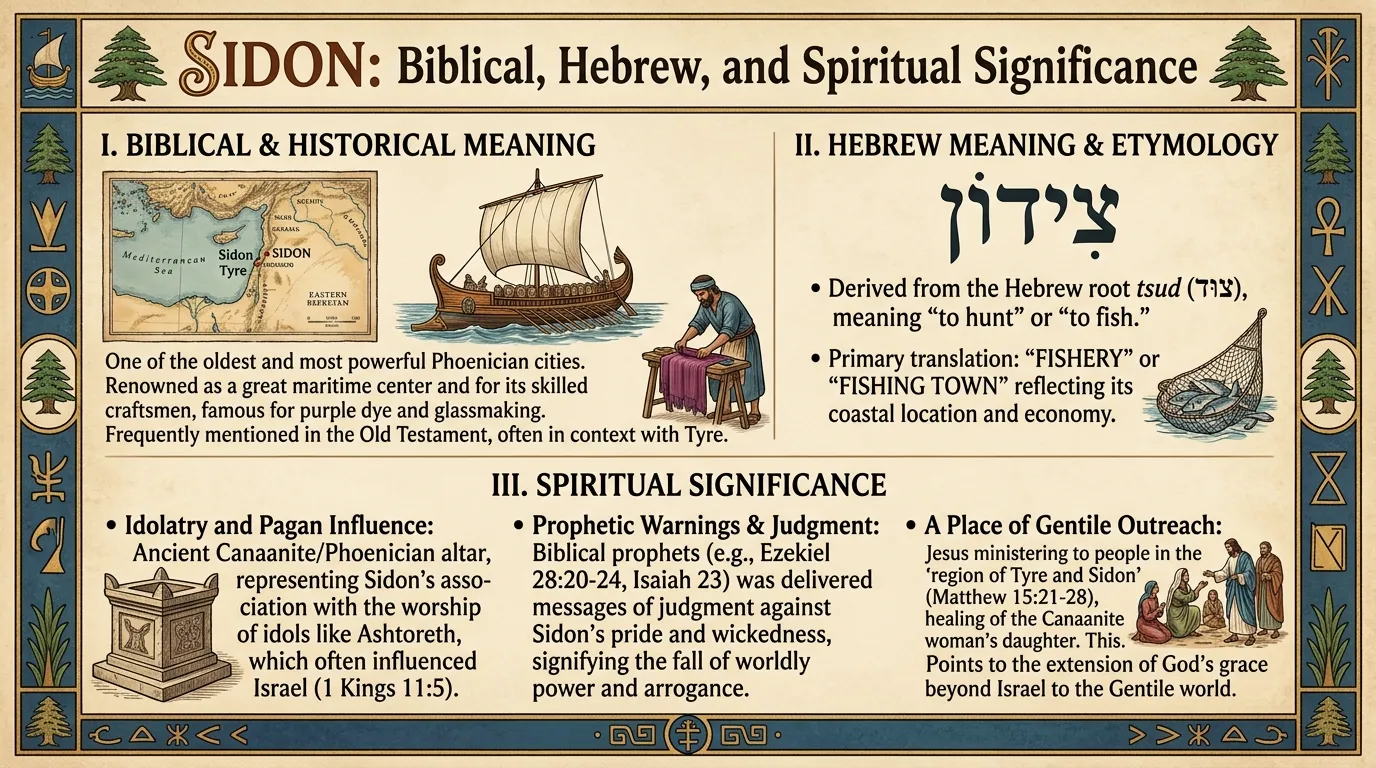
When Jesus withdrew to the region of Tyre and Sidon, He met a woman who would not take no for an answer. She was a Canaanite, a Gentile, an outsider by every measure that mattered in first-century Israel. Her daughter was suffering, and she came to Jesus crying out for mercy. What followed was one of the most surprising conversations in the Gospels, and it ended with Jesus praising a faith He rarely praised: “O woman, great is your faith!” (Matthew 15:28). This is Sidon’s New Testament story: the story of mercy reaching beyond the borders everyone expected.
The Region Jesus Visited
Sidon was an ancient Phoenician city on the Mediterranean coast, north of Israel, famous for its ships, craftsmen, and trade. In Jesus’ day, the region of Tyre and Sidon was Gentile territory. Jews of the time generally avoided it, and the old hostilities between Israel and the Phoenician cities were part of the cultural memory. When Matthew says Jesus “withdrew” to that region (Matthew 15:21), the word suggests a deliberate step outside His usual territory, a journey into Gentile space.
Why did Jesus go there? Mark says He entered a house and did not want anyone to know (Mark 7:24), suggesting He sought rest. But in the Gospels, Jesus’ withdrawals often become the setting for His most revealing encounters. The region of Sidon, which the Old Testament associated with Jezebel and Baal worship, became the place where Jesus would demonstrate that His mercy was not limited to Israel.
The Woman Who Would Not Leave
The woman who came to Jesus is identified differently by the two Gospel writers. Matthew calls her a Canaanite woman, using the ancient name for the peoples of that coast. Mark calls her a Syrophoenician woman, a Greek by birth (Mark 7:26). Both labels mark her as an outsider. She was not a daughter of Abraham by birth. She had no claim on Israel’s covenant. She had only a suffering daughter and a desperate hope.
She cried out, “Have mercy on me, O Lord, Son of David” (Matthew 15:22). The title is remarkable. A Gentile woman from Sidon’s region was addressing Jesus with a Jewish messianic title. She had heard about Him, and she believed enough to come. The disciples wanted Jesus to send her away. She was, in their view, a nuisance. Jesus’ first response was silence, and then a statement that sounded like a refusal: “I was sent only to the lost sheep of the house of Israel” (Matthew 15:24).
The Conversation About Crumbs
The exchange that followed is one of the most discussed in the New Testament. The woman knelt before Jesus and said, “Lord, help me.” Jesus answered, “It is not right to take the children’s bread and throw it to the dogs” (Matthew 15:26). The word He used for dogs was the word for household pets, not wild scavengers, and the statement was a picture of His mission’s order: the gospel would come to Israel first, and then to the nations.
The woman’s reply has become famous: “Yes, Lord, yet even the dogs eat the crumbs that fall from their masters’ table” (Matthew 15:27). She did not argue with the picture. She accepted it and found mercy inside it. If the children were fed at the table, she said, then even the crumbs were enough. She was not demanding a place at the table. She was asking for what fell from it, and her humility turned the conversation.
Jesus’ response was immediate and warm: “O woman, great is your faith! Be it done for you as you desire” (Matthew 15:28). Her daughter was healed instantly. The woman from the region of Sidon, who had no standing, no covenant claim, and no invitation, received a miracle and a commendation that few in Israel received.
What the Encounter Reveals About Jesus
The story reveals several things about Jesus at once. It shows His mission’s structure: He came first to Israel, and through Israel to the world. It shows His willingness to be moved by persistent, humble faith, even from an outsider. And it shows that the boundaries people draw around God’s mercy are not God’s boundaries. The woman’s faith crossed the border that separated Sidon from Israel, and Jesus honored it.
The story also corrects a common misunderstanding. Jesus was not being cruel or prejudiced. He was drawing out the woman’s faith in a conversation that the disciples, and Matthew’s readers, needed to hear. The exchange taught everyone present that the gospel’s order, Israel first, was not the gospel’s limit. The crumbs were enough, and the table would soon be open to all.
Sidon and the Gentile Mission
The Sidon encounter points forward to the whole Gentile mission of Acts. The gospel that reached a Canaanite woman in the region of Sidon would go on to reach Samaritans, an Ethiopian official, a Roman centurion, and eventually the whole Mediterranean world. The woman’s story is a preview of Pentecost’s promise: the Spirit would fall on all flesh, and the nations would come in.
Jesus also used Sidon as a measure of judgment. He said that if the mighty works done in Chorazin and Bethsaida had been done in Tyre and Sidon, they would have repented long ago in sackcloth and ashes (Matthew 11:21). The statement cuts both ways. It warns the towns that saw His miracles and refused to believe. And it honors the people of Sidon’s region, like the Canaanite woman, who responded to far less light with far greater faith.
The Mercy That Crosses Borders
The Disciples’ Reaction and Ours
The disciples’ response to the woman is part of the story’s challenge. They urged Jesus to send her away, because she kept crying out after them. Their annoyance is understandable in human terms: she was loud, persistent, and an outsider. But the Gospel records their reaction as a failure, not as a model. The disciples wanted to dismiss the very person Jesus was about to commend. The church has repeated that mistake in every generation, treating the persistent, the inconvenient, and the outsider as a problem rather than as a person of faith.
The woman’s persistence is therefore a rebuke as well as an example. She did not accept dismissal. She cried out, she knelt, and she answered. Her faith was not quiet or polite. It was loud, stubborn, and unwilling to leave. Jesus honored it. The church should ask itself how often it has sent away the people Jesus was about to praise.
Sidon and the Table of the Kingdom
The image of the table in the conversation with the Canaanite woman reaches far beyond that moment. The table is the kingdom’s feast, the place where God’s people are fed. In the woman’s day, the table was Israel’s. The crumbs were the mercy that fell to the Gentiles. But the New Testament’s later vision is of a table where the nations sit together: “Many will come from east and west and recline at table with Abraham, Isaac, and Jacob in the kingdom of heaven” (Matthew 8:11). The woman from Sidon’s region was an early guest at that table, and her faith was the invitation.
The story ends with healing and praise, but its larger ending is the church itself: a community made up of people from every nation, tribe, and tongue, sitting at a table that was once Israel’s alone. The woman who asked for crumbs became a sign of the feast to come. Sidon’s New Testament story is, in the end, a story about the reach of mercy. The city that the Old Testament associated with Jezebel and idolatry became the region where a Gentile woman’s faith was praised by Jesus Himself. The border that separated Israel from Sidon did not separate the woman from Christ. She came, she knelt, she persisted, and she was heard.
The Woman’s Faith and the Church’s Mission
The Canaanite woman’s story became a foundational text for the Gentile mission. When the early church debated whether Gentiles could belong to God’s people without first becoming Jews, the story of a Gentile woman whose faith Jesus praised was part of the evidence. The woman had not kept the law, had not been circumcised, and had not grown up in the covenant. She had only believed, persisted, and asked. And Jesus had answered. The story showed that faith, not ancestry, was the way into the kingdom.
That lesson is still the church’s foundation. The gospel does not belong to any nation, tribe, or culture. It belongs to all who believe, and the woman from Sidon’s region is one of its first witnesses. Her faith crossed a border that had stood for centuries, and Jesus honored it. The church that bears her story should never rebuild the border she crossed.
For readers today, the story is an invitation. No background, no nationality, no history of being an outsider puts a person beyond the reach of Jesus’ mercy. The woman from Sidon had no credentials except her need and her faith, and those were enough. The crumbs from the table fed her daughter, and the table itself would soon be opened to the whole world. For the story of this woman and how the church has read her faith, see the Wikipedia article on the Canaanite woman.










