Troas is the city where Paul’s plans broke down and God’s plan broke through. He arrived there with one set of intentions and left with another, after a vision that redirected the gospel toward Europe. He would return to Troas later for a long sermon, a young man falling from a window, and a farewell to friends. The city appears in Acts and in Paul’s letters as a place of guidance, preaching, and parting. Its meaning in the Bible is not hidden in the name or in a symbol. It is in the pattern: God guides His servants through closed doors, open visions, and the ordinary stops along the way.
A City on the Edge of Two Worlds
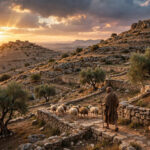
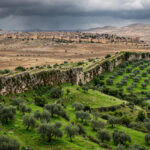
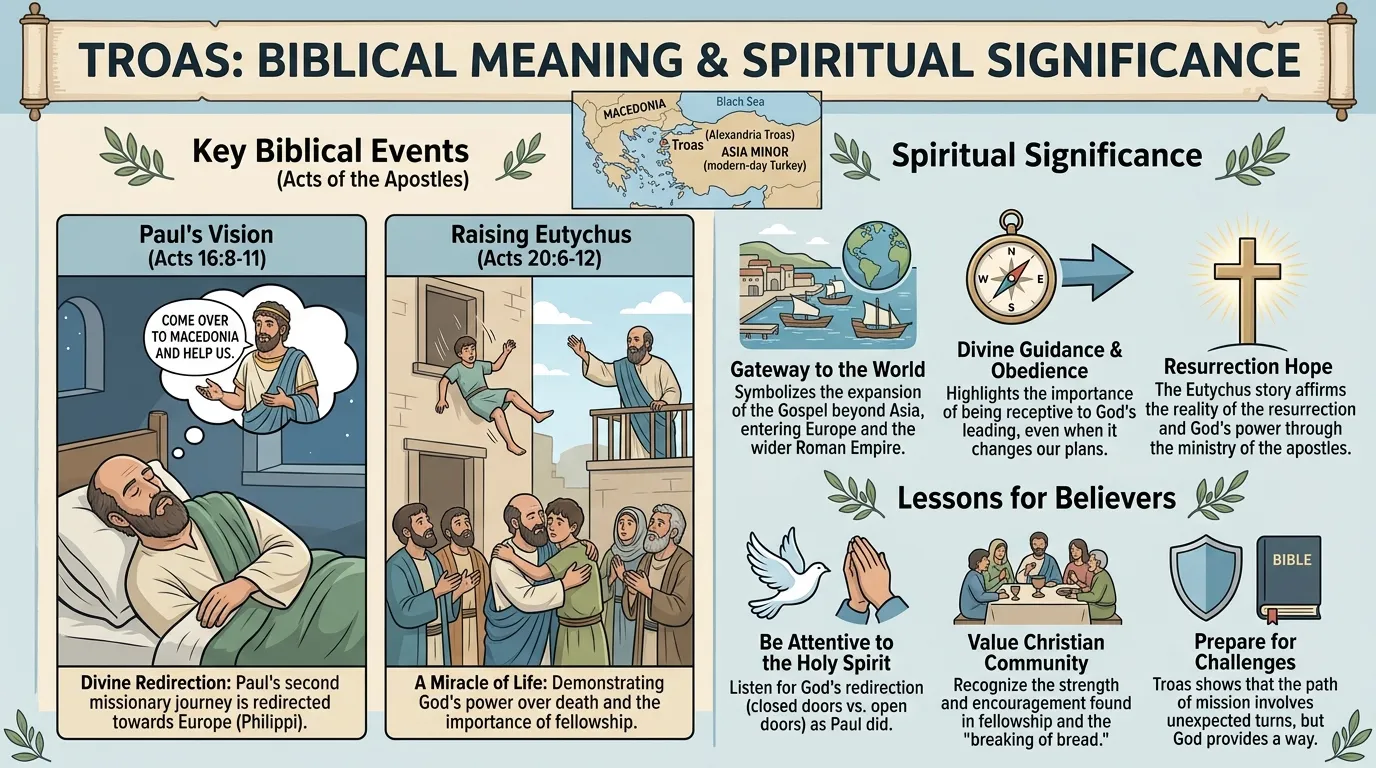
Troas, more fully called Alexandria Troas, stood on the northwest coast of Asia Minor, near the Aegean Sea and not far from the ancient site of Troy. It was a major port, founded in the wake of Alexander’s conquests and developed under the Romans into one of the most important harbors of the region. From Troas, ships sailed to Macedonia and the Greek world. For a traveler moving between Asia and Europe, Troas was the natural crossing point, the last port of one continent and the gateway to the other.
Paul’s first arrival at Troas came during his second missionary journey. He had been traveling through Asia Minor, and Luke records two striking frustrations: the Holy Spirit prevented them from speaking the word in Asia, and the Spirit of Jesus did not allow them to enter Bithynia (Acts 16:6-7). Paul’s plans were good. Asia needed the gospel. Bithynia needed the gospel. But the doors were closed. He came to Troas not knowing where to go next, and it was there, at the edge of the map, that the vision came.
The Macedonian Call
“And a vision appeared to Paul in the night: a man of Macedonia was standing there, urging him and saying, ‘Come over to Macedonia and help us'” (Acts 16:9). The vision is one of the most famous guidance passages in the Bible, and it came at the moment of Paul’s greatest uncertainty. He had been stopped twice. He was at a port city with nowhere to go. The vision gave him a direction: west, across the sea, into Europe.
Paul’s response was immediate. Luke says that when Paul had seen the vision, “immediately we sought to go on into Macedonia, concluding that God had called us to preach the gospel to them” (Acts 16:10). Notice the plural: “we.” This is the first time Luke uses the first person in Acts, suggesting he joined Paul’s party at Troas. The vision did not come to a committee. It came to Paul, and the party tested it together and concluded it was God’s call. The pattern is worth noting: guidance came through a vision, but it was confirmed by community, by the open door of the sea route, and by the gospel purpose that was clear.
Eutychus and the Long Sermon
Paul returned to Troas on his third missionary journey, and the visit produced one of the most human stories in Acts. On the first day of the week, the believers gathered to break bread, and Paul talked with them, intending to leave the next day. He prolonged his speech until midnight (Acts 20:7). A young man named Eutychus, sitting in a window, sank into a deep sleep and fell from the third story. He was picked up dead.
Paul went down, bent over him, and took him in his arms. “Do not be alarmed,” he said, “for his life is in him” (Acts 20:10). Eutychus was brought back alive, and the believers went back upstairs, broke bread, ate, and talked until dawn. The story is often told as a warning against long sermons, and there is some humor in that reading. But Luke’s point is more serious: the God who guides Paul’s journeys is also the God who restores life. The same power that redirected the mission at Troas raised a young man who had fallen from a window there. The city holds both stories: the vision and the resurrection.
The Cloak Left Behind
Troas appears once more, in one of the most poignant sentences Paul ever wrote. From prison, near the end of his life, he wrote to Timothy: “When you come, bring the cloak that I left with Carpus at Troas, also the books, and above all the parchments” (2 Timothy 4:13). The apostle who had preached across the empire, survived shipwrecks and beatings, and written letters that would shape the world was cold, in prison, and asking for his cloak.
The detail is small, and that is why it matters. Troas was not only the place of the great vision. It was also a place where Paul left ordinary things behind: a cloak, some books, some parchments. The Christian life contains both the dramatic and the mundane, and Troas holds both. The vision sent Paul to Europe. The cloak kept him warm. Both were part of the same life.
Guidance Through Closed Doors
Troas is the Bible’s great lesson in guidance through frustration. Paul did not receive the Macedonian vision while his plans were succeeding. He received it after two doors had closed and he had run out of ideas. The closed doors were not failures. They were guidance. The Holy Spirit’s “no” to Asia and Bithynia was as much a part of God’s leading as the vision’s “come” to Macedonia.
Christians often wish for guidance that arrives before the frustration: a clear map, a detailed itinerary, a voice that speaks before the plan fails. Troas suggests that guidance often comes at the port, not before the journey. Paul kept moving, kept seeking, and arrived at the edge of his plans. There, in the place where his ideas ran out, God spoke. The lesson is not to manufacture visions or to treat every strong impression as a message. It is to keep walking faithfully, to accept closed doors as guidance, and to trust that God speaks clearly when the time is right.
Troas and the First “We” Passage
The Troas departure contains a detail that scholars have long noticed: it is where Luke begins to write “we.” Up to Acts 16:9, the narrative is in the third person: Paul, Silas, and Timothy traveled. From Acts 16:10 onward, Luke writes, “we sought to go on into Macedonia.” The shift suggests that Luke himself joined the party at Troas. The city is therefore not only the place of the vision. It is the place where the author of Acts entered the story.
That detail adds a human dimension to the guidance at Troas. The vision came to Paul, but the decision was made by a group, and the group included a physician who would record the journey. The “we” passages that follow, through Philippi, Jerusalem, and the voyage to Rome, are the firsthand accounts of a companion who was there. Troas is where the historian became a participant, and the story became an eyewitness account.
The Return to Troas and the Broken Bread
Paul’s return to Troas on the third journey is often remembered for Eutychus, but the gathering itself deserves attention. The believers met “on the first day of the week, to break bread” (Acts 20:7). This is one of the earliest descriptions of Christian Sunday worship: a gathering on the first day, centered on the breaking of bread, with teaching that extended into the night. The church at Troas was not large or famous, but it practiced the same pattern the whole church would follow: gathering on the Lord’s Day, sharing the meal, and listening to the word.
Paul’s long sermon that night was not a performance. It was a farewell. He was leaving the next day, and he knew he would not return. The believers at Troas stayed up all night to hear him, and when the young man fell from the window, the community’s grief and relief became part of the night’s worship. The church at Troas shows that worship is not only a Sunday morning formality. It is a community staying together through the night, through accident, through grief, and through joy, until dawn.
Troas and the Long Obedience
The Troas story is often told as a moment of dramatic guidance, but its deeper lesson is about long obedience. Paul’s vision at Troas did not end his frustrations. It began a new chapter of them. The Macedonian mission would bring a beating and a prison in Philippi, opposition in Thessalonica, and a riot in Corinth. The vision did not promise ease. It promised direction. The God who called Paul at Troas was the same God who sustained him through everything that followed. Guidance, in the Bible, is not a guarantee of comfort. It is a promise of presence.
Troas also reminds us that God’s guidance is confirmed in community. Paul did not act on the vision alone. The party concluded together that God had called them. Visions, impressions, and feelings should be tested against Scripture, wisdom, and the counsel of other believers. The Troas pattern, closed doors, a clear call, communal confirmation, and immediate obedience, remains a sound model for decision-making today. For the history of the ancient port city, its harbor, and its ruins, see the Wikipedia article on Alexandria Troas.