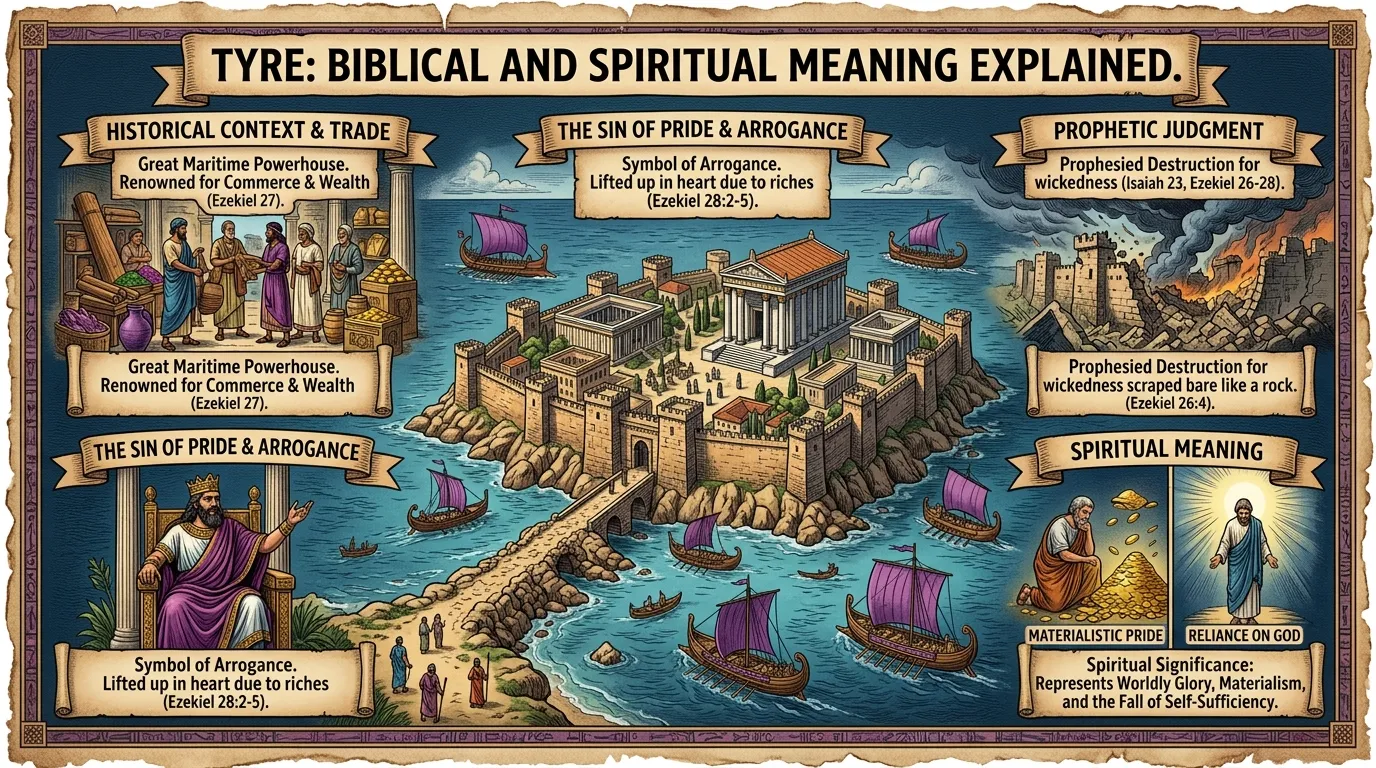
Tyre was the richest city in the ancient Mediterranean, and the Bible treats it as a case study in what wealth does to a soul. The city appears in stories of friendship and blessing, in prophecies of judgment, and in the ministry of Jesus. Its arc is one of the most instructive in Scripture: a city that helped build God’s temple, grew proud of its own achievements, and became an example of how prosperity can rot from the inside. Tyre’s meaning in the Bible is not that wealth is evil. It is that wealth, trusted in, becomes an idol.
An Island Fortress Built on Trade
Tyre stood on the Mediterranean coast, in two parts: a mainland settlement and an island city half a mile offshore, ringed by walls so high and strong that it was considered unconquerable. Its sailors were the finest in the ancient world, its merchants traded from Spain to Arabia, and its craftsmen produced the purple dye that clothed kings. The prophet Ezekiel gives a catalog of Tyre’s trade that reads like a shipping manifest: silver, iron, tin, and lead from Tarshish; slaves and bronze vessels from Greece; horses and mules from Armenia; ivory and ebony from Dedan; wine and wool from Damascus (Ezekiel 27). The city was the marketplace of the nations.
Tyre’s wealth was real, and the Bible does not pretend otherwise. The city earned its prosperity through skill, daring, and hard work. Its ships crossed the Mediterranean when most peoples stayed close to shore. Its craftsmen were the best in the world. The question the Bible asks about Tyre is not how it got rich. It is what riches did to it.
Hiram and the Temple: Friendship With Israel
Tyre’s earliest biblical appearances are friendly. Hiram, king of Tyre, sent messengers to David with cedar trees and craftsmen to build David a palace (2 Samuel 5:11). He maintained a friendship with Solomon and supplied cedar and cypress timber, along with skilled workers, for the building of the temple (1 Kings 5:1-12). In return, Solomon gave Hiram wheat and oil and twenty towns in Galilee. The two kings made a treaty, and the temple, the most sacred building in Israel’s history, rose with Tyrian timber and Tyrian hands.
This friendship shows that Tyre was not always an enemy. Its skill was a gift, and when that skill served God’s purposes, it was a blessing. The same craftsmen who built ships and palaces built the house of the Lord. Wealth and skill are not the problem in the Bible. The problem is what happens when they become the object of trust.
The Pride of the Prince of Tyre
Ezekiel’s oracle against Tyre is one of the most devastating passages in the prophets. The prince of Tyre, Ezekiel says, had come to believe his own publicity: “Because your heart is proud, and you have said, ‘I am a god, I sit in the seat of the gods, in the heart of the seas,’ yet you are but a man, and no god, though you make your heart like the heart of a god” (Ezekiel 28:2). The city that had grown rich through trade now believed its wealth was proof of divinity.
Ezekiel traces the corruption step by step. Tyre’s wisdom had grown with its commerce. Its heart was lifted up because of its beauty (Ezekiel 28:17). The city’s sin was not that it traded but that it came to worship its own success. The oracle ends with a promise of destruction, and history fulfilled it. Nebuchadnezzar besieged Tyre for thirteen years. Alexander the Great eventually conquered the island city by building a causeway from the mainland, one of the most famous sieges in ancient history. The unconquerable city fell.
Jesus in the Region of Tyre
Centuries later, Tyre appears in the Gospels in a different light. Jesus withdrew to the region of Tyre and Sidon (Matthew 15:21; Mark 7:24), seeking rest, and there He met a Syrophoenician woman whose daughter was oppressed by a demon. The woman, a Gentile from the very region of Tyre, begged Jesus for help. When Jesus tested her with the words about children’s bread and dogs, she answered with humility and wit: “Yes, Lord, yet even the dogs eat the crumbs that fall from their masters’ table” (Matthew 15:27). Jesus praised her faith and healed her daughter.
The encounter is a turning point. The region that had once produced Jezebel and the pride of the prince of Tyre now produced a woman whose faith Jesus held up as a model. The gospel was reaching the Gentiles, and Tyre, the city of wealth and pride, became the setting for a demonstration of grace. Jesus also used Tyre as a measuring stick for judgment, saying that if the miracles done in Jewish towns had been done in Tyre and Sidon, they would have repented long ago (Matthew 11:21-22). The city that had heard the prophets’ warnings was now accountable for a greater revelation.
What Tyre Teaches About Wealth
The Siege of Tyre: The Unconquerable City Falls
Tyre’s pride rested on a real military fact: the island city was considered unconquerable. Its walls rose from the sea, its navy controlled the waters, and its mainland settlement could be abandoned when threatened. Nebuchadnezzar besieged it for thirteen years and never fully took the island. The city’s confidence was not fantasy. It was built on experience.
Alexander the Great changed that. After Tyre refused him entry, Alexander built a causeway from the mainland to the island, piling stone and timber into the sea until his army could reach the walls. The siege lasted seven months and ended in the city’s destruction. The causeway still exists, in a sense: the silt and sand that accumulated around it eventually joined the island to the mainland, so that the Tyre of today stands on a peninsula, not an island. The city that said “I am a god, I sit in the seat of the gods, in the heart of the seas” (Ezekiel 28:2) became a peninsula. The sea that had protected it became the road that defeated it.
Tyre in Acts: The Gospel Arrives
Tyre appears once more in the New Testament, in a quiet scene that completes its arc. On Paul’s final journey to Jerusalem, his ship put in at Tyre, and he found disciples there. He stayed with them for seven days, and when he left, the whole church, with wives and children, accompanied him to the beach, knelt down, and prayed (Acts 21:3-6). The city that had once been the symbol of pride and resistance to God now had a church that knelt on the beach to pray for an apostle.
The scene is a fitting end to Tyre’s biblical story. The wealth and the walls are gone. The pride is judged. What remains is a community of believers on a beach, praying. The city that had trusted in its riches learned, over centuries of judgment and grace, to trust in something else. The beach at Tyre is the opposite of the prince’s throne: a place of humility, prayer, and farewell. And it is there, not on the throne, that the story finds its peace.
Tyre’s Pride and the Modern Reader
Tyre’s story is often read as ancient history, but its pattern is modern. Every generation produces its own versions of the prince of Tyre: people, companies, cities, and nations that mistake success for self-sufficiency and begin to believe their own publicity. The Bible’s diagnosis of Tyre is not that it was poor or unsuccessful. It was that it confused the gift with the giver. Wealth, skill, and influence are real blessings, and the Bible never denies it. The danger comes when the blessed begin to believe they are the source of the blessing.
The antidote the Bible prescribes is not guilt about success but gratitude for it. The same trade that made Tyre proud had once supplied the temple. The same skill that built the prince’s throne had once built the house of God. The difference was never in the gift. It was in the direction of the heart. A heart that receives its wealth as a trust will use it to serve. A heart that receives its wealth as a trophy will use it to preen. Tyre’s story asks every reader which kind of heart they have.
Tyre’s story offers a balanced theology of wealth. The Bible does not teach that prosperity is proof of God’s favor or proof of His disfavor. Tyre’s wealth began as a blessing of skill and trade. It became a curse when the city trusted in it. The same pattern repeats in every generation: success breeds confidence, confidence breeds pride, and pride breeds the illusion of self-sufficiency. The antidote is not poverty but humility: the recognition that every gift comes from God and that wealth, however honestly earned, is a trust rather than a trophy.
The story also teaches that no city’s fate is sealed. The region of Tyre that produced pride also produced faith. The woman who met Jesus there shows that grace reaches the places judgment named. Tyre’s meaning in the Bible is therefore double: a warning against trusting in riches, and a witness that mercy reaches even the proudest places. For the history of the ancient city, its sieges, and its ruins, see the Wikipedia article on Tyre.










