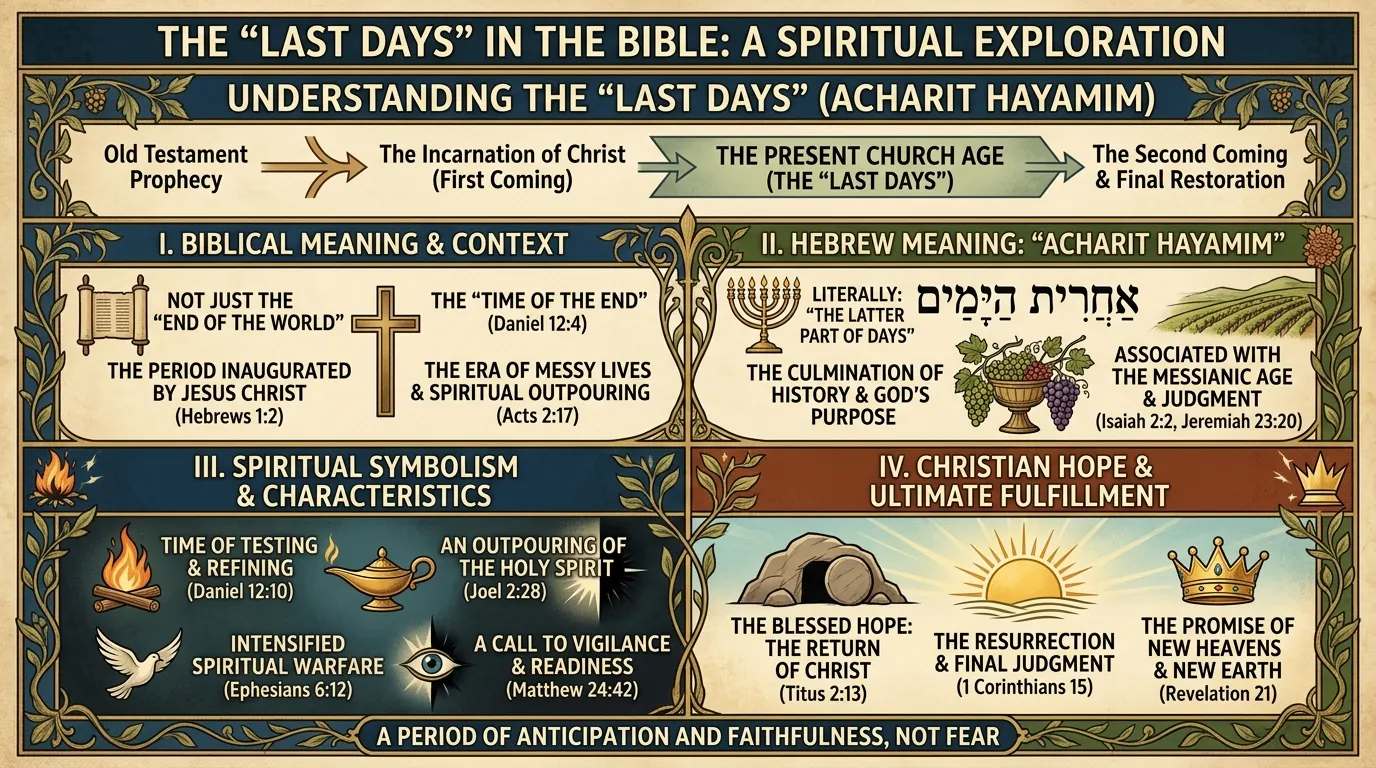
“Are we living in the last days?” The question surfaces every time the news turns dark — wars, earthquakes, moral collapse, rumors of worse. Christians have asked it in every century, and the Bible’s answer is more surprising than most expect: yes — and you have been living in them for two thousand years. Peter, preaching at Pentecost, declares that Joel’s prophecy of the last days is being fulfilled “in the last days” — right then, in the first century. The last days are not a future crisis. They are the era we inhabit.
This reframes everything. The Bible’s teaching on the last days is not primarily a puzzle to solve but a life to live. It is pastoral before it is prophetic: a call to readiness, holiness, and hope for people who live between Christ’s first coming and His second. This article takes that pastoral approach — less timeline, more discipleship.
Already in the Last Days: The New Testament’s Claim
The New Testament writers are unanimous and explicit. Peter at Pentecost: “This is what was uttered through the prophet Joel: ‘And in the last days it shall be…'” The writer of Hebrews: “In these last days he has spoken to us by his Son.” John: “Children, it is the last hour.” Paul to Timothy: “Understand this, that in the last days there will come times of difficulty.”
The logic is clear: the last days began with Christ’s first coming and continue until His return. The resurrection and Pentecost were the opening acts of the end. We are not waiting for the last days to start. We are living in them — which means the Bible’s descriptions of the last days are descriptions of our time, not just someone else’s future.
This should sober us without panicking us. Every generation that has tried to pinpoint the end by matching headlines to prophecy has been wrong, because the signs — wars, famines, earthquakes, deception — characterize the whole era, not its final week. Jesus said these things “must take place, but the end is not yet.” The last days are long. They are the church’s entire earthly lifetime. The question is not “how much time is left?” but “how should we live in the time we have?”
Times of Difficulty: Paul’s Portrait
Paul’s description of the last days in 2 Timothy 3 is uncomfortably familiar: “People will be lovers of self, lovers of money, proud, arrogant, abusive, disobedient to their parents, ungrateful, unholy, heartless, unappeasable, slanderous, without self-control, brutal, not loving good, treacherous, reckless, swollen with conceit, lovers of pleasure rather than lovers of God, having the appearance of godliness, but denying its power.”
Read that list slowly and it reads like a commentary on the evening news — and on the human heart in every age. Paul’s point is not that any single generation is uniquely wicked. It is that the last days will be marked by a particular kind of religious decay: godliness as appearance, power denied. The danger is not only outside the church. It is inside — people who keep the form while losing the force.
Paul’s counsel to Timothy is the model for ours: “Avoid such people” — and then, positively: “But as for you, continue in what you have learned.” The answer to last-days difficulty is not anxiety but anchoring: hold to Scripture (“able to make you wise for salvation”), hold to the gospel, hold to godly examples. The times may be difficult. The resources are sufficient. They always have been.
The Wedding Parables: Readiness as a Way of Life
Jesus teaches last-days readiness through wedding imagery, and the parables are pointed. In the parable of the ten virgins, five are wise and five are foolish; the difference is oil — preparation. The bridegroom is delayed. The foolish run out. The door shuts. “Watch therefore, for you know neither the day nor the hour.” Readiness is not a last-minute scramble. It is a lifestyle of kept lamps.
The parable of the talents presses the active side: the master entrusts resources and expects them multiplied. The servant who buries his talent — playing it safe, doing nothing — is condemned. Readiness, in Jesus’ teaching, is not passive waiting. It is faithful working. The church in the last days is not a bunker. It is a business — the Father’s business — conducted with diligence until the Master returns.
And the parable of the faithful servant adds the ethical dimension: the servant who says “my master is delayed” and begins to beat his fellow servants will be cut in pieces. Delay is not permission for cruelty. The long last days are not an excuse to mistreat people because the end seems far off. They are the arena in which faithfulness is proven — precisely because the end seems far off.
Scoffers and the Promise of His Coming
Peter addresses the skepticism the long delay produces: “Scoffers will come in the last days with scoffing, following their own sinful desires. They will say, ‘Where is the promise of his coming? For ever since the fathers fell asleep, all things are continuing as they were.'” Two thousand years of apparent delay make the question sharper, not duller.
Peter’s answer is twofold. First, God’s perspective on time differs from ours: “With the Lord one day is as a thousand years, and a thousand years as one day.” The delay is not divine forgetfulness. Second, the delay is mercy: “The Lord is not slow to fulfill his promise as some count slowness, but is patient toward you, not wishing that any should perish, but that all should reach repentance.” Every day of delay is a day of grace — another opportunity for the lost to come home.
This transforms how we experience the waiting. The last days are not God’s slow clock. They are God’s open door. The same patience that frustrates our curiosity is saving our neighbors. And Peter draws the practical conclusion: “Since all these things are thus to be dissolved, what sort of people ought you to be in lives of holiness and godliness, waiting for and hastening the coming of the day of God?” Holiness, godliness, and a strange phrase — “hastening” the day. Our prayers, our witness, our readiness somehow participate in bringing it closer.
Living Ready: The Last-Days Rule of Life
So what does a last-days life look like, practically? The New Testament’s answer is remarkably consistent and remarkably ordinary. It does not involve survival bunkers, date calculations, or headline exegesis. It involves the ancient disciplines, practiced with eschatological seriousness.
Stay in the word. “All Scripture is breathed out by God” — Paul writes this in the same letter where he describes the last days. The antidote to last-days confusion is first-days revelation. Stay in prayer. “The end of all things is at hand; therefore be self-controlled and sober-minded for the sake of your prayers.” Stay in love. “Above all, keep loving one another earnestly.” Stay in witness. “This gospel of the kingdom will be proclaimed throughout the whole world as a testimony to all nations, and then the end will come.” The church’s mission is the clock of the last days — and we wind it.
And stay in hope. The last days end not with dissolution but with arrival: “the appearing of the glory of our great God and Savior Jesus Christ.” Titus calls it “the blessed hope.” The Christian’s posture toward the future is not dread but longing — the longing of the bride for the bridegroom, of the servant for the master’s return, of the creation for its liberation. “Amen. Come, Lord Jesus” is not a cry of despair. It is the church’s wedding vow, renewed daily.
The last days, in the end, are not a problem to be solved. They are a promise to be lived in. Christ has come. Christ is coming. Between those two comings lies our lifetime — the last days, the days of grace, the days in which lamps are kept burning, talents are multiplied, and the gospel goes to the nations. Live them ready. Live them holy. Live them hopeful. The Bridegroom is on His way.
The church’s historic reflection on the final judgment — the event toward which the last days point — is summarized in the article on the Last Judgment, tracing how Christians have understood the day when the last days reach their end.










