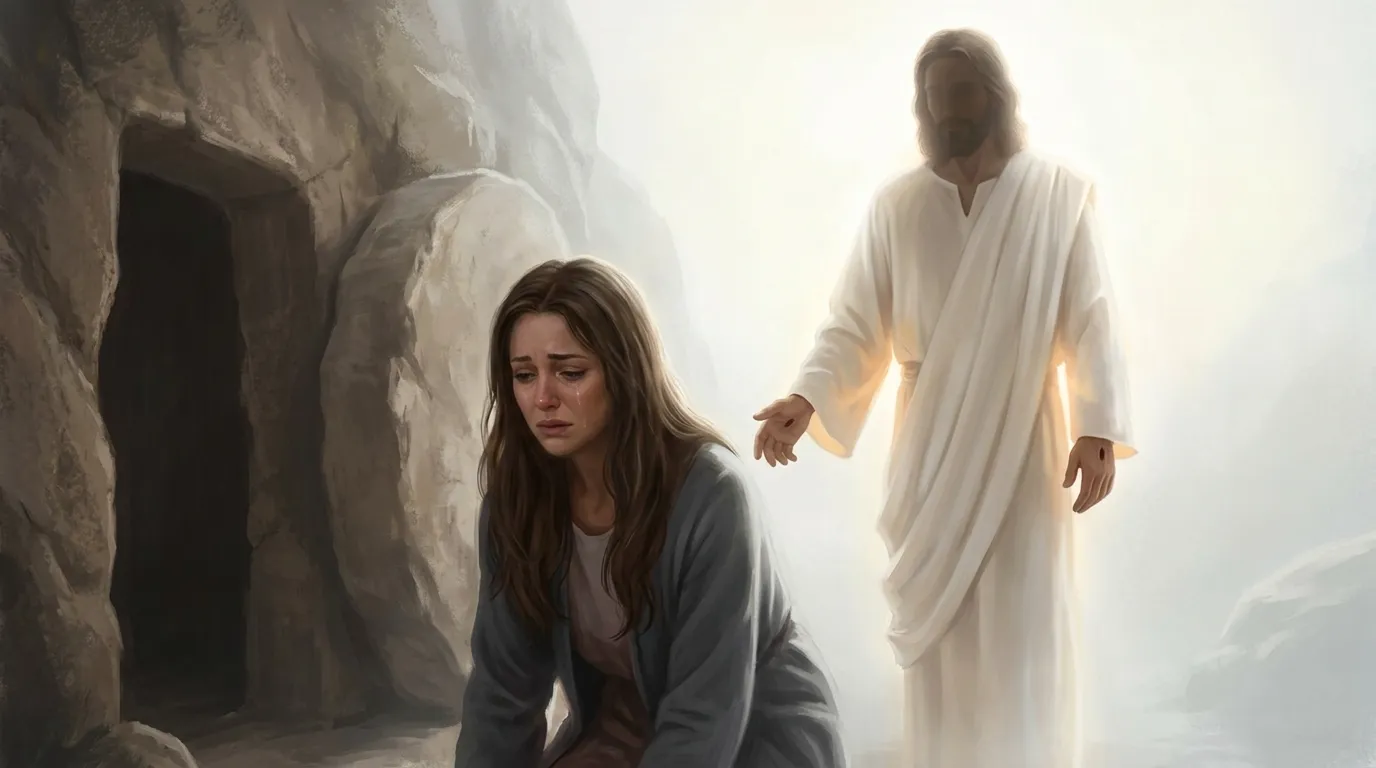
The resurrection is not a single event in the Gospels. It is a sequence — a series of appearances spread over forty days, each one tailored to the person who receives it. Mary Magdalene weeping at the tomb. Two disciples walking to Emmaus. Thomas demanding evidence. Seven fishermen eating breakfast on a beach. More than five hundred at once. The risen Jesus does not appear generically. He appears personally, and the pattern of His appearances is itself a revelation: this is how the risen Christ still meets people.
This article walks through the appearances in order, asking at each stop: whom did He meet, how did He meet them, and what does the meeting teach? The resurrection is the foundation of the Christian faith — but the appearances are its pastoral application.
Mary Magdalene: The First Witness
It is no small thing that the first witness of the resurrection is Mary Magdalene — a woman, in a culture where women’s testimony was discounted, and a woman with a past, from whom Jesus had cast seven demons. She comes to the tomb while it is still dark, finds it empty, and weeps. Jesus stands beside her and she mistakes Him for the gardener — until He speaks one word: “Mary.” She turns and cries, “Rabboni!”
The personal call is everything. Mary does not recognize the risen Christ by sight but by voice — the voice that had called her out of darkness before. And Jesus gives her the first apostolic commission: “Go to my brothers and say to them…” The first preacher of the resurrection is a formerly demon-possessed woman. The church has never gotten over the scandal of it, and it should not. Grace chooses the unlikely, and the unlikely become its heralds.
There is also a gentle rebuke in the encounter: “Do not cling to me.” Mary wants to hold onto the Jesus she knew. But the resurrection is not a return to the old relationship. It is the beginning of a new one — ascended, universal, Spirit-mediated. Faith must learn to hold Christ in the new way, not clutch at the old.
Emmaus: The Slow-Burning Hearts
Two disciples walk the seven miles to Emmaus, discussing the catastrophe in Jerusalem. Jesus joins them, “but their eyes were kept from recognizing him.” What follows is the Bible’s great model of how Scripture leads to Christ: “Beginning with Moses and all the Prophets, he interpreted to them in all the Scriptures the things concerning himself.” Their hearts burn within them — and still they do not recognize Him.
Recognition comes at the table, in the breaking of bread. Then He vanishes. And the two run seven miles back to Jerusalem in the dark to tell the others. The Emmaus road teaches that Christ is often nearest when He seems most absent — walking beside us in our confusion, opening the Scriptures to our blindness, revealed in the ordinary sacrament of a shared meal. Many believers have walked Emmaus without knowing it: the burning heart before the open eyes.
Thomas: The Honest Doubter
Thomas misses the first appearance and refuses secondhand faith: “Unless I see in his hands the mark of the nails, and place my finger into the mark of the nails, and place my hand into his side, I will never believe.” A week later, Jesus appears and offers exactly what Thomas demanded: “Put your finger here, and see my hands.” Thomas collapses into the highest confession in the Gospels: “My Lord and my God!”
Jesus does not shame Thomas for his conditions. He meets them — and then gently widens the frame: “Have you believed because you have seen me? Blessed are those who have not seen and yet have believed.” Thomas’s doubt becomes the charter for every later believer. We are the blessed ones — believing without seeing, trusting the testimony of those who saw. And Thomas’s confession stands as the theological summit of the appearances: the resurrection proves not just survival, but deity. “My Lord and my God.”
Galilee: Breakfast and Restoration
Seven disciples go fishing — back to the old life, it seems — and catch nothing. At dawn, a figure on the shore tells them to cast the net on the right side. The catch is enormous: 153 fish. John recognizes Him first: “It is the Lord!” Peter, impetuous as ever, jumps in and swims. On the beach, Jesus has a charcoal fire going, with fish and bread. “Come and have breakfast.”
Then the restoration. Three times Jesus asks Peter, “Do you love me?” — one for each denial. Three times Peter answers, and three times Jesus commissions: “Feed my lambs… Tend my sheep… Feed my sheep.” The charcoal fire echoes the courtyard fire where Peter denied Him; the three questions answer the three denials. This is what the risen Christ does with failures: He does not merely forgive them. He reinstates them. Peter the denier becomes Peter the shepherd, over breakfast, by a lake, at dawn.
Damascus: The Last and Least Likely Witness
Paul insists his own encounter belongs on the list: “Last of all, as to one untimely born, he appeared also to me.” On the road to Damascus, the persecutor becomes the apostle in a flash of light and a voice: “Saul, Saul, why are you persecuting me?” The risen Christ appears not to a friend but to an enemy — not to comfort a disciple but to conscript a hunter.
The Damascus appearance extends the pattern of the forty days and universalizes it. If Christ can appear to Saul the persecutor, He can appear to anyone — which is precisely Paul’s point when he calls himself the foremost of sinners, saved as a pattern “for those who were to believe in him for eternal life.” No one is beyond the reach of the risen Christ. The appearances began with a weeping woman at a tomb and ended with a murderous Pharisee on a highway. Between those two poles, there is room for every witness — including you.
The Commission and the Ascension
The appearances culminate in commissioning. On a mountain in Galilee, Jesus declares: “All authority in heaven and on earth has been given to me. Go therefore and make disciples of all nations.” The resurrection is not a private consolation. It is a public authorization. The risen Christ claims universal authority and sends His witnesses to the ends of the earth — with the promise, “I am with you always, to the end of the age.”
Paul adds that Jesus “appeared to more than five hundred brothers at one time” — a claim his readers could verify, since “most of whom are still alive.” The resurrection is presented not as a mystical experience but as a public fact, witnessed by crowds. Then, forty days after the resurrection, He ascends: lifted up, received by a cloud, with the angels’ promise, “This Jesus… will come in the same way as you saw him go.”
What the Appearances Teach About the Risen Life
Several threads run through all the appearances. First, continuity and transformation: it is the same Jesus — the wounds visible, the voice recognizable — yet transformed, appearing in locked rooms, vanishing at will. The resurrection body is both continuous and glorified: a preview of what awaits believers. “We shall be like him.”
Second, mission: every appearance sends. Mary to the brothers, the Emmaus two to Jerusalem, the disciples to the nations. Encounter with the risen Christ is never terminal. It is always commissioning. The church exists because witnesses could not keep quiet.
Third, peace: His first word in the upper room is “Peace be with you” — repeated, as if He knows one saying will not be enough. The resurrection is God’s declaration that the war is over, the debt is paid, the estrangement is ended. Peace is not the absence of trouble. It is the presence of the risen Christ in the middle of it.
And finally, hope: “Because I live, you also will live.” The resurrection of Jesus is not an isolated miracle. It is the firstfruits — the first sheaf of the harvest, guaranteeing the rest. Every believer’s future is contained in that empty tomb. Death has been defeated in principle; its final abolition is a matter of time. The appearances are the evidence. The promise is the inheritance.
The historical and theological dimensions of the event are examined in the study of the Resurrection of Jesus, covering the biblical accounts, the early creeds, and two millennia of reflection on the church’s founding claim.










