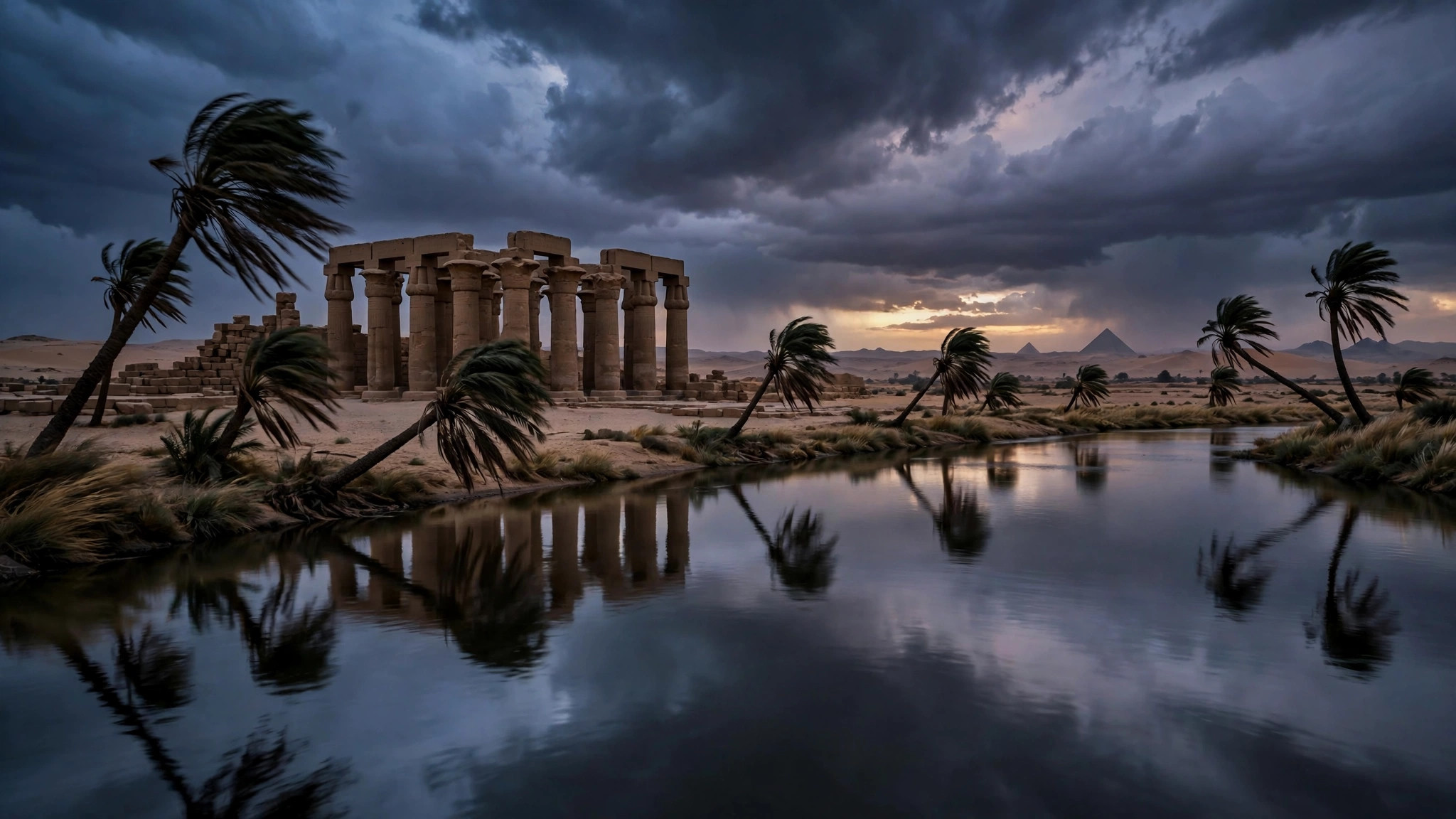
The sun rose over the Nile the way it always had, gold on slow green water, reeds bowing in the morning breeze. Fishermen pushed their boats out. Women came down the steps with jars for the day’s water. Then an old man with a wooden staff walked to the riverbank, lifted his arm, and struck the water — and the great river of Egypt turned red as blood.
By evening the fish were floating belly-up along the banks, and the stench had settled over the whole land. The Egyptians dug wells around the river just to find water fit to drink, because the Nile — the lifeblood of their civilization, the god they worshipped — had become a river of death. And in the palace, Pharaoh turned and went into his house, and did not take this to heart either. That was the first of ten.
Blood on the Nile: Where It All Started
The plagues did not begin with water turning to blood. They began four centuries earlier, with a promise God made to an old man staring at the stars, and with a pharaoh who came to power “who did not know Joseph” (Exodus 1:8). The children of Israel had multiplied in the land of Goshen until Egypt looked at them and felt afraid. So Egypt did what fearful empires always do: it tried to manage the problem. Slavery. Then infanticide — every Hebrew boy thrown into the Nile. The river that would one day run red had already drunk the blood of murdered infants.
God raised up a deliverer in the unlikeliest place: the palace of the murderer. Moses, the Hebrew baby pulled from the Nile in a basket, grew up as a prince of Egypt, fled to the desert as a murderer, and came back as a prophet of eighty years old carrying nothing but a staff and a message. The message was not “let’s negotiate.” It was “Let my people go” — and the name on the demand was the name of Israel’s God: Yahweh.
Pharaoh’s answer was the question that started everything: “Who is the LORD, that I should obey his voice?” (Exodus 5:2). The ten plagues are God’s answer to that question. They are not random disasters. They are a sentence of judgments — the Hebrew word for them is makkot, strikes or blows — delivered by what Scripture calls a yad chazakah, a strong hand (Exodus 13:9). And Exodus 12:12 tells us exactly what they were: “Against all the gods of Egypt I will execute judgments: I am the LORD.” Every plague was aimed at something Egypt worshipped.
Ten Strikes, One Message
The plagues came in waves, each one rising in severity, each one answering Pharaoh’s hardness — and each one striking at the gods Egypt trusted.
The first wave fell through the hands of Aaron’s staff. The Nile became blood (Exodus 7:14–25). Then frogs swarmed the land — into ovens, into bedrooms, into the kneading bowls (Exodus 8:1–15). Then gnats from the dust of the earth, covering man and beast (Exodus 8:16–19). Here is the turning point most readers miss: Pharaoh’s magicians copied the first two plagues with their secret arts. But at the gnats they failed, and they said to Pharaoh, “This is the finger of God.” (Exodus 8:19). The counterfeiters had reached their limit. Pharaoh’s heart stayed hard anyway.
The second wave came with a new feature: distinction. God set the land of Goshen apart. Swarms of flies tormented Egypt while Goshen stayed clear (Exodus 8:22). Pestilence struck Egypt’s livestock while Israel’s herds stood untouched (Exodus 9:4). Boils broke out on man and beast — and this time the magicians themselves were afflicted, “for the boils were on the magicians” (Exodus 9:11). The gods of Egypt — the frog-goddess Heqet, the cattle-god Apis — sat silent while their worshippers suffered. And between the waves, God named His purpose: “I will make a distinction between my people and your people” (Exodus 8:23).
The third wave was announced, not just delivered. Hail came with a warning: bring your livestock in, and whoever feared the word of the LORD hurried his servants home (Exodus 9:20). Some Egyptians believed by now. Then locusts, called by an east wind, covered the face of the whole land and ate everything the hail had left (Exodus 10:13–15). Then darkness — thick darkness that could be felt, for three days — falling on the nation that worshipped Ra, the sun god (Exodus 10:21–23). In Goshen, “all the children of Israel had light in their dwellings” (Exodus 10:23). The sun god could not light his own temple.
And then the final night. At midnight the LORD struck every firstborn in Egypt, from Pharaoh’s heir to the prisoner in the dungeon. That night God gave Israel a different kind of sign: a lamb, slain and eaten in haste, its blood on the doorposts. “When I see the blood, I will pass over you,” God said (Exodus 12:13). Judgment fell on Egypt; grace marked the doors of the obedient. That night Pharaoh called for Moses and said, Go.
What God Was Proving
Pharaoh asked, “Who is the LORD?” The plagues are the ten-part answer, and Scripture keeps pointing us back to what God was proving.
“The Egyptians shall know that I am the LORD, when I stretch out my hand against Egypt and bring out the children of Israel from among them.” (Exodus 7:5)
The knowledge of God was the point — for Egypt and for Israel. God told Moses plainly why Pharaoh had been left on the throne this long:
“For this very purpose I have raised you up, that I may show my power in you, and that my name may be declared in all the earth.” (Exodus 9:16)
Moses preached this verse to Pharaoh as a sermon, not as comfort. The whole earth was meant to hear. And when the plagues were over, God commanded Israel to retell them — not as ancient history but as present instruction:
“That you may tell in the hearing of your son and your son’s son the mighty things I have done in Egypt, and my signs which I have done among them, that you may know that I am the LORD.” (Exodus 10:2)
Moses later summarized the plagues as “signs and wonders, great and awesome” by which God brought Israel out (Deuteronomy 6:22). And the New Testament refuses to let us file them away as mere history. Paul writes that Israel’s wilderness story happened as examples — “written for our admonition” (1 Corinthians 10:11). The plagues are not just what God did to Egypt. They are what God shows the church about Himself: that He judges sin, that He keeps His promises, that He distinguishes between those who belong to Him and those who do not, and that no power on earth — no army, no magic, no god of the Nile — can stand against the strong hand of the LORD.
Your Egypt Today
So where are you in this story? The Bible treats Egypt as more than a place on the map. Egypt is a picture of bondage — the slavery of sin, the bricks-without-straw grind of a life that demands more than it gives. Some of us are still making bricks there. The plagues say: God hears the groaning. He remembers His covenant. He comes down.
The plagues are also a warning about the hard heart. Read Exodus carefully and you will see a pattern: Pharaoh hardened his own heart again and again (Exodus 8:15, 32), and then Scripture says God hardened Pharaoh’s heart (Exodus 9:12). The order matters. God confirmed the direction Pharaoh had already chosen. A heart that refuses to soften eventually loses the ability to soften. Every small “no” to God is practice for a bigger one.
And the plagues end with the Passover lamb — and this is where the story walks straight into the New Testament. Paul calls Christ “our Passover” who was sacrificed for us (1 Corinthians 5:7). The blood on the doorposts said: judgment is coming, but it will pass over the house that trusts the lamb. The cross says the same thing, forever.
Finally, remember Goshen. While darkness lay on Egypt, Israel had light. God can judge a world and still shelter His people in the middle of it. The plagues teach us not only to fear the God who judges, but to rest in the God who distinguishes, delivers, and remembers His own.
Questions About the Plagues
Why did God harden Pharaoh’s heart?
Scripture presents both sides honestly: Pharaoh hardened his own heart first, repeatedly (Exodus 8:15, 32; 9:34), and God confirmed that hardness (Exodus 9:12; 10:1). Romans 9:17–18 explains the theology: God raised Pharaoh up to display His power, and “He has mercy on whom He wills, and whom He wills He hardens.” The hardening was judicial — God giving Pharaoh over to the direction he had chosen — so that Egypt and Israel would both know that the LORD is God.
Were the plagues natural disasters or miracles?
Some scholars note natural parallels — red algae can discolor the Nile, which can trigger frog migrations and insect plagues. But the biblical account will not let the plagues be reduced to nature. Each plague came at Moses’ announced word, struck precisely, stopped at Moses’ prayer, and — crucially — distinguished between Egypt and Goshen (Exodus 8:22; 9:4, 26). Nature does not honor borders or obey prophets. The plagues were miracles that may have used natural instruments, all under God’s sovereign hand.
What do the plagues teach us about God’s character?
They teach that He is both just and patient. Just, because He judged real evil — slavery, infanticide, idolatry, and a king who claimed to be a god. Patient, because He warned before each wave, gave Pharaoh nine chances to repent, and even spared the Egyptians who heeded His word (Exodus 9:20). The plagues reveal a God who does not rush to judgment, does not excuse sin, and does not fail to keep His promises.
The Nile ran red, the frogs came, the darkness fell — and Israel walked out free, carrying Egypt’s gold and the knowledge of the LORD. Four thousand years later the story still asks Pharaoh’s question of every reader: Who is the LORD? The ten plagues are God’s answer. And if you have trusted the Passover Lamb, His answer is also your deliverance. For more historical and scholarly background on the plagues narrative, see the Wikipedia article on the Plagues of Egypt.










