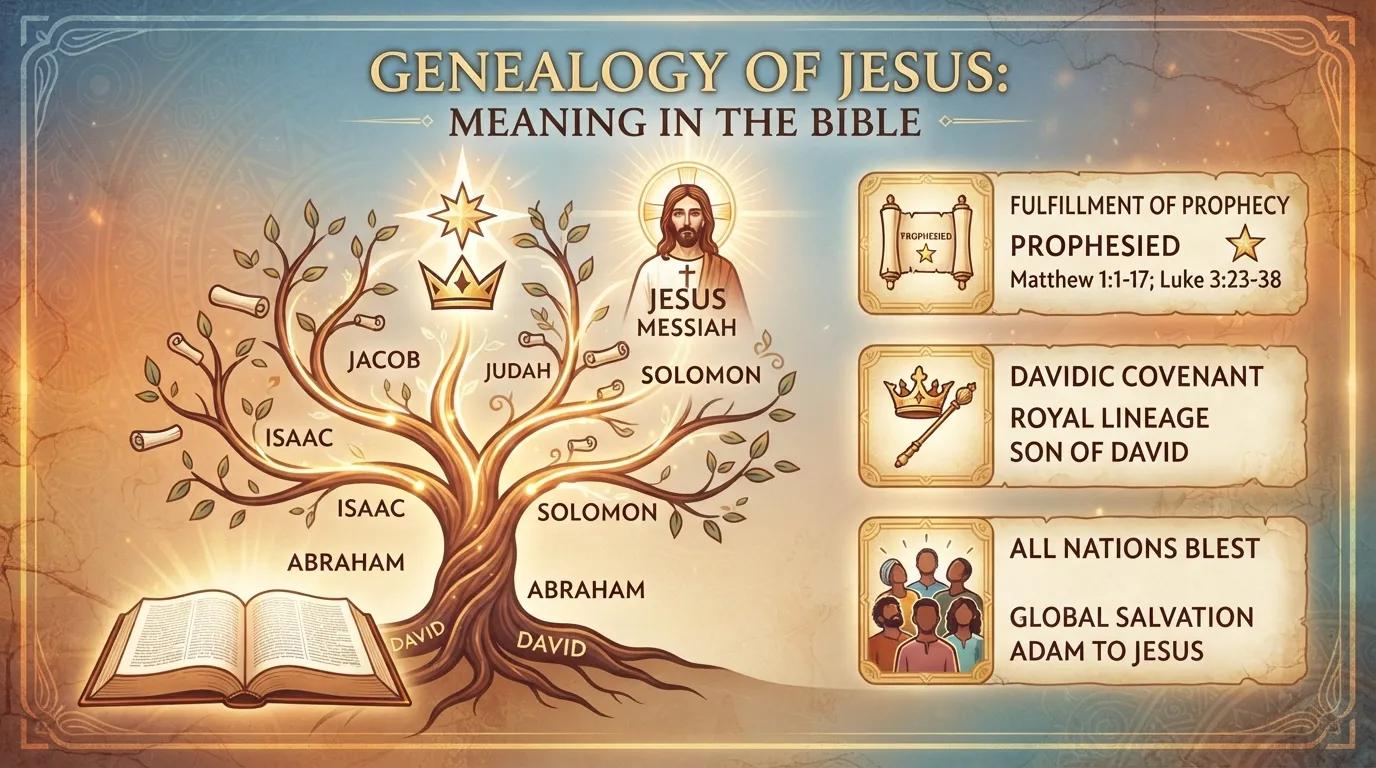
Most readers skip them. A long column of unfamiliar names, page after page, and the story seems to stall. But the genealogy of Jesus meaning in the Bible is much deeper than a list of names. It is a story in miniature — of God’s faithfulness, human weakness, grace, and the coming of the promised Messiah. Matthew opens his Gospel with Jesus’ family line. Luke gives one too, presented differently. Together they connect Jesus to Abraham, David, the exile, and ultimately Adam — and they show that Jesus did not appear in history by accident. His coming was the destination of promises carried through generations of waiting.
Act One: Abraham to David
Matthew 1:1 opens with a declaration: “The book of the genealogy of Jesus Christ.” He then connects Jesus with Abraham and David, the two figures most central to God’s covenant promises. The word translated “genealogy” is related to the Greek word genesis — origin, beginning, coming into being. Matthew is beginning a story about Jesus’ place in God’s unfolding plan, and his opening language echoes the language of beginnings in Genesis itself.
Matthew begins with Abraham because God’s covenant with Abraham is central to redemption. God called Abraham from his homeland and promised to make him a great nation and to bless the nations through him (Genesis 12:1–3). Jesus’ genealogy reminds readers that Christ’s mission is bound to that ancient promise. Paul later explains that the promise given to Abraham finds its fulfillment in Christ and extends to those who belong to Him through faith (Galatians 3:16, 29).
Matthew also emphasizes Jesus’ connection to David. David was Israel’s king, and God made a covenant with him concerning his descendants and kingdom (2 Samuel 7:12–16). The prophets spoke of a coming ruler from David’s line — Isaiah pictured a child who would sit on David’s throne (Isaiah 9:6–7). By identifying Jesus as the Son of David, Matthew connects Him with that royal expectation. The genealogy is organized in three major sections — Abraham to David, David to the exile, and the exile to Jesus (Matthew 1:17) — so readers can see the great stages of Israel’s history at a glance.
Act Two: David to Exile
The second section of Matthew’s genealogy runs from Israel’s golden age into its darkest hour. The exile in Babylon was a painful period: Jerusalem destroyed, many people carried away, the nation experiencing deep loss. Yet God’s promises did not disappear. The genealogy continues after the exile and eventually reaches Jesus.
That continuation is the message. Human failure and national suffering did not cancel God’s purposes. The people named in this stretch were not all perfect — the biblical story includes people who made serious mistakes. David himself committed grave sins, yet God continued His redemptive work through the family line connected with him. This does not mean sin is unimportant; Scripture takes sin seriously. It means human failure does not make God incapable of carrying out His purposes.
Act Three: Exile to Jesus
The final section moves from the exile to Jesus Himself. Generations passed. Kingdoms rose and fell. Israel experienced victory, failure, exile, and restoration. And God’s promises continued. God’s faithfulness does not depend on human circumstances remaining stable — a truth that can encourage believers who are waiting on God in difficult seasons.
Matthew includes several women in this genealogy, which was unusual for ancient family records: Tamar, Rahab, Ruth, and “the wife of Uriah,” referring to Bathsheba (Matthew 1:3, 5–6). Their stories are different, and each deserves careful biblical context. Rahab was a woman from Jericho who responded to the God of Israel with faith (Joshua 2; Hebrews 11:31). Ruth was a Moabite woman who became part of Israel’s story and showed remarkable loyalty to Naomi (Ruth 1–4). Their inclusion highlights something beautiful: God’s redemptive story includes people whom society might overlook. Grace reaches unexpected people.
The Same Story Told Backward: Luke’s Genealogy
Luke’s genealogy appears after Jesus’ baptism and traces His ancestry backward (Luke 3:23–38). Instead of stopping at Abraham, Luke goes all the way back to Adam, the first man. That gives Luke’s presentation a wider human focus. Matthew emphasizes Jesus’ connection to Abraham and David; Luke places Jesus within the story of humanity as a whole. This fits Luke’s Gospel, which repeatedly highlights God’s concern for people from different backgrounds. Jesus came as Savior not only for one family or nation but for people from every nation.
The two genealogies differ in several names and details, and Christians have offered various explanations over the centuries. One common explanation is that Matthew emphasizes Jesus’ legal or royal line through Joseph, while Luke may present another family line; another traditional explanation connects Luke’s genealogy with Mary. The Bible does not explicitly explain every difference, so Christians should be careful not to present any one proposed explanation as certain biblical fact. What Scripture clearly teaches is that both Gospel writers connect Jesus with Israel’s history and establish His place within God’s redemptive story. The important point is not to force details Scripture does not explain, but to focus faithfully on what the texts actually emphasize.
There is a further lesson in the very existence of two genealogies. God did not give us one polished, harmonized family tree. He gave us two witnesses, each telling the story with its own emphasis — Matthew with the covenant promises to Abraham and David, Luke with the whole human family back to Adam. Together they show that Jesus belongs both to Israel’s particular story and to humanity’s universal story. Neither perspective cancels the other. Both are needed to see the full picture of who He is.
What Family Lines Meant in Ancient Israel
In the Hebrew Bible, genealogies were often introduced with expressions such as “these are the generations.” Family records established identity, inheritance, tribal relationships, and connections to God’s covenant promises. So the biblical meaning behind genealogy goes far beyond knowing one’s relatives. It points to identity, heritage, covenant, belonging, and God’s work through generations.
That is why the genealogy can speak so directly to everyday Christian life. Imagine someone from a broken family wondering whether their family’s mistakes will define their future. The genealogy points toward a different hope: God can work through broken histories without approving the sins within them. Imagine someone faithfully praying for children or grandchildren, never knowing how those prayers and that example will influence future generations. The genealogy reminds us that God sees the larger story even when we see only one chapter. Imagine someone who feels insignificant because they hold no important position. Most names in Matthew’s list are not famous today — yet each had a meaningful place in God’s story without becoming famous.
Three Reminders for the Road
First, the genealogy is a reminder of God’s faithfulness. Abraham did not see everything God would eventually do through his descendants. David did not see the full story of Christ’s kingdom. Likewise, Christians today may not understand how every part of their lives fits into God’s purposes. Faithfulness across generations is God’s pattern.
Second, it is a reminder that your past does not have the final word. Jesus’ family history includes complicated stories. That can encourage someone who feels ashamed of their own past. The genealogy does not teach that sin does not matter. Rather, the gospel shows that God’s grace is greater than the brokenness people bring to Him.
Third, it is a reminder that God values ordinary people. A parent raising children, a believer serving quietly at church, someone faithfully helping a neighbor — none of them may ever become famous, yet faithful living still matters to God. Your legacy is not simply money, property, or accomplishments. It includes your character, prayers, kindness, forgiveness, service, and faithfulness. A simple conversation with a child about Jesus may have influence that lasts for years.
So trust God when you cannot see the whole story. Take your spiritual heritage seriously — if parents, grandparents, or mentors taught you about Christ, give thanks for their influence, and if you did not grow up in a Christian home, remember that your past does not prevent you from following Jesus faithfully today. Remember that grace is part of the gospel: Jesus’ genealogy contains stories of weakness, suffering, outsiders, and complicated family histories, and Christ came into a broken world to bring redemption — not because humanity had already become perfect.
The main message is that Jesus Christ stands at the center of God’s unfolding redemptive story. Matthew connects Him with Abraham and David; Luke traces Him back to Adam. Together, the genealogies place Jesus within the story of Israel and of humanity. They are not a boring introduction. They are a quiet testimony to God’s faithfulness, grace, promise, and redemption. You may not understand everything God is doing in your life. You may come from a complicated family. You may be waiting for an answer to prayer or wondering whether your quiet faithfulness matters. The genealogy of Jesus gives you reason to hope: God sees the whole story when you can see only one part, and His grace is still at work. For a scholarly overview of the two Gospel lists, their structure, and the long history of attempts to reconcile them, the Wikipedia article on the genealogy of Jesus gathers the key theories and debates in one place.










