Have you ever looked at your family tree and wondered how the people before you shaped your story? A family tree can show where we came from, but the family tree of Jesus in the Bible shows much more than ancestry.
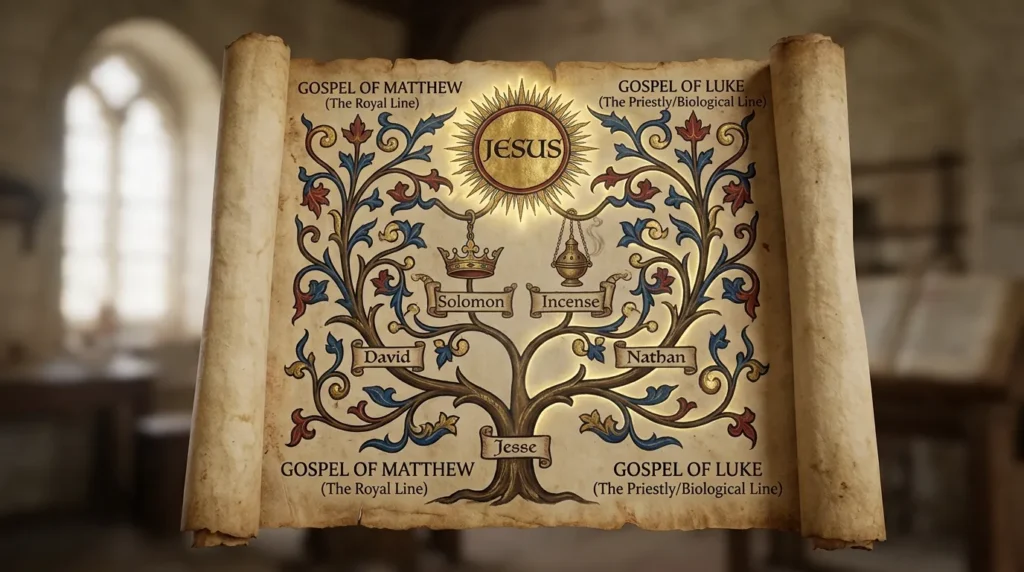
The Bible gives two main genealogies of Jesus: Matthew 1:1–17 and Luke 3:23–38. At first, these lists of names may seem hard to read. Yet every name points to an important truth about God’s plan.
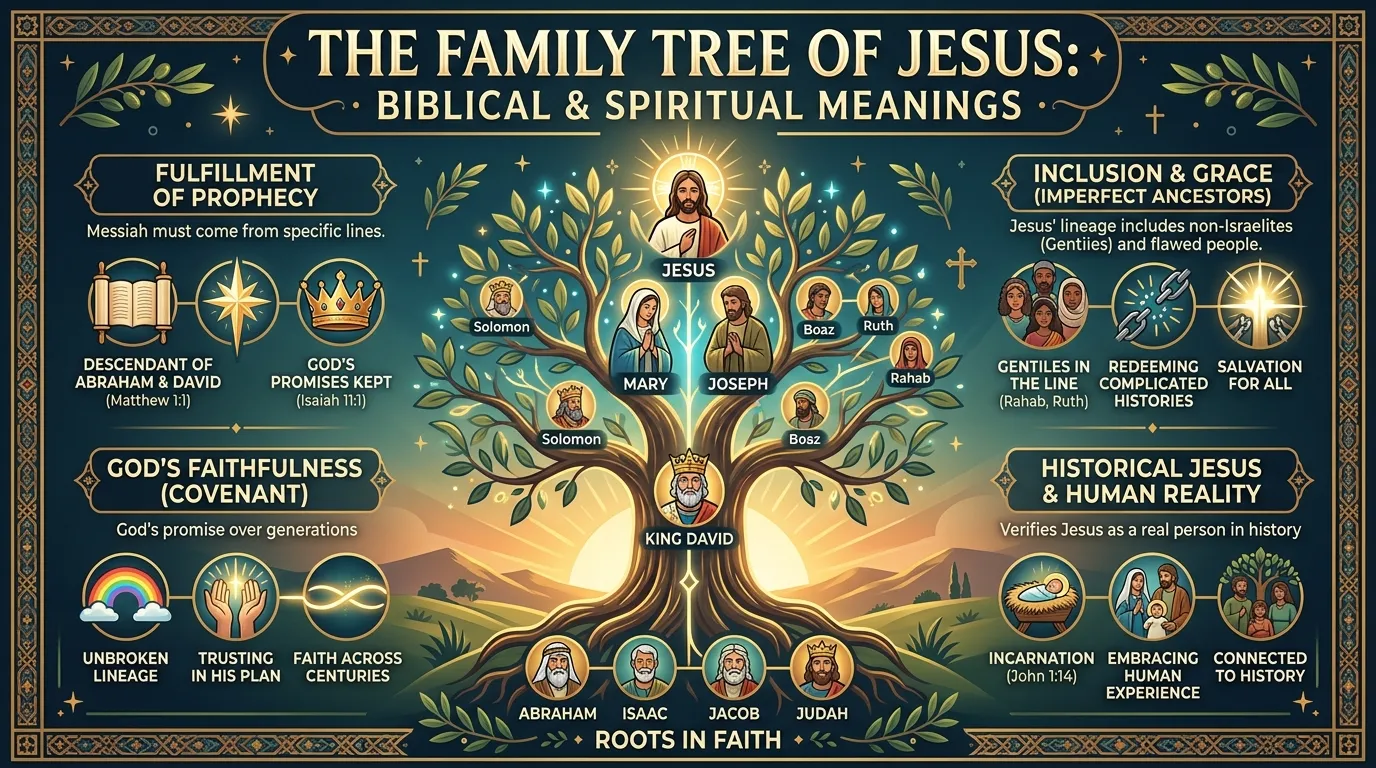
The family tree of Jesus meaning in the Bible is deeply connected to God’s promises, Jesus’ identity as the Messiah, the line of David, and God’s faithfulness across generations.
Jesus did not appear suddenly in history. His birth came through a story that began long before Bethlehem. God worked through families, kings, ordinary people, suffering, failure, and hope to bring His promise to fulfillment.
The genealogy also reminds us that God can work through imperfect people. Jesus’ ancestors included people with painful and complicated stories. Still, God continued His plan.
So, what does the family tree of Jesus mean in the Bible?
It points us to God’s faithfulness, Jesus’ identity, His connection to David and Abraham, and the hope of salvation for all people.
Biblical Meaning of Family Tree of Jesus in the Bible
The biblical meaning of the family tree of Jesus begins with God’s promises.
Matthew opens his Gospel with these words:
Matthew 1:1: “The book of the generation of Jesus Christ, the son of David, the son of Abraham.”
This opening is very important. Matthew immediately connects Jesus with David and Abraham.
God promised Abraham that his descendants would become a great nation and that blessing would come through his family (Genesis 12:1–3).
God also made a special covenant with David. He promised that David’s royal line would continue and that his throne would have an enduring place in God’s plan (2 Samuel 7:12–16).
Jesus’ genealogy shows that these promises were not forgotten.
Jesus Is Connected to Abraham
Matthew traces Jesus’ family line back to Abraham.
Abraham was a man of faith. God called him to leave his homeland and trust Him.
Jesus being connected to Abraham shows that His story is part of God’s larger covenant plan.
This is one reason the genealogy is more than a list of names. It connects Jesus to the history of God’s people.
Jesus Is the Son of David
Another major meaning is Jesus’ connection to King David.
The title Son of David appears many times in the New Testament. People used it when speaking about Jesus as the promised Messiah.
For example, in Matthew 21:9, people cried:
“Hosanna to the Son of David!”
This connection matters because the Old Testament points toward a future ruler from David’s line.
The family tree therefore supports the Christian belief that Jesus is the promised King and Messiah.
Jesus Came Through a Real Human Family
The genealogy also shows that Jesus entered human history through a real family.
Matthew 1 records the line leading to Joseph, while Luke 3 gives another genealogy associated with Jesus’ earthly family. Christians have understood the relationship between these genealogies in different ways. Some see Matthew as emphasizing Joseph’s royal and legal line and Luke as reflecting another family line, often connected with Mary. Others explain the differences differently.
The Bible does not give a detailed explanation of every difference between the two lists. What is clear is that both genealogies connect Jesus with David and the history of Israel.
The Genealogy Includes Unexpected People
Matthew’s genealogy is especially striking because it mentions several women, including Tamar, Rahab, Ruth, and Bathsheba.
Their stories were very different.
Some experienced shame, loss, hardship, or difficult circumstances. Yet God’s plan continued through their lives.
This gives a powerful spiritual lesson:
God can bring His purposes through imperfect people and complicated family histories.
Your family story may contain things you would rather forget. But your past does not limit God’s ability to work in your life.
The Family Tree Shows God’s Faithfulness
Generation after generation appears in the genealogy.
Some names are famous. Others are almost unknown to modern readers.
But God knew every one of them.
This teaches us that God sees people whose names may never become famous.
A person may feel that his or her life is small. The genealogy of Jesus reminds us that one generation can be part of a much bigger story.
Family Tree of Jesus Hebrew Meaning
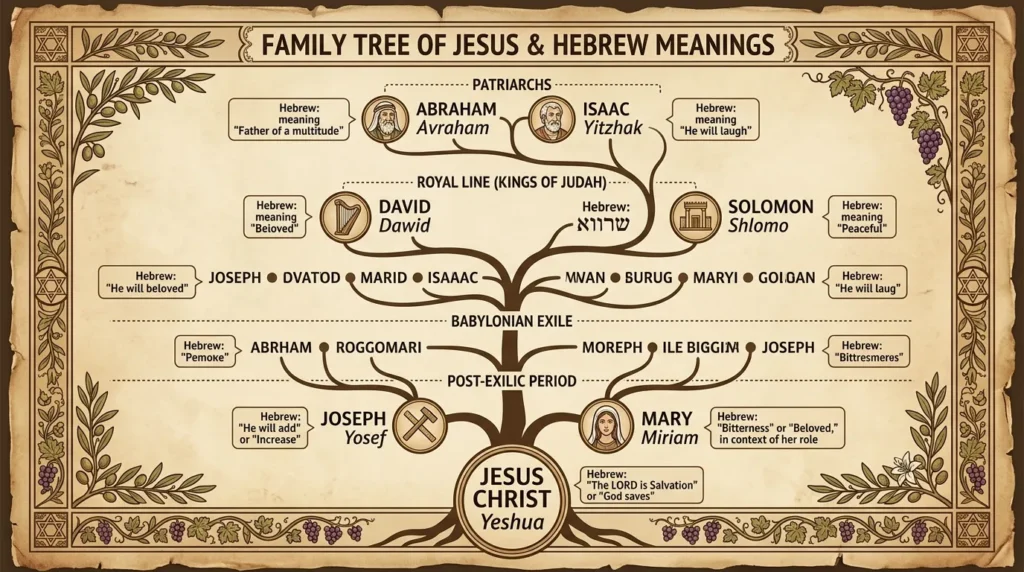
There is an important language point here.
The exact phrase family tree of Jesus is not a Hebrew phrase from the Bible. The New Testament was written primarily in Greek, and Matthew and Luke use Greek genealogical language when presenting Jesus’ ancestry.
Matthew begins with:
biblos geneseōs — “book of the genealogy” or “record of the generation” (Matthew 1:1).
The Greek word genea relates to a generation or family line, while genesis can refer to origin, beginning, or generation.
In the Hebrew Bible, family lines and ancestry are also very important. Hebrew uses words such as mishpachah (מִשְׁפָּחָה), meaning family, clan, or family group.
Another important Hebrew word is ben (בֵּן), meaning son. Biblical genealogies often use expressions such as “son of” when tracing a person’s family line.
The idea of house is also important. The Hebrew word bayit (בַּיִת) can mean house or household. In biblical language, a “house” can refer not only to a building but also to a family or dynasty.
This is especially meaningful with David. The house of David became an important biblical idea connected with God’s covenant promise.
So, there is no special Hebrew word meaning “Jesus’ family tree.” Instead, the biblical concept is built around generations, families, sons, households, tribes, and covenant lines.
The central message is that Jesus belongs to the story of God’s people and fulfills promises made throughout Scripture.
Spiritual Significance and Symbolism of Jesus’ Family Tree
The spiritual meaning of Jesus’ family tree reaches beyond genealogy.
It teaches several beautiful lessons about faith and spiritual growth.
God Works Through Generations
The genealogy reminds us that God’s work can continue across generations.
A parent may pray for a child. A grandparent may teach Scripture. A family may pass down faith through simple acts of love.
You may not see the full result today.
But God sees the whole story.
God Uses Imperfect People
Jesus’ family tree contains people with complicated histories.
That should give hope to anyone who feels unworthy because of past mistakes.
The genealogy does not hide the brokenness of human history. Instead, it shows that God can work in the middle of it.
This does not mean sin is unimportant. It means God’s grace is greater than human failure.
Jesus Brings Hope
The genealogy ultimately leads to Jesus.
Matthew moves from Abraham through many generations until he reaches Joseph and the birth of Christ.
The direction is important.
The story is moving toward Jesus.
For Christians, this points to the hope found in Christ. Human history contains pain, sin, loss, and uncertainty, but God was working toward redemption.
God Keeps His Promises
Perhaps the strongest spiritual lesson is faithfulness.
Generations passed.
Kingdoms rose and fell.
People failed.
Yet God continued His purpose.
The family tree of Jesus reminds believers that God does not forget His promises.
His timing may be slower than we expect, but Scripture repeatedly calls us to trust Him.
Family Tree of Jesus in Dreams or Real Life
Some people may see a family tree of Jesus in a dream, notice a genealogy while reading the Bible, or suddenly become interested in their ancestry.
The Bible does not teach that every dream about a family tree is a divine message.
Dreams can come from many sources, including memories, emotions, stress, and daily experiences.
Still, a family-tree image may personally lead someone to reflect on family, identity, heritage, faith, or spiritual roots.
A Christian should test any spiritual impression against Scripture rather than immediately treating it as a prophecy.
If you dream about Jesus’ family tree, you might prayerfully ask:
- What does my family history teach me?
- What patterns do I need to break?
- What good lessons can I carry forward?
- Am I trusting God with my past and future?
- How can my faith influence the next generation?
The safest Christian approach is to let Scripture guide interpretation, rather than allowing a dream to create beliefs that Scripture does not teach.
Bible Verses About the Family Tree of Jesus
Several passages are especially important when studying Jesus’ genealogy.
Matthew 1:1
“The book of the generation of Jesus Christ, the son of David, the son of Abraham.”
This verse connects Jesus with David and Abraham from the beginning.
Matthew 1:16
Matthew ends the genealogy by pointing toward Jesus:
“And Jacob begat Joseph the husband of Mary, of whom was born Jesus, who is called Christ.”
The verse brings the long family record to its central person: Jesus Christ.
Luke 3:38
Luke traces the line all the way back to Adam:
“Which was the son of Enos, which was the son of Seth, which was the son of Adam, which was the son of God.”
Luke’s genealogy gives a wider human perspective.
It connects Jesus with Adam, showing His place in the story of humanity.
2 Samuel 7:16
God told David:
“And thine house and thy kingdom shall be established for ever before thee.”
This passage helps explain why Jesus’ connection with David is so important in the New Testament.
Romans 1:3
Paul writes that the gospel concerns God’s Son:
“which was made of the seed of David according to the flesh.”
Again, Jesus is connected with David’s line.
What the Family Tree of Jesus Teaches Christians Today
The genealogy of Jesus has a message for ordinary life.
You do not need to come from a perfect family for God to work through you.
You do not need a famous name.
You do not need a flawless past.
God can use people in every generation.
If your family has experienced conflict, loss, addiction, broken relationships, or other painful experiences, the genealogy of Jesus can remind you that God is not limited by a complicated family history.
At the same time, a healthy family legacy matters.
You can choose to pass on faith, kindness, forgiveness, prayer, and love.
Your actions today may influence people you will never meet.
The family tree of Jesus also encourages patience. God’s plan unfolded through many generations before Christ came.
Sometimes your life may feel like one small part of a much bigger story.
That is okay.
God sees the whole story.
Practical Faith Lessons From Jesus’ Family Tree
When studying the family tree of Jesus, take time to pray and read Matthew 1 and Luke 3 slowly.
Thank God for the people who helped shape your faith.
Ask Him to heal painful parts of your family story and help you avoid harmful patterns.
Think about what kind of spiritual legacy you want to leave.
Most of all, remember that your identity is not controlled by your ancestry. For Christians, identity is ultimately found in Christ.
Trust God with your past, present, and future.
Conclusion
The family tree of Jesus meaning in the Bible is much deeper than a list of names. It shows Jesus’ connection to Abraham, David, Israel, and humanity. It also reveals God’s faithfulness through many generations.
The genealogy teaches us that God can work through imperfect families and ordinary people. It points toward Jesus, the promised Messiah and source of hope.
If your own family story feels broken or uncertain, remember this: God can still write a beautiful story of redemption.
Keep praying, keep reading Scripture, and trust God with the generations that came before you and those still to come.