Imagine opening the Bible and reading about kings, royal families, and long lines of rulers. You may wonder why Scripture gives so much space to these names and kingdoms. What was God showing His people through them?
The phrase ruling dynasties of Israel is not a special Bible phrase with one fixed spiritual meaning. It is a way of describing the families and royal lines that ruled Israel or Judah during different periods of biblical history.
When people search for the ruling dynasties of Israel meaning in the Bible, they may want to understand more than history. They may be asking what these kings and royal houses teach about leadership, obedience, power, sin, judgment, faith, and God’s promises.
The Bible shows that some rulers followed God, while many turned away from Him. Some kingdoms became strong for a time, but later fell. Yet God’s purposes continued.
This gives us an important lesson. Human rulers change, but God remains faithful. Earthly kingdoms rise and fall, but God’s kingdom does not end.
Let us look at the biblical meaning of ruling dynasties and the spiritual lessons they can teach us.
Biblical Meaning of Ruling Dynasties of Israel
The biblical meaning of ruling dynasties of Israel is closely connected with Israel’s history, kingship, covenant, obedience, and God’s sovereignty.
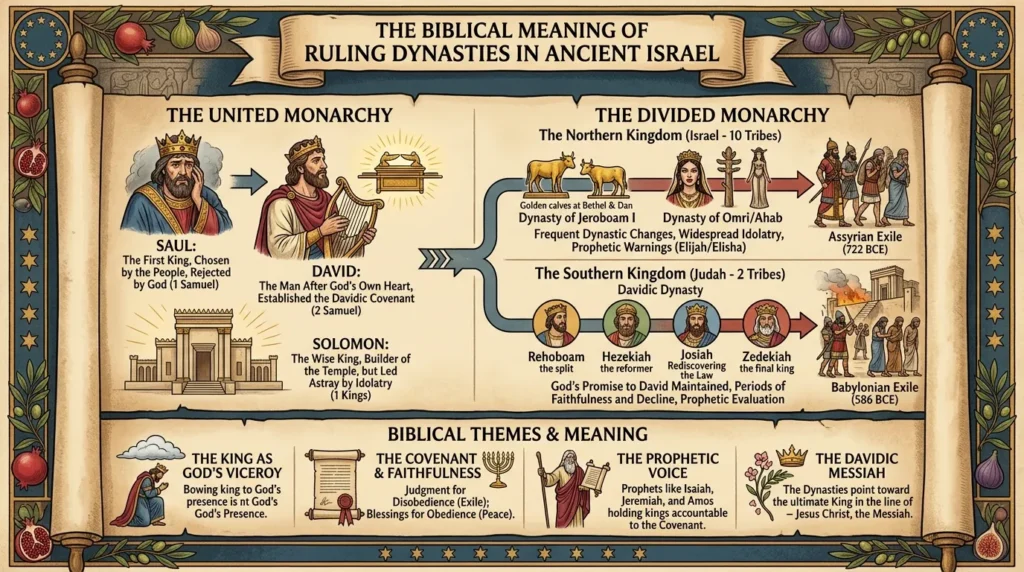
After Israel became a nation, God led His people through different forms of leadership. Later, Israel had kings. Saul became the first king of Israel. After Saul, David became king, and God made an important covenant with him.
God promised David that his royal line would have lasting significance. We see this promise in 2 Samuel 7:12–16. David’s house became the main royal line of the kingdom of Judah.
After Solomon’s reign, the united kingdom divided. The northern kingdom was called Israel, while the southern kingdom was called Judah.
The two kingdoms then experienced different royal histories.
The Davidic Dynasty
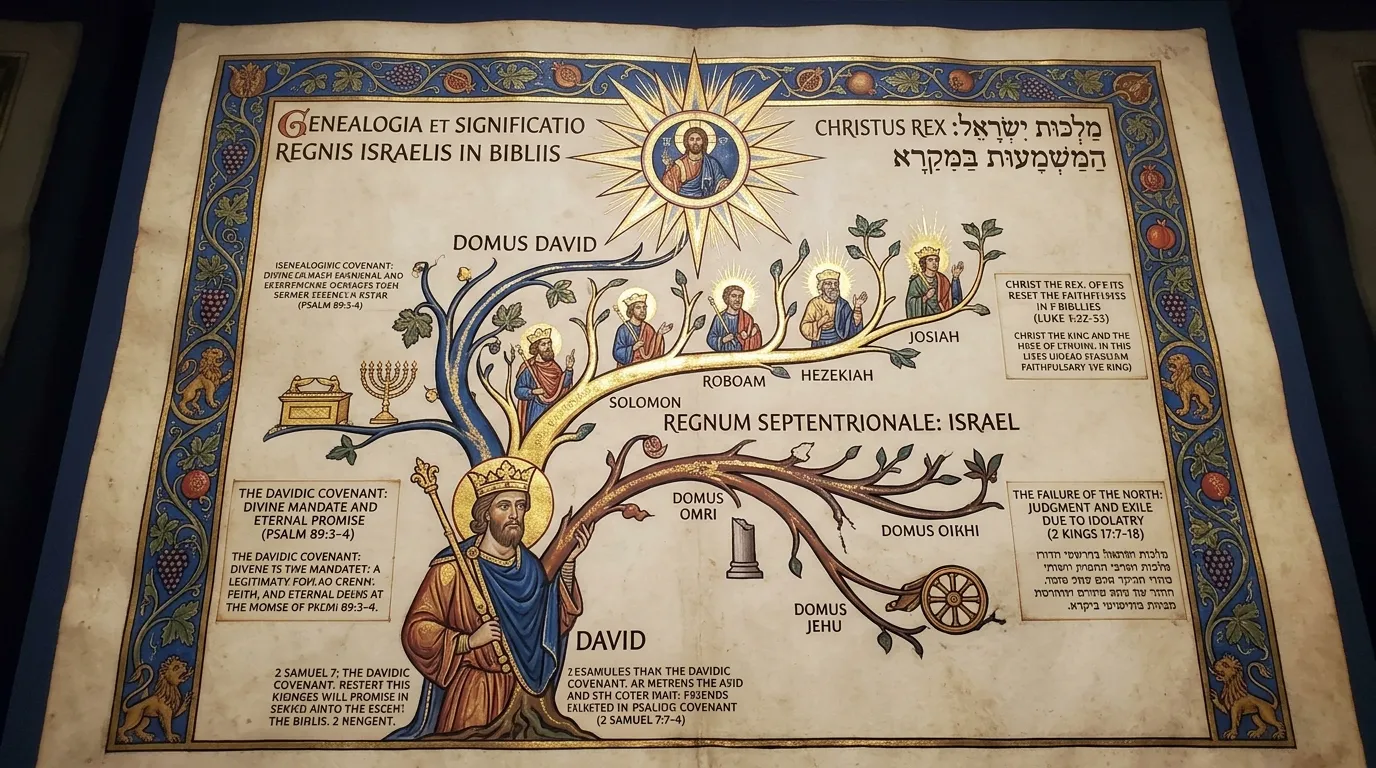
The house of David was the most important royal dynasty in Judah.
David was not a perfect man. He made serious mistakes. Yet he sought God, repented, and trusted Him. God chose David and promised that his royal house would have an enduring place in His plan.
Second Samuel 7 points forward to God’s promise concerning David’s descendants.
This dynasty is especially important for Christians because the New Testament connects Jesus Christ with David’s line.
Matthew 1:1 calls Jesus the Son of David, and Luke 1:32 says that God would give Jesus the throne of His father David.
Therefore, the Davidic dynasty is not simply a story about kings. It points toward the Messianic hope fulfilled in Christ.
The Dynasties of the Northern Kingdom
The northern kingdom of Israel had several ruling houses.
Unlike Judah, Israel did not have one continuous royal family. Different dynasties came to power through political struggles, violence, and rebellion.
For example, the house of Omri became a powerful dynasty. Omri established Samaria as the capital of the northern kingdom. His son Ahab later became king.
Ahab and Jezebel are remembered for promoting the worship of Baal and leading Israel into serious spiritual rebellion. 1 Kings 16:30–33 describes Ahab’s evil in strong terms.
Later, the house of Jehu became another ruling dynasty. Jehu removed the house of Ahab from power, but his reforms were incomplete. Second Kings 10:31 says Jehu did not fully turn from the sins connected with the golden calves.
These stories show that political change does not always mean spiritual transformation.
A new ruler may replace an old ruler, yet the people can continue in the same sinful ways.
What the Dynasties Teach Us
The royal dynasties teach several important biblical truths.
Power does not make a person righteous.
A king can have wealth, authority, soldiers, and influence and still be far from God.
Leadership carries responsibility.
Kings affected entire nations. Their choices could lead people toward worship or away from God.
God judges injustice and rebellion.
The Bible does not hide the failures of Israel’s rulers. It openly records their sins and their consequences.
God keeps His promises.
Even when human rulers failed, God’s covenant purposes continued.
This is one of the strongest lessons in the ruling dynasties of Israel in the Bible. Human history may look unstable, but God’s plan remains steady.
Ruling Dynasties of Israel Hebrew Meaning
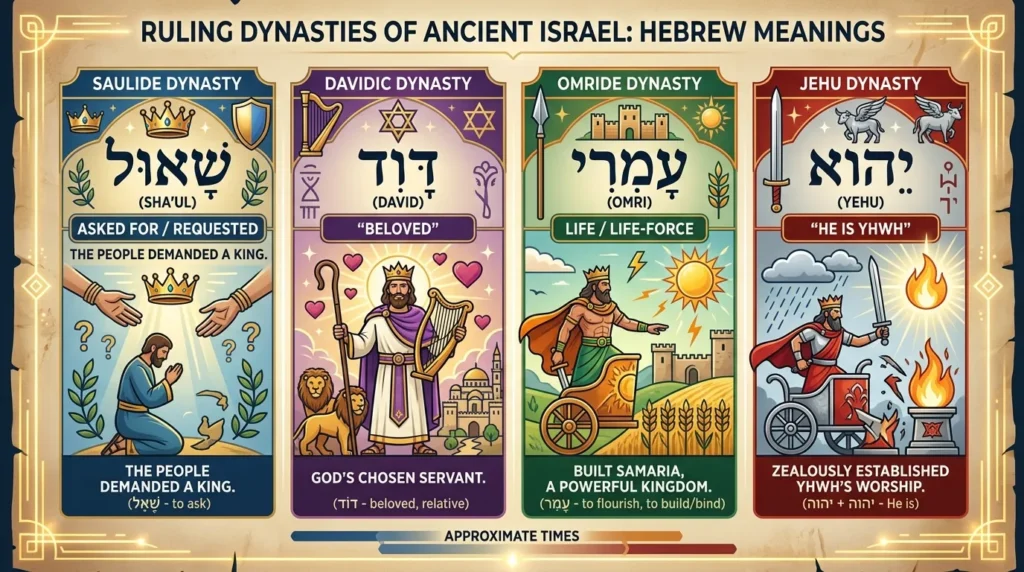
There is no single Hebrew word that directly means “ruling dynasties of Israel.” This English phrase combines several ideas found in the Hebrew Bible.
The Hebrew word commonly translated as house is בַּיִת, transliterated bayit. It can mean a physical house, household, family, or family line.
This is important because the Bible often speaks about a royal family as a house.
For example, the house of David means more than David’s physical home. It can refer to his family, descendants, royal line, and dynasty.
The Hebrew word for king is מֶלֶךְ, transliterated melekh, meaning king or ruler.
The word for kingdom is מַמְלָכָה, transliterated mamlakhah, meaning kingdom, dominion, or royal rule.
The name Israel is יִשְׂרָאֵל, transliterated Yisra’el.
So, while there is no special Hebrew term that exactly matches the modern English phrase ruling dynasties of Israel, the biblical language gives us the ideas of house, king, kingdom, family line, and royal rule.
This helps us read the Old Testament correctly. A royal “house” can describe a dynastic line, not simply a building.
Spiritual Significance and Symbolism
The spiritual meaning of ruling dynasties of Israel can be understood through the larger message of Scripture.
Leadership and Responsibility
Kings were placed in positions of great influence.
This reminds us that leadership is a responsibility, not just a privilege.
You may not rule a kingdom, but you still influence people around you. Your words, choices, and actions can affect your family, friends, children, coworkers, or church community.
The Bible encourages believers to lead with wisdom, humility, justice, and love.
Power and Pride
Several kings show how power can become dangerous when God is forgotten.
A person may begin with good intentions and later become proud. Success can make someone feel that they no longer need God.
The dynasties of Israel warn us not to place our trust in human strength.
Proverbs 16:18 teaches that pride comes before destruction.
The lesson is simple: stay humble when life goes well.
God’s Sovereignty
The rise and fall of royal families also show God’s sovereignty.
Kings made decisions. Nations fought wars. Families gained and lost power. Yet God remained Lord over history.
This can bring peace when your own life feels uncertain.
You may not know what tomorrow will bring, but God is not confused about your future.
Hope Through God’s Promise
The Davidic line also carries a message of hope.
God’s promise to David points toward the coming Messiah. Christians understand Jesus as the ultimate fulfillment of this royal hope.
Jesus is not simply another earthly king.
He is the King whose kingdom has no end.
This gives the study of Israel’s dynasties a deeper Christian meaning. The story moves from temporary earthly kings toward the eternal reign of Christ.
Biblical Interpretations in Dreams or Real Life
If you dream about kings, royal families, dynasties, ancient rulers, thrones, or kingdoms, the Bible does not give one automatic meaning for every dream.
Scripture shows that God sometimes used dreams to communicate with people, such as Joseph and Daniel. However, not every dream is a divine message.
A dream about a royal dynasty could personally remind you of authority, responsibility, family legacy, leadership, conflict, or change.
For example, seeing a good king may make you think about wise leadership. Seeing a corrupt ruler may remind you to examine where pride or control has entered your life.
Seeing a royal family may also bring thoughts about family influence and spiritual inheritance.
But these are personal interpretations, not guaranteed biblical meanings.
If you have such a dream, do not build a major belief or decision on the dream alone. Pray, read Scripture, and seek wise Christian counsel.
God’s written Word should remain the foundation of your faith.
Bible Verses Related to Israel’s Kings and Dynasties
Several passages help explain the biblical meaning behind Israel’s royal history.
2 Samuel 7:12–16
God makes a covenant with David concerning his descendants and royal house.
This passage is central to understanding the Davidic dynasty and its place in God’s redemptive plan.
1 Kings 2:4
David reminds Solomon of God’s promise concerning his descendants.
The passage connects the royal line with obedience and faithfulness.
1 Kings 16:30–33
This passage describes the wickedness of King Ahab.
It shows how a ruler’s choices could lead an entire nation deeper into idolatry.
2 Kings 10:31
Jehu’s story shows that removing one form of evil does not always mean complete obedience to God.
This teaches us that partial obedience is not the same as wholehearted faithfulness.
Matthew 1:1
The New Testament opens by identifying Jesus Christ as the Son of David.
This connects Jesus with the promises and royal line associated with David.
Luke 1:32–33
The angel tells Mary that Jesus will receive the throne of David and reign forever.
For Christians, this points to the eternal kingship of Christ.
What Ruling Dynasties Teach Christians Today
The history of Israel’s dynasties can feel distant, but its lessons are still powerful.
Do Not Put Your Hope in Human Leaders
Kings fail. Governments change. Powerful people come and go.
But God remains faithful.
Your ultimate hope should not rest on a person, political system, or human institution.
Examine Your Own Leadership
Ask yourself:
How do I use the influence God has given me?
Do you use it to help others or control them?
Do your words bring peace or fear?
Do your actions reflect Christ?
These simple questions can lead to meaningful spiritual growth.
Choose Wholehearted Obedience
The kings of Israel remind us that outward success is not enough.
A person can look successful while being spiritually empty.
God cares about the heart.
Trust God’s Timing
David waited many years before fully receiving the throne.
His story reminds us that God’s promises may unfold slowly.
Waiting does not mean God has forgotten you.
Sometimes God is working during the waiting season.
Practical Lessons and Faith Insights
The story of Israel’s ruling dynasties gives us simple lessons for daily life.
Pray before making important choices.
Stay humble when you succeed.
Read Scripture when you feel confused.
Do not place your whole hope in human power.
Learn from the failures of biblical leaders.
Trust God’s promises even when you cannot see the outcome.
Most of all, remember that God’s presence is greater than changing circumstances. His faithfulness does not depend on human rulers.
Conclusion
The ruling dynasties of Israel meaning in the Bible points us to much more than ancient kings and royal families. These stories teach about leadership, obedience, pride, judgment, God’s sovereignty, and hope.
The Davidic dynasty also points toward Jesus Christ, the eternal King. Israel’s changing rulers show that human power is temporary, but God’s kingdom stands forever.
If you are facing uncertainty today, take comfort in this truth: people and circumstances may change, but God does not change. Keep praying, keep reading Scripture, and trust Him to guide your path in His perfect time.