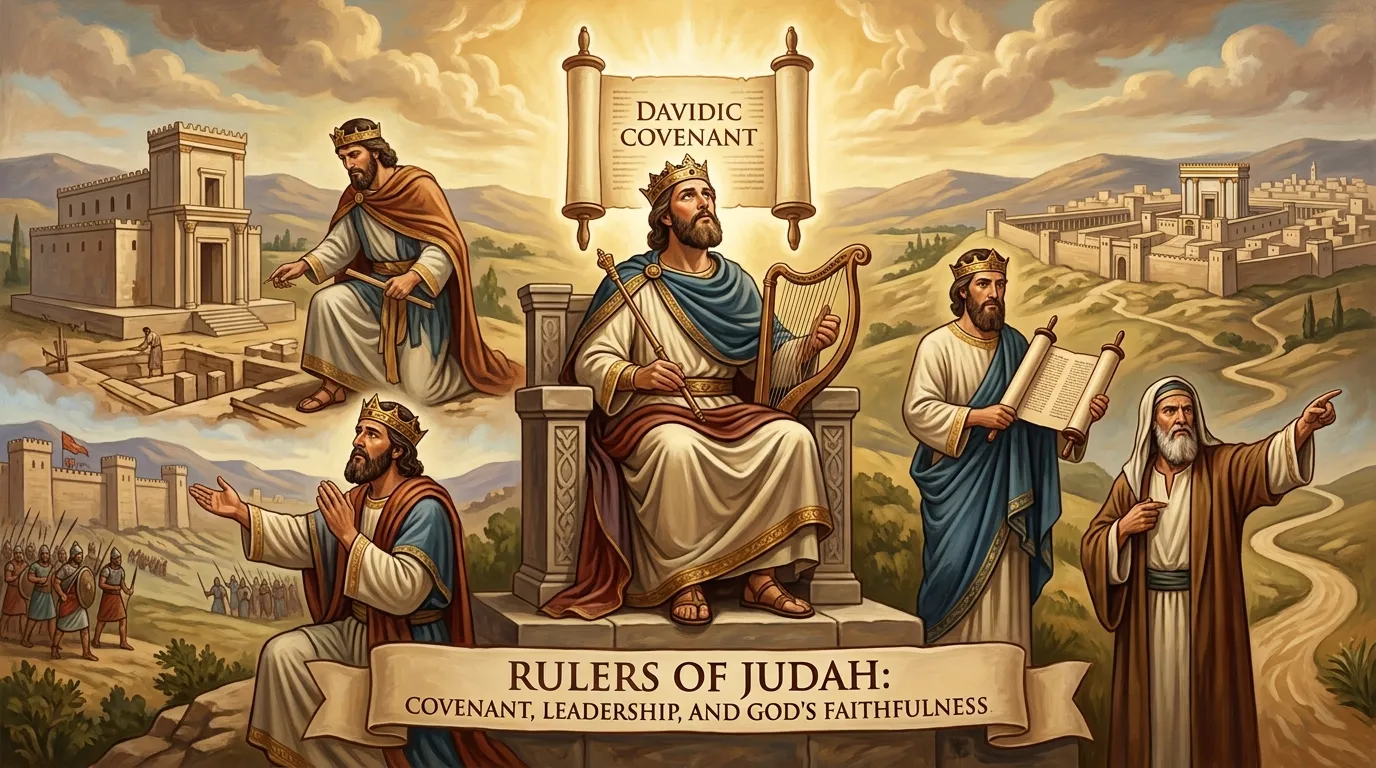
Have you ever wondered why the Bible gives so much attention to the rulers of Judah? The stories of David, Solomon, Hezekiah, Josiah, and other kings are more than old records of royal families. Their lives show moments of faith, failure, courage, repentance, judgment, and hope.
The phrase Judah rulers meaning in the Bible points to the spiritual lessons found in the kings and leaders who ruled the kingdom of Judah. Their history helps us understand how God works through imperfect people while calling His people to remain faithful.
Some rulers followed God closely. Others turned to idols and led the nation away from Him. Some brought spiritual renewal, while others brought great harm. Yet through all these changes, God remained faithful to His covenant.
So, what does the Bible teach through the rulers of Judah? Their stories remind us that leadership matters, obedience matters, and turning back to God is always important.
Let us look at the biblical meaning of Judah rulers, their Hebrew background, spiritual symbolism, and the lessons their lives can offer Christians today.
Biblical Meaning of Judah Rulers in the Bible
The rulers of Judah were the kings and leaders who governed the southern kingdom of Judah after the kingdom of Israel divided.
The division happened after the reign of Solomon. The northern tribes formed the kingdom of Israel, while Judah and Benjamin remained connected to the southern kingdom, commonly called Judah.
Jeroboam ruled the northern kingdom, while Rehoboam, Solomon’s son, ruled Judah (1 Kings 12:16–17).
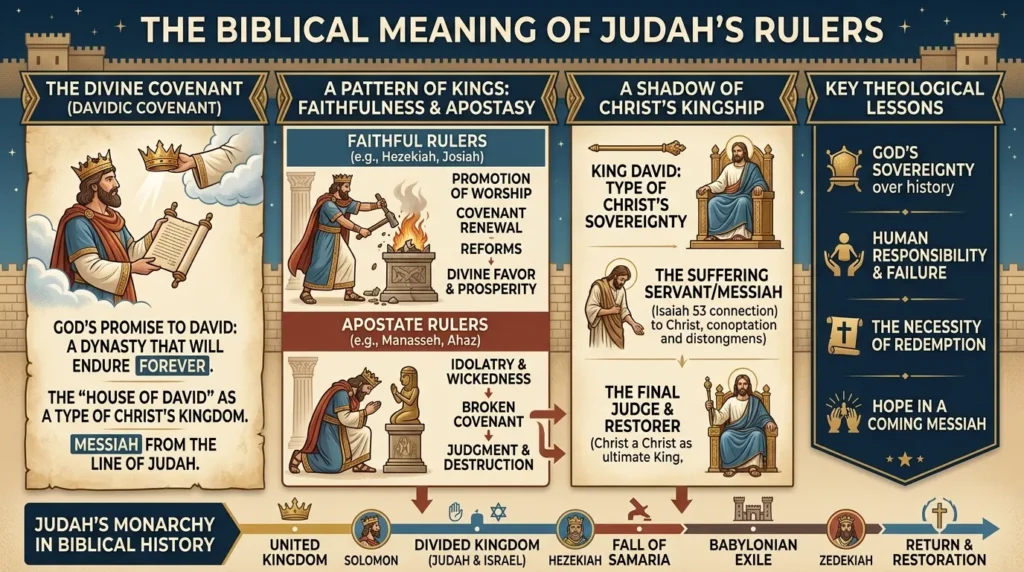
The rulers of Judah were important because Judah carried a special place in God’s covenant story. David’s royal line continued through Judah, and Scripture connects this line to the coming Messiah.
God told David:
“Your house and your kingdom will endure forever before me; your throne will be established forever.”
— 2 Samuel 7:16
This promise is central to understanding the biblical meaning of Judah’s rulers.
Judah’s Rulers Represent Leadership Under God
The kings of Judah show that earthly leadership should remain under God’s authority.
A king could be powerful, wealthy, or respected, but he was still accountable to God.
Some kings demonstrate this clearly.
Hezekiah trusted the Lord when Judah faced danger from Assyria. Second Kings 18:5 says:
“He trusted in the LORD, the God of Israel.”
Hezekiah’s story shows faith during fear.
Another important ruler was Josiah. During his reign, the Book of the Law was found, and Josiah responded with repentance and reform (2 Kings 22:8–13).
His response shows the power of hearing God’s Word and acting on it.
But not every ruler followed God.
Kings such as Manasseh led Judah into serious idolatry. Second Kings 21 describes his evil practices and his influence over the nation.
This gives us an important warning: leadership can influence others toward God or away from Him.
The Rulers of Judah and the Davidic Covenant
The kings of Judah also point toward God’s promise to David.
David was from the tribe of Judah, and the royal line that followed him became part of the story leading to Jesus Christ.
Matthew 1 traces Jesus’ genealogy through David.
Jesus is called:
“the Lion of the tribe of Judah”
— Revelation 5:5
Therefore, the biblical meaning of Judah rulers is not simply about political history. Their story becomes part of the larger biblical message of God’s kingdom, covenant, redemption, and the coming Messiah.
A Warning Against Disobedience
The rulers of Judah also teach that God’s people cannot ignore Him without consequences.
When kings rejected God, the nation suffered spiritual and often political consequences. Eventually, Jerusalem was destroyed and many people were taken into exile by Babylon (2 Kings 24–25).
Yet judgment was not the final word.
God later allowed a remnant of His people to return.
This shows a beautiful truth: God disciplines, but He also restores according to His purposes.
Judah Rulers Hebrew Meaning
There is no single Hebrew word that means “Judah rulers” as one fixed biblical phrase. The expression is an English description of the kings and leaders who ruled Judah.
However, the Hebrew meanings of Judah and king help us understand the biblical setting.
Judah in Hebrew
The Hebrew name for Judah is:
יְהוּדָה — Yehudah
It is related to the Hebrew root ידה (y-d-h), associated with praise, thanksgiving, or giving thanks.
The name Judah is explained in Genesis 29:35. When Leah gave birth to Judah, she said:
“Now I will praise the LORD.”
So, the name Judah carries an important connection with praise and thanksgiving.
This makes the story of Judah’s rulers especially meaningful. The kingdom was connected to a name that pointed toward praise, yet its kings sometimes chose idolatry instead of worshiping God.
King in Hebrew
The common Hebrew word for king is:
מֶלֶךְ — melekh
It means king, ruler, or sovereign.
The Bible uses this word for human kings, but Scripture also teaches that God is the ultimate King.
Psalm 47:7 says:
“For God is the King of all the earth.”
This gives us a deeper biblical perspective. A ruler may have authority over people, but God remains the highest authority.
The Hebrew background therefore supports an important spiritual lesson: human leadership should exist under God’s rule.
Spiritual Significance and Symbolism of Judah Rulers
The spiritual meaning of Judah rulers can be understood through the patterns found in their stories.
They symbolize several important truths about faith and spiritual growth.
Leadership and Responsibility
The kings of Judah remind us that influence is a responsibility.
You do not have to be a king to influence others. Parents, teachers, pastors, friends, and coworkers can all affect people around them.
Your choices may encourage someone toward faith—or discourage them.
The rulers of Judah teach us to ask:
Am I using my influence in a way that honors God?
Repentance and Restoration
The story of Josiah is a strong picture of repentance.
When he heard God’s Law, he humbled himself and responded.
This teaches that spiritual awakening can begin when we listen to God’s Word honestly.
You may have made mistakes. You may have wandered from God. But Scripture repeatedly shows that repentance matters.
God can use a changed heart.
Courage During Trouble
Hezekiah’s story also carries hope.
When Assyria threatened Jerusalem, Hezekiah sought God in prayer (2 Kings 19:14–19).
His response teaches Christians to bring fear to God rather than allowing fear to control them.
When life feels too large for you, prayer can become an act of trust.
The Hope of God’s Promises
The rulers of Judah also remind us that God’s promises are bigger than individual people.
Many kings failed. David’s descendants were imperfect. Judah eventually experienced exile.
Still, God’s covenant purposes continued.
This points toward a central Christian belief: God’s plan does not depend on human perfection.
Judah Rulers in Dreams or Real Life: Biblical Interpretation
If you dream about a king, ruler, Judah, a throne, or a biblical leader, it can feel spiritually important.
However, the Bible does not give one universal meaning for every modern dream.
A dream about a Judah ruler might personally remind someone of leadership, responsibility, authority, faith, repentance, or God’s promises. But such an interpretation should not automatically be treated as a divine message.
Scripture should remain the foundation.
For example, dreaming about a good king might make you reflect on godly leadership. Dreaming about a troubled ruler might lead you to examine areas of disobedience or poor choices in your life.
If you have such a dream, pray and ask God for wisdom. Compare what you are thinking with Scripture.
James 1:5 gives this encouragement:
“If any of you lacks wisdom, let him ask of God.”
The safest Christian approach is to seek biblical truth rather than chase signs.
What the Kings of Judah Teach Christians Today
The lives of Judah’s rulers offer practical lessons for everyday faith.
Seek God before making important decisions. Hezekiah’s example shows the value of prayer during crisis.
Stay close to Scripture. Josiah responded strongly when God’s Law was rediscovered.
Do not let success replace faith. A powerful position cannot protect a person from spiritual failure.
Learn from mistakes. The history of Judah contains many warnings that can help believers avoid similar choices.
Trust God’s promises. Even when circumstances change, God’s character remains steady.
Most of all, remember that God wants the heart, not merely outward religious behavior.
Bible Verses About the Rulers of Judah
Several passages are helpful when studying the biblical meaning of Judah rulers:
- 2 Samuel 7:16 — God’s promise concerning David’s house and kingdom.
- 1 Kings 12:16–17 — The division of the kingdom and the beginning of Judah’s separate rule.
- 2 Kings 18:5 — Hezekiah’s trust in the Lord.
- 2 Kings 19:14–19 — Hezekiah brings Judah’s crisis before God in prayer.
- 2 Kings 22:8–13 — Josiah responds to the discovery of God’s Law.
- 2 Kings 24–25 — Judah’s fall and the destruction of Jerusalem.
- Psalm 47:7 — God is King over all the earth.
- Revelation 5:5 — Jesus is called the Lion of the tribe of Judah.
Together, these passages show the movement from human kingship to God’s greater redemptive plan.
What Is the Main Spiritual Lesson?
The central lesson is simple:
Human rulers change, but God remains faithful.
The kings of Judah had different personalities, strengths, weaknesses, and spiritual choices. Some honored God. Some rejected Him. Some repented after failure.
Their stories remind us not to place our ultimate hope in human power.
People can disappoint us. Leaders can fail. Circumstances can change.
But God’s faithfulness does not depend on any human ruler.
For Christians, the story ultimately points beyond Judah’s earthly kings to Jesus Christ, the promised King and the Lion of Judah.
Conclusion
The Judah rulers meaning in the Bible is deeply connected with leadership, covenant, obedience, repentance, judgment, restoration, and hope. The kings of Judah show both the blessing of trusting God and the danger of turning away from Him.
Their history also points toward God’s greater promise fulfilled in Jesus, the Lion of Judah.
If you are studying Judah’s rulers because of a dream, life situation, or spiritual question, take time to pray and read Scripture. God’s Word remains the safest source of guidance and hope.