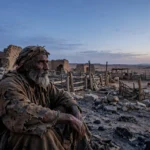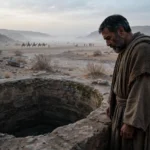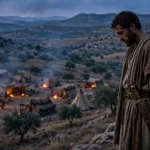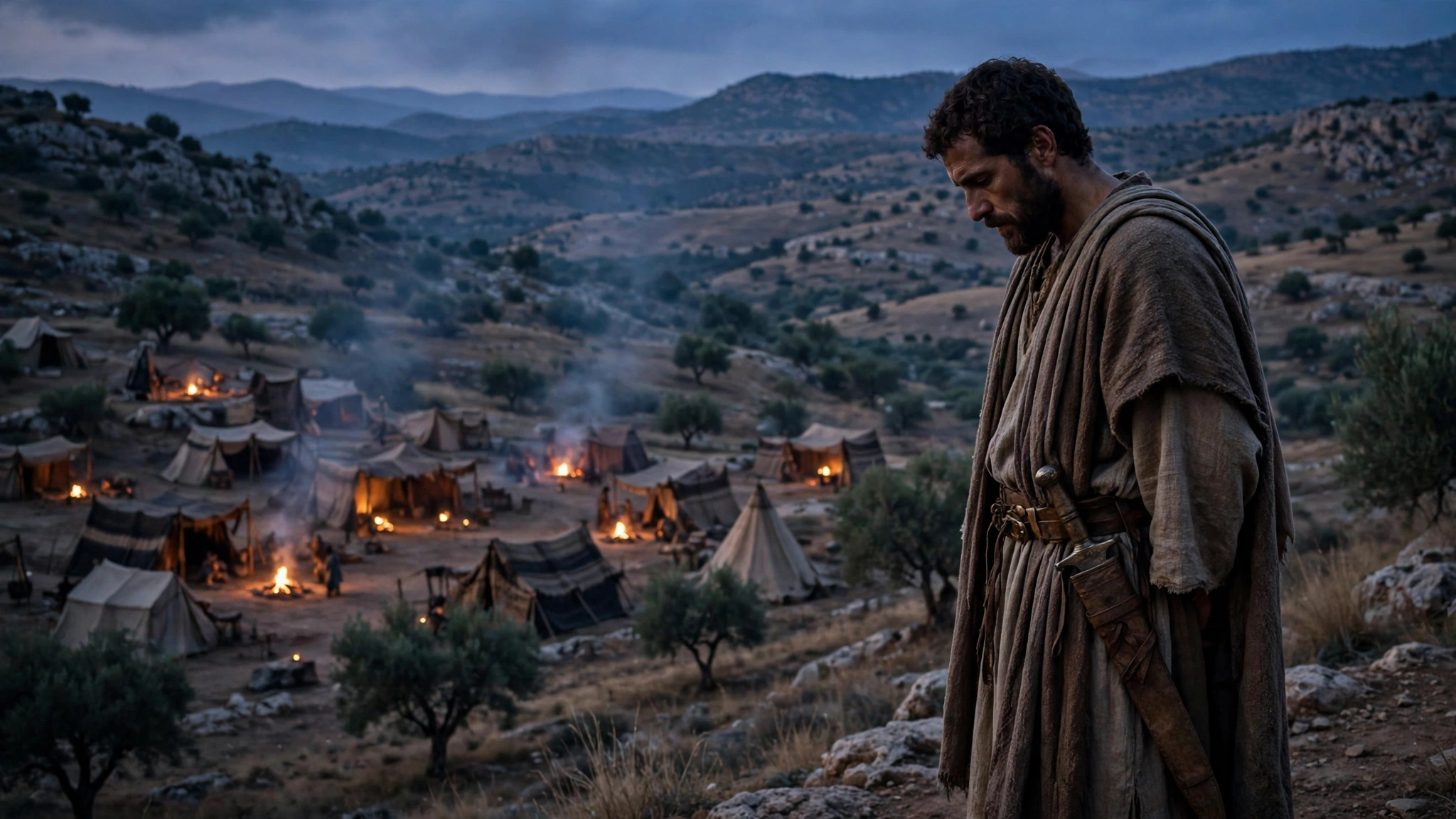
Simeon is the second son of Jacob and Leah, born in Genesis 29:33 after Reuben, and his life is marked by a fierce loyalty to his family that twice turns into violence. His mother names him Simeon because, as she says, “Because the Lord heard that I am not loved, he gave me this one too.” The name, Hebrew Shimon, is linked to hearing — God has heard Leah’s affliction. That beginning is tender: a child born as evidence that God listens to an unloved wife. Simeon’s later story, however, shows how hearing can become a pretext for vengeance, and how a tribe born from being heard can become known for being scattered.
Simeon is often paired with his brother Levi. The two are full brothers, sons of Leah, close in age, and partners in the most notorious episode of their lives. Jacob’s blessing in Genesis 49:5–7 addresses them together, and Moses’ blessing in Deuteronomy 33 notably omits Simeon altogether, a silence scholars have long discussed. Simeon’s tribe, unlike Judah or Joseph, does not produce a king or a dominant leader in the biblical narrative. Instead, it gradually fades, absorbed into Judah’s territory. Simeon’s meaning, therefore, is not about triumph. It is about anger, its consequences, and the quiet disappearance of a tribe that could not channel its strength rightly.
To understand Simeon, readers need to hold two truths together. He is a son of the covenant family, counted among the twelve, blessed as part of Israel’s future. He is also a man whose anger, in Jacob’s words, was fierce and cruel. The Bible does not resolve that tension by erasing Simeon. It preserves his name in genealogies, in the tribal allotments, and in the census lists, even as it records his diminishment. That preservation matters: Simeon is judged, but not forgotten.
A Sister Avenged, A City Destroyed
The defining episode of Simeon’s life is Genesis 34. Dinah, Jacob’s daughter by Leah and Simeon’s full sister, goes out to visit the women of the land near Shechem. Shechem, son of Hamor the Hivite, sees her, takes her, and violates her. The text is brief and the language is stark, and modern readers rightly recognise this as sexual violence, not romance. Afterward, Shechem says he loves Dinah and asks his father to arrange a marriage. Jacob hears what happened and waits for his sons to return from the fields. When they hear, Genesis 34:7 says they were filled with grief and fury because Shechem had done an outrageous thing in Israel by defiling Jacob’s daughter.
Hamor proposes a treaty: intermarriage, shared land, and trade between his people and Jacob’s family. He offers a bride-price and suggests the two groups become one people. Simeon and Levi respond with deceit. They say they cannot give their sister to an uncircumcised man, and propose that all the men of Shechem be circumcised as a condition for intermarriage. Hamor and Shechem agree, and the men of the city are circumcised. On the third day, when the men are still in pain, Genesis 34:25 says Simeon and Levi, each with his sword, attacked the unsuspecting city, killed every male, killed Hamor and Shechem, and took Dinah from Shechem’s house.
The brothers then plunder the city, and Jacob rebukes them in Genesis 34:30, saying, “You have brought trouble on me by making me obnoxious to the Canaanites and Perizzites, the people living in this land. We are few in number, and if they join forces against me and attack me, I and my household will be destroyed.” Simeon and Levi reply, “Should he have treated our sister like a prostitute?” The chapter ends on that unresolved question, with no reconciliation recorded. The Bible leaves the reader to weigh both sides: the genuine horror of Dinah’s violation and the genuine horror of mass killing carried out by deception.
What Jacob Cursed — and What He Didn’t
Later biblical reflection sides, in effect, with Jacob’s concern without dismissing the brothers’ grief. Genesis 49:5–7, Jacob’s deathbed words, says, “Simeon and Levi are brothers — their swords are weapons of violence. Let me not enter their council, let me not join their assembly, for they have killed men in their anger and hamstrung oxen as they pleased. Cursed be their anger, so fierce, and their fury, so cruel! I will scatter them in Jacob and disperse them in Israel.” Note carefully what is cursed: not Simeon and Levi as persons in every respect, but their anger and fury. The punishment is scattering, not annihilation. Levi’s scattering later becomes a priestly dispersion without land, which is transformed into a vocation. Simeon’s scattering becomes gradual absorption into Judah, without such a transformation.
That distinction is the interpretive key to Simeon’s whole story. Jacob does not disown his sons; he disowns their anger. The curse names a pattern — fierce, cruel fury that acts without restraint — and predicts its social result: a people who cannot hold together will not hold territory together either. Simeon’s later history reads like that prediction coming true in slow motion, not in a single catastrophe but in a long, quiet diminishment.
Bound in Egypt, Counted in the Wilderness
Simeon appears again in the Joseph story, and his role there is quieter but telling. When Joseph, disguised as Egypt’s vizier, accuses his brothers of spying, he keeps Simeon as a hostage in Egypt in Genesis 42:24 while the others return to Canaan to fetch Benjamin. The text says Joseph had Simeon bound before their eyes. Why Simeon was chosen is not explained. Some readers suggest Joseph chose the second-born after Reuben, or the brother most associated with violence, as a test. Others note that Simeon, as a full brother of Levi and Dinah, may have been prominent in the earlier plot against Joseph. The text does not say, and readers should not invent a motive Joseph does not state. What is clear is that Simeon, once a perpetrator of violence, now experiences confinement and vulnerability himself.
After the exodus, Simeon’s tribe is counted in the censuses of Numbers 1 and 26. In the first census, Simeon numbers 59,300 fighting men. By the second census, after the wilderness years, the number has fallen to 22,200 — the sharpest decline of any tribe. The Bible does not explain that drop in a single verse, though later events, including the plague associated with Baal of Peor in Numbers 25, in which a Simeonite leader named Zimri is killed, are sometimes connected by interpreters to Simeon’s diminishment. What can be said from the text is that Simeon’s tribe shrinks dramatically between Egypt and the promised land, a numerical echo of Jacob’s prediction of scattering.
Simeon’s later appearances also include a role in the wilderness that deserves notice. In Numbers 25, after Israel’s apostasy at Peor, a Simeonite leader named Zimri openly brings a Midianite woman into the camp, and Phinehas, grandson of Aaron, kills them both. The plague that follows is stopped, but the episode further associates Simeon with impulsive, public wrongdoing in a moment of crisis. The Bible does not use that episode to condemn every Simeonite, and later Simeonites do serve faithfully, but the pattern is consistent: Simeon’s strength, when it is not governed, harms the community that should have benefited from it.
Inside Judah’s Borders
When land is allotted in Joshua 19:1–9, Simeon’s inheritance is not a separate territory but towns within Judah’s allotment, because Judah’s share was too large for it. The text says Simeon’s inheritance lay inside Judah’s. That geographical fact embodies the scattering: Simeon does not hold a distinct region with its own borders, but lives interspersed among Judah. Over time, Simeonites are mentioned in Chronicles as moving south and east in search of pasture, and in 1 Chronicles 4:39–43 some Simeonites are described as striking Amalekites and settling. The tribe persists, but it never regains a central political role.
The omission of Simeon from Moses’ blessing in Deuteronomy 33 is striking, because every other tribe except Simeon is blessed there, though some manuscripts and traditions differ on details. Scholars debate whether the omission reflects Simeon’s decline, a textual issue, or the fact that Simeon was already so intertwined with Judah that a separate blessing seemed unnecessary. The safest reading is to note the omission without building a doctrine on silence. The Bible’s overall pattern for Simeon is clear enough without it: a tribe that began with God’s hearing, acted in violent anger, was scattered by its father’s word, and faded into its brother’s territory.
Was Simeon cursed as a person?
No. Genesis 49 curses his anger and fury, and predicts scattering — not annihilation. Simeon remains in the genealogies, censuses, and allotments throughout the Old Testament.
Why is Simeon missing from Deuteronomy 33?
The text does not say. The leading explanations are Simeon’s decline, a textual question, or that Simeon was already so intertwined with Judah that a separate blessing seemed unnecessary. None of these should be treated as certain.
Does Simeon disappear entirely?
Not at once. Simeonites persist in Chronicles, settle in new areas, and appear in later lists — but the tribe never again holds a distinct territory or a central political role.
Simeon’s meaning for readers today is therefore a sobering study in anger. Grief and fury at real injustice — Dinah’s violation was real and terrible — do not automatically justify any response. Simeon and Levi were right to be grieved, but their deceitful massacre created new injustice and endangered their whole family. Jacob’s curse on their anger, not on their personhood, points to a distinction modern readers need: anger itself can be a signal that something wrong has happened, but anger that becomes cruel, deceptive, and disproportionate must be named and restrained. Simeon shows what happens when it is not: strength is scattered, influence is lost, and a tribe that might have led instead survives only within another’s borders. Readers who want the tribal allotments and census figures in full will find them collected in the entry on Simeon, son of Jacob.