Issachar is the ninth son of Jacob and the fifth son of Leah, born after a long and painful rivalry between Leah and Rachel for Jacob’s love and for children. His birth is recorded in Genesis 30:14–18, in a story involving mandrakes, a bargain between sisters, and Leah’s conviction that God has rewarded her. Issachar’s name, Hebrew Yissakhar, is explained in Genesis 30:18 as linked to reward or hire: Leah says, “God has rewarded me for giving my servant to my husband.” That naming gives Issachar a distinctive meaning among Jacob’s sons: he is a son understood as wages, recompense, or gift received after service and waiting. Later, Issachar’s tribe becomes known not for kingship or warfare alone, but for wisdom, understanding of the times, and steady labour — a reputation that fits a name about reward for faithful work.
The mandrake episode that precedes Issachar’s birth is unusual and needs to be read in its ancient context. Reuben finds mandrakes, plants then believed to promote fertility, and brings them to Leah. Rachel, still childless, asks for them, and Leah trades them for a night with Jacob. That night Leah conceives Issachar. The Bible does not endorse mandrakes as magic, nor does it present Leah’s bargain as an ideal model of marriage. It presents a household where two sisters are competing for love and children, and where God is still at work in the midst of messy human arrangements. Leah’s interpretation — that God has rewarded her — is her testimony, not a claim that every bargain in the story was righteous. Readers should hold that distinction.
Issachar’s brothers include Reuben, Simeon, Levi, and Judah before him, and Zebulun after him, all sons of Leah, plus Joseph and later Benjamin, sons of Rachel, and Dan, Naphtali, Gad, and Asher, sons of the servants Bilhah and Zilpah. Issachar grows up in that crowded, competitive family, but unlike Reuben, Simeon, and Levi, he is not associated in Genesis with a scandal or a violent act. His story is quieter. That quietness continues into the tribal history, where Issachar is remembered for discernment rather than drama.
Wages After Waiting
The wordplay around Issachar’s name deserves careful attention. Genesis 30:18 uses a Hebrew root for hire or wages, sakhar, and Leah says God has given her her hire. The name Issachar is traditionally read as “man of reward” or “there is reward.” Some scholars debate the exact vocalisation and whether the name contains an additional element, but the Genesis explanation is clear in its direction: Leah experiences Issachar’s birth as God’s recompense. She had given her servant Zilpah to Jacob, and she had endured being unloved, and now she receives another son.
That sense of reward should not be reduced to a transaction. Leah does not purchase a child from God. She testifies that God has seen her service and her suffering and has answered with life. In a household where children were understood as blessing and as future security, another son was both personal joy and practical provision. Issachar’s name therefore carries a theology of God’s attentiveness to those who feel overlooked. Leah, who named her first sons out of misery and hope for love, now names a son out of a sense of having been rewarded. The progression in Leah’s namings — from “see my misery” to “God has heard” to “God has rewarded” — traces a slow movement from longing toward gratitude, even though her marriage remains difficult.
For later readers, Issachar’s name has sometimes been used to teach that faithful labour is not forgotten by God. That is a fair pastoral application if it is kept general and not turned into a promise that every act of service will be repaid in a specific, visible way. The Bible itself shows many faithful people who are not rewarded in this life as Leah was, and Job’s story is a direct challenge to any simple wages theology. Issachar’s name is best read as Leah’s particular testimony in her particular story, not as a universal formula.
The Donkey’s Burden
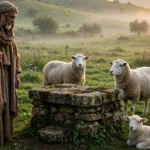
Jacob’s blessing for Issachar in Genesis 49:14–15 uses an image that has puzzled and fascinated readers: “Issachar is a rawboned donkey lying down among the sheep pens. When he sees how good is his resting place and how pleasant is his land, he will bend his shoulder to the burden and submit to forced labour.” At first glance, that sounds insulting. A donkey suggests stubbornness or lowliness, and forced labour suggests subjugation. But in the ancient world, a strong donkey was a valuable, hardworking animal, capable of carrying heavy loads over difficult terrain. The image may picture a tribe that is strong, settled, and willing to work, even if that willingness makes it vulnerable to being taxed or conscripted by stronger powers.
Interpreters differ on whether Jacob’s words are praise, warning, or both. Some read them as praise for Issachar’s industriousness and love of a good land. Others read them as a warning that a tribe that loves comfort too much will accept servitude to keep it. The most honest reading holds both together: Issachar is strong and productive, settled in a fertile area, but that very settlement and productivity can lead to being burdened by others. The blessing is therefore realistic, not idealised. It names a strength and its shadow side in the same breath, as Jacob’s blessings often do.
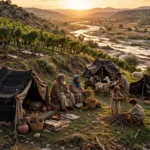
Issachar’s territory, allotted in Joshua 19:17–23, lies in the fertile Jezreel Valley, including towns like Jezreel, Shunem, and Beth Shemesh. That valley was agriculturally rich and strategically important, lying on trade and military routes between the coastal plain and the Jordan Valley. A tribe settled there would prosper from farming, but would also be exposed to armies passing through and to taxation by kings. Jacob’s donkey image fits that geography: a strong worker in a good land, carrying burdens imposed by others as well as by the land itself.
Issachar’s tribal history in Judges and Samuel is relatively modest. The tribe is mentioned in Deborah’s song in Judges 5:15, where the princes of Issachar are with Deborah and Barak, suggesting loyalty in battle. In the time of David, Issachar contributes warriors, and later, Tola, one of the judges listed in Judges 10:1–2, is a man of Issachar who judges Israel for twenty-three years. Tola’s brief notice — no battles, no dramatic exploits, just a long, steady judgeship — fits Issachar’s reputation for quiet faithfulness. Not every leader in Judges is a Samson or a Gideon. Some, like Tola, simply serve steadily.
Two Hundred Chiefs Who Read the Moment
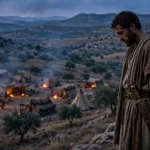
Issachar’s most famous description comes not from Genesis, but from 1 Chronicles 12:32, in a passage listing the warriors who came to David at Hebron to turn Saul’s kingdom over to him. Of Issachar, the text says there were two hundred chiefs “who understood the times and knew what Israel should do,” with all their relatives under their command. That phrase has become Issachar’s signature in preaching and teaching, and for good reason. It pictures wisdom not as abstract knowledge, but as practical discernment: understanding the moment, and knowing the right action for that moment.
That reputation for discernment is often linked to Issachar’s later association with learning and with the calendar. In Jewish tradition, Issachar is associated with study of Torah and with reckoning times and seasons, though those traditions develop after the biblical period and should be distinguished from what Chronicles itself says. What Chronicles says is simpler and still powerful: Issachar’s leaders could read their political and spiritual moment and guide their people accordingly, and their people trusted them enough to follow. In a time of transition from Saul to David, that kind of leadership was as valuable as military strength.
Issachar’s wisdom also has a communal dimension that is easy to overlook. The chiefs in 1 Chronicles 12 do not act alone; the text says all their relatives were under their command, suggesting a tribe that trusted its leaders’ discernment and moved together. Understanding the times, in that passage, is not private insight hoarded by a few, but shared judgment that enables a whole community to act at the right moment. That communal aspect distinguishes Issachar’s discernment from mere cleverness.
Steadiness as a Calling
For modern readers, Issachar offers a model of wisdom that is often undervalued. He is not the firstborn, not the kingly tribe, not the priestly tribe, and not the tribe of the most famous judge or prophet. He is the tribe of steady workers who know their land, bear their burdens, and, at a crucial moment, understand the times well enough to choose rightly. His name, reward, reminds readers that such steady faithfulness is seen by God, even when it does not make headlines. His donkey image reminds readers that strength can be quiet, and that loving a good resting place must not become an excuse for accepting unjust burdens without thought.
There is also a caution inside Issachar’s story that modern readers should not skip. A people who love their resting place can be tempted to pay any price to keep it — including submission to burdens that should be resisted. Jacob’s blessing holds praise and warning together, and the tribe’s valley geography made that warning concrete: fertile land attracts both prosperity and predators. Steadiness is a calling, but it is not passivity. The same chiefs who understood the times also acted on what they understood, moving their whole community at the decisive moment. Discernment without action is only observation.
Issachar’s meaning, then, is reward received after waiting, strength expressed in labour, and wisdom expressed in timing. From Leah’s testimony in Genesis 30, through Jacob’s donkey blessing in Genesis 49, to the discerning chiefs in 1 Chronicles 12, Issachar traces a consistent thread: God notices overlooked labour, and a people who understand their times can lead without dominating. That is a legacy worth remembering in a culture that prizes spectacle over steadiness. The article on Issachar sets out the valley towns and later tribal notices for anyone tracing the story further.