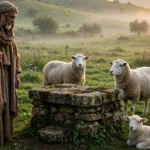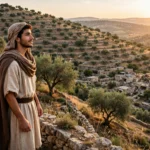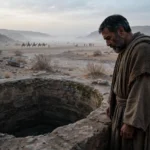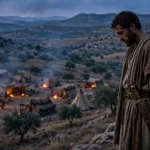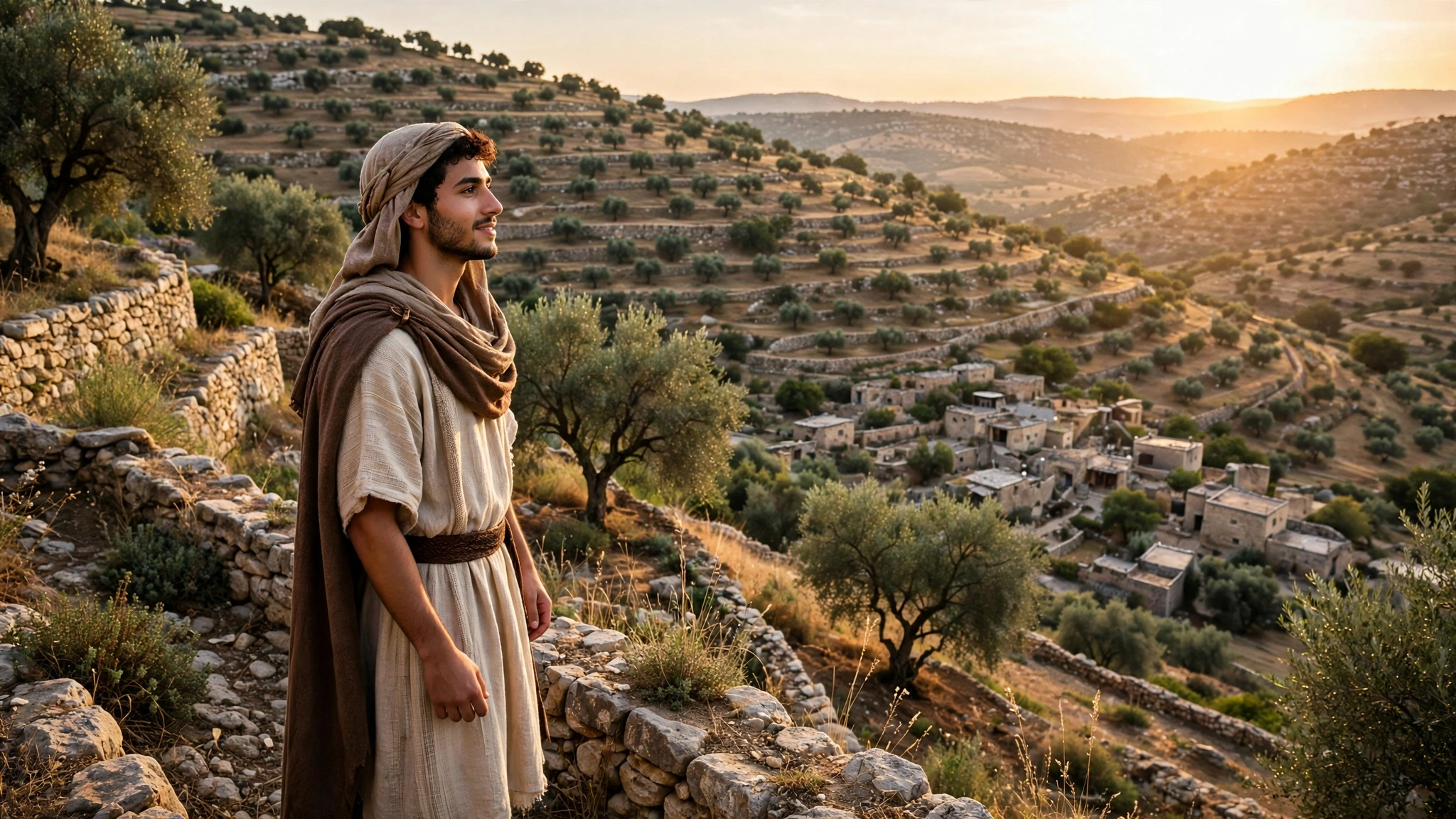
Benjamin enters the Bible on a roadside, in grief. He is born on the journey from Bethel toward Ephrath, in Genesis 35:16–20, as his mother Rachel dies in childbirth. With her last breath she names him Ben-Oni, meaning son of my trouble or son of my sorrow, but Jacob renames him Benjamin, meaning son of the right hand. That renaming sets the tone for Benjamin’s whole biblical life: a child of grief who becomes a child of favour, a youngest brother who is fiercely protected, and later the name of a tribe that plays an outsized role in Israel’s history far beyond its small size.
The phrase “son of the right hand” is well attested as the meaning of Benjamin in Hebrew, Binyamin. The right hand in the ancient world symbolised strength, favour, and honour. To be at someone’s right hand was to be close and trusted. Some scholars also note a geographical nuance: Benjamin’s territory lay to the south of Ephraim, and “right hand” could carry a southern association when facing east, but the primary sense in Genesis is favour and closeness, not geography alone. Jacob’s renaming is therefore an act of hope. He refuses to let his youngest son carry only a name of sorrow for life.
Benjamin’s early life is shaped by loss and by his father’s protectiveness. After Joseph is sold into Egypt — an event Benjamin, as a young child, does not participate in — Jacob keeps Benjamin at home while his older brothers travel. When famine drives the brothers to Egypt for grain, Jacob initially refuses to send Benjamin, saying in Genesis 42:38 that if harm comes to him, Jacob’s grey hair will be brought down in sorrow to the grave. That protectiveness is understandable after losing Joseph, but it also places Benjamin in a difficult position: he is loved intensely, yet his brothers resent the favour shown to Rachel’s sons.
The Youngest Brother in Egypt
The Joseph story in Genesis 42–45 is where Benjamin’s character is tested most directly, even though he says little. When the brothers first arrive in Egypt, Joseph, now vizier, accuses them of being spies and demands they bring their youngest brother to prove their story. He keeps Simeon as a hostage until they return with Benjamin. Jacob relents only when Judah pledges himself as surety for Benjamin’s safety in Genesis 43:8–9. That pledge matters: Judah, who once proposed selling Joseph, now stakes himself for the youngest brother.
In Egypt, Joseph treats Benjamin with conspicuous favour. At a meal in Genesis 43:33–34, the brothers are seated by age, and Benjamin receives five times as much food as the others. Joseph is testing whether his brothers have changed: will they resent favour shown to a younger brother again, as they once resented Joseph’s coat and dreams? This time, they do not attack Benjamin. They eat and drink with him. The test continues when Joseph plants his silver cup in Benjamin’s sack and then has him arrested on the way home in Genesis 44. The brothers, faced with losing Benjamin, tear their clothes and return to Egypt together rather than abandoning him.
Judah’s speech in Genesis 44:18–34 is the climax. He pleads for Benjamin, recounts Jacob’s love for the boy and his grief over Joseph, and offers himself as a slave in Benjamin’s place. That speech moves Joseph to reveal himself in Genesis 45. Benjamin, in this story, is less an actor than a catalyst. His presence exposes whether the brothers have repented of their earlier jealousy. Their willingness to stand with him, rather than sacrifice him as they sacrificed Joseph, shows transformation. Benjamin’s meaning here is therefore relational: he is the brother whose safety becomes the measure of his family’s change.
It is also worth noting Benjamin’s own silence in these chapters. He does not scheme, boast, or plead for special treatment. He receives favour and also bears the danger of being framed. Later readers sometimes overlook quiet figures like Benjamin, but Genesis suggests that being the occasion for others’ repentance is itself a significant role. Benjamin does not need to dominate the story to matter to it.
A Wolf, a King, and an Apostle
After Genesis, Benjamin becomes a tribe, and the tribe’s history is disproportionate to its size. Jacob’s blessing in Genesis 49:27 pictures Benjamin as a ravenous wolf, devouring prey in the morning and dividing plunder in the evening. That image suggests martial energy, and the tribe lives up to it in Judges. Judges 19–21 tells a horrifying story of violence in Gibeah, a Benjaminite town, leading to a civil war that nearly wipes out the tribe. The story is told without approval of the violence, and it ends with the tribe preserved but diminished. It is a sobering chapter in Benjamin’s legacy: strength without justice can turn inward and destroy.
Yet Benjamin also produces Israel’s first king. Saul, son of Kish, is a Benjaminite, as 1 Samuel 9:1–2 states. Saul is described as handsome and taller than others, chosen from the smallest tribe, as he himself notes in 1 Samuel 9:21. His reign ends tragically, but his origin in Benjamin shows that God can choose leadership from an unlikely, small place. Later, after the kingdom divides, Benjamin largely stays with Judah, forming the southern kingdom of Judah and Benjamin, while the other ten tribes form the north. Jerusalem itself sits on the border of Benjamin and Judah, giving the tribe a central geographical and political position despite its size.
Benjamin’s territory, described in Joshua 18:11–28, lies between Ephraim to the north and Judah to the south, including towns like Bethel, Gibeon, and Jericho’s region. That central location made Benjamin strategically important and often contested. The tribe’s warriors were famed for skill, particularly left-handed slingers mentioned in Judges 20:16 and 1 Chronicles 12:2. The image of the wolf in Jacob’s blessing, combined with these military traditions, gave Benjamin a reputation for fierceness that persisted through the monarchy.
The most famous Benjaminite in the New Testament is Paul, formerly Saul of Tarsus. In Philippians 3:5, Paul describes himself as of the tribe of Benjamin, a Hebrew of Hebrews, and in Romans 11:1 he says, “I am an Israelite myself, a descendant of Abraham, from the tribe of Benjamin.” Paul’s self-identification is significant. He does not hide his tribal origin, even though Benjamin’s history includes both Saul’s failed kingship and the Gibeah atrocity. Instead, he presents Benjaminite identity as part of his Jewish heritage that he now understands in light of Christ. For early Christian readers, Paul’s Benjaminite roots linked the new movement to Israel’s story in a personal way.
Resting Between His Shoulders
Benjamin’s personal meaning can be gathered from his beginning and his end. He begins as Ben-Oni, son of sorrow, born in grief on a roadside, buried with his mother at a pillar Jacob sets up in Genesis 35:20. He is renamed Benjamin, son of the right hand, and he grows up under a father’s fierce love. That movement from sorrow to favour does not erase the sorrow — Rachel’s death remains part of his story — but it refuses to let sorrow be the final name. Jacob’s renaming is a small act of pastoral care with large implications: names, in Genesis, shape identity, but they can also be reshaped by a parent’s hope and by God’s purposes.
Benjamin also appears in the story of the famine’s aftermath, when Jacob’s family settles in Goshen and later grows into a nation in Egypt. Exodus 1 does not single Benjamin out, but the tribal lists that follow preserve his place among the twelve, and the blessing tradition keeps returning to his image as beloved and shielded. That persistence matters because Benjamin’s tribe, small as it was, never disappears from Israel’s memory. It survives civil war, monarchy, division, and exile, and it reappears in post-exilic lists as part of the restored community. Smallness, in Benjamin’s case, never meant insignificance.
For readers today, Benjamin offers a quieter lesson than Joseph or Judah. He reminds us that the youngest, the smallest, and the most protected can still play a decisive role, not by striving for prominence, but by being present when a family must decide whether it has changed. He reminds us that a tribe’s size does not determine its significance, and that a history containing both violence and kingship, both failure and apostolic mission, can still be part of God’s story. Benjamin is not a perfect figure — his tribe’s history proves that — but he is a favoured one, and favour in Genesis is rarely about merit alone.
Benjamin’s story ends, in Genesis, not with a grand speech but with a blessing and a place among his brothers. Moses’ blessing in Deuteronomy 33:12 says of Benjamin, “Let the beloved of the Lord rest secure in him, for he shields him all day long, and the one the Lord loves rests between his shoulders.” That image — a beloved child resting secure, shielded — returns to the beginning: a boy born in sorrow, renamed for favour, protected by his father, and finally pictured as resting in God’s protection. It is a fitting close for a life that began on a journey and ended in security. If you want to trace the tribe’s borders and later history, the entry on Benjamin gathers the essentials in one place.