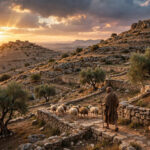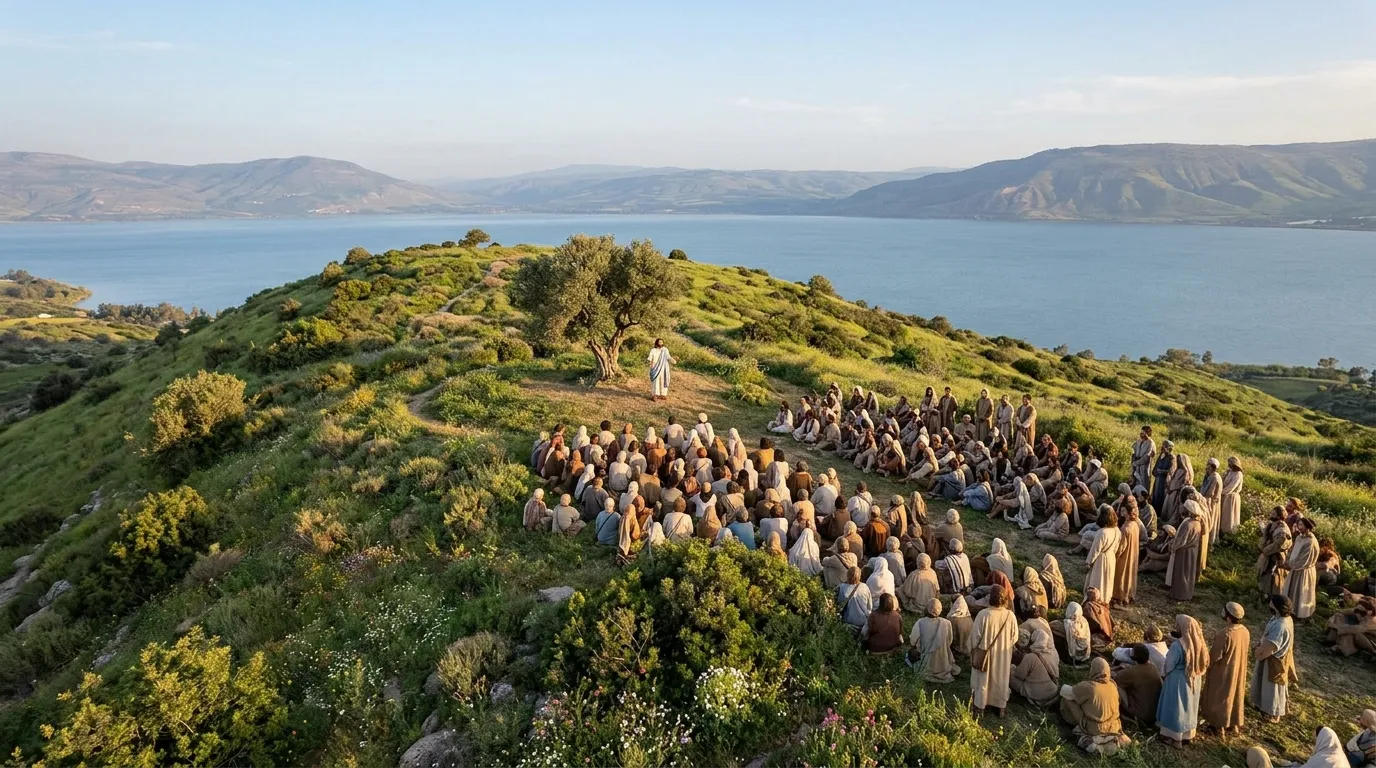
Imagine standing on a quiet hillside early in the morning. The air is fresh. The noise of life feels far away. Below you, people gather to hear the words of Jesus. Some are tired. Some are hurting. Others are searching for hope and truth.
This picture helps us understand why many Christians wonder about the Sermon on the Mount location meaning in the Bible. Where did Jesus give this famous teaching? Does the mountain itself have a special spiritual meaning? And what can this place teach us about following Christ today?
The Bible tells us that Jesus went up on a mountain and taught His disciples and the crowds. Matthew 5–7 records this teaching and calls attention to the mountain. However, Scripture does not give the mountain an exact name or say that the physical location has special spiritual power.
The main message is not about a particular hill. It is about Jesus, His kingdom, the character of His followers, and the kind of life God desires.
The location gives us a beautiful setting, but the words of Jesus give us the lasting truth.
What Is the Sermon on the Mount?

The Sermon on the Mount is the name Christians commonly use for one of Jesus’ most important teachings. It is recorded mainly in Matthew 5–7.
Jesus teaches about many parts of daily life, including:
- The Beatitudes
- Being salt and light
- Anger and forgiveness
- Marriage and purity
- Loving enemies
- Prayer
- Giving
- Fasting
- Worry
- Judging others
- Money and earthly treasure
- Treating others with love
- Building life on God’s Word
Matthew 5:1–2 says that Jesus saw the crowds, went up on the mountain, sat down, and began to teach His disciples.
This setting matters because Jesus was not simply giving a speech. He was teaching people what life under God’s kingdom should look like.
His teaching reaches the heart. He does not only address outward actions. He speaks about motives, thoughts, relationships, forgiveness, prayer, trust, and love.
Where Was the Sermon on the Mount?

The Bible does not give us the exact name of the mountain where Jesus delivered the Sermon on the Mount.
Matthew simply says that Jesus went up on “the mountain” (Matthew 5:1).
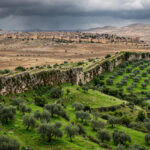
Many Christians traditionally connect the Sermon on the Mount with the hills near the Sea of Galilee, especially the area often called the Mount of Beatitudes. This traditional location is associated with the northern part of the Sea of Galilee.
However, it is important to separate biblical fact from Christian tradition.
The Bible clearly teaches that:
Jesus taught on a mountain or elevated place.
The Bible does not explicitly say:
“Jesus gave the Sermon on the Mount on the Mount of Beatitudes.”
That traditional identification may help Christians picture the setting, but Scripture itself does not provide the exact location.
Why Is the Exact Location Not Given?
The Gospel writers focus more on what Jesus taught than on preserving the name of the hill.
This is important for Christian faith. The power of Jesus’ teaching does not depend on visiting a certain geographical location.
A believer does not need to stand on a particular mountain to receive God’s truth.
Jesus’ words can transform a heart in a church, a home, a hospital room, a quiet bedroom, or anywhere God’s Word is read and obeyed.
Sermon on the Mount Location Meaning in the Bible
The location of the Sermon on the Mount can point our attention to several biblical ideas, but we should not claim that every symbolic interpretation is directly stated by Scripture.
One clear feature is that Jesus taught from a mountain setting.
In the Bible, mountains are sometimes important places where God reveals His will or where major events take place. For example, Moses received God’s law at Mount Sinai in Exodus 19–20.
Matthew’s presentation of Jesus on a mountain may remind readers of this biblical background. Jesus is presenting God’s kingdom and teaching His people how to live.
Still, the Bible does not say, “The mountain means this.”
Therefore, Christians should treat spiritual symbolism as a thoughtful interpretation rather than a direct biblical command.
The Mountain Can Remind Us of God’s Revelation
Mountains often provide a setting for significant moments in Scripture.
Moses received the Law at Sinai. Jesus was later transfigured on a high mountain (Matthew 17:1–8). Elijah also experienced a major encounter with God at Mount Horeb (1 Kings 19).
Against this background, Jesus teaching on a mountain can remind readers of God revealing truth to His people.
Yet there is a major difference.
Jesus does not simply repeat the teachings of earlier prophets. Throughout the Sermon on the Mount, He speaks with remarkable authority.
For example, Matthew 5 repeatedly records Jesus saying, “You have heard that it was said…” and then explaining God’s will more deeply.
The focus is therefore not the mountain itself.
The focus is Jesus and His authority.
Sermon on the Mount Location + Hebrew Meaning
The phrase “Sermon on the Mount” is an English Christian title, so there is no single Hebrew phrase in the Bible that directly translates the full title as a fixed biblical expression.
However, the Hebrew word commonly translated as “mountain” is har (הַר).
The Hebrew noun har can refer to a mountain, hill, or elevated land, depending on the context.
This is helpful because it reminds us not to build a spiritual doctrine around the idea that Jesus necessarily stood on a huge mountain. The Gospel of Matthew simply describes the setting as a mountain or elevated place.
The word “sermon” itself is a later description of Jesus’ teaching. The New Testament was written primarily in Greek, and Matthew records Jesus’ teaching in Greek rather than giving us a Hebrew title called “Sermon on the Mount.”
So, when considering the Sermon on the Mount location Hebrew meaning, the safest conclusion is:
“Mountain” connects with the biblical idea of an elevated place, while the spiritual meaning comes from Jesus’ teaching rather than from the Hebrew word itself.
This distinction protects us from assigning meanings to words that Scripture does not give them.
Why Did Jesus Teach From a Mountain?
The Bible does not directly explain why Jesus chose that particular physical setting.
However, Matthew 5:1–2 gives us an important picture. Jesus went up the mountain, sat down, and His disciples came to Him. Then He began teaching.
A mountain or hillside could also provide a natural setting where a large group could gather and hear a teacher.
More importantly, Matthew’s Gospel places Jesus’ teaching in a setting that may remind readers of Moses and God’s revelation at Sinai.
This creates a powerful biblical picture.
Jesus is not merely offering advice for a happier life.
He is teaching people what it means to live as citizens of God’s kingdom.
The Sermon Begins With Blessing
The first major section of the Sermon on the Mount is the Beatitudes in Matthew 5:3–12.
Jesus says that people who appear weak, poor in spirit, mourning, meek, hungry for righteousness, merciful, pure in heart, and persecuted can be blessed.
This is surprising.
The world often says that happiness comes from power, wealth, success, comfort, or popularity.
Jesus gives a different picture.
He teaches that God’s kingdom belongs to people who recognize their need for Him and desire His righteousness.
The mountain setting therefore becomes a backdrop for a message of hope, humility, mercy, and dependence on God.
Jesus Teaches His Followers to Be Salt and Light
In Matthew 5:13–16, Jesus calls His followers salt of the earth and light of the world.
This teaching connects the Sermon on the Mount to everyday Christian life.
A Christian is not called to hide from the world. Believers are called to live in a way that points others toward God.
Jesus says in Matthew 5:16 that people should see the good works of His followers and glorify their Father in heaven.
This means the Sermon is practical.
It affects how we speak.
It affects how we forgive.
It affects how we treat people.
It affects how we respond when someone hurts us.
It affects how we handle money, worry, prayer, and relationships.
The Deeper Meaning of the Sermon on the Mount
One of the most important truths in the Sermon is that God cares about the heart, not only outward behavior.
Jesus teaches that anger matters, not only murder (Matthew 5:21–22).
He teaches that lust matters, not only physical adultery (Matthew 5:27–28).
He teaches people to love their enemies and pray for those who persecute them (Matthew 5:44).
These teachings show the depth of God’s holiness.
Jesus is not merely saying, “Try to behave better.”
He is calling people to a transformed heart.
Jesus Calls Us to Love Difficult People
Loving someone who loves you is easy to understand.
Loving an enemy is much harder.
Yet Jesus says in Matthew 5:44 to love your enemies and pray for those who persecute you.
This does not mean Christians must approve of evil or ignore injustice.
Instead, Jesus calls His followers away from hatred and personal revenge.
For example, if a coworker treats you unfairly, you can seek justice while still refusing to fill your heart with hatred.
If a family relationship becomes difficult, you can set wise boundaries while still praying for that person.
Christian love does not require pretending that wrong is right. It calls us to respond without becoming controlled by hatred.
The Sermon on the Mount and Prayer
Matthew 6 gives special attention to prayer.
Jesus warns against praying simply to impress other people. He teaches His disciples to pray sincerely and then gives what Christians commonly call the Lord’s Prayer (Matthew 6:9–13).
The prayer begins with God:
“Our Father in heaven, hallowed be your name.”
This is important.
Prayer is not mainly about getting everything we want.
It begins with God’s name, God’s kingdom, and God’s will.
Then Jesus teaches His followers to ask for daily bread, forgiveness, and help when facing temptation.
The location of the Sermon points us toward Jesus, but the teaching points us toward a daily relationship with God.
Jesus Teaches Us Not to Live in Fear
Matthew 6:25–34 addresses worry.
Jesus points to birds and flowers and teaches His followers to trust their heavenly Father.
This does not mean Christians will never experience stress.
Life can bring real pain, uncertainty, financial pressure, family problems, and loss.
Jesus’ message is not that problems are imaginary.
His message is that God knows what His children need.
For someone facing an uncertain future, the Sermon on the Mount offers a simple reminder:
You do not have to carry tomorrow before tomorrow arrives.
Faith learns to trust God one day at a time.
What Does the Sermon on the Mount Mean Spiritually?
The Sermon on the Mount can have deep spiritual meaning for Christians because it reveals the heart of life in God’s kingdom.
It calls believers to:
- Humility instead of pride
- Mercy instead of cruelty
- Forgiveness instead of revenge
- Purity instead of hidden sin
- Generosity instead of greed
- Trust instead of constant worry
- Prayer instead of self-reliance
- Love instead of hatred
- Obedience instead of empty religion
These are not mystical meanings attached to the mountain.
They come directly from Jesus’ teaching.
Sermon on the Mount Location Meaning in Dreams
Some people may dream about a mountain, Jesus teaching, a church, or a biblical place and wonder whether the dream has a spiritual meaning.
The Bible does contain examples of God using dreams at certain times, such as Joseph in Genesis 37 and Joseph, the husband of Mary, in Matthew 1–2.
However, the Bible does not teach that every dream is a message from God.
Therefore, if you dream about the Sermon on the Mount or see yourself standing on a mountain while Jesus teaches, it is wise to respond with prayer rather than fear.
You might reflect on questions such as:
- Am I listening to Jesus’ teachings?
- Is God calling me to forgive someone?
- Do I need to trust God instead of living in worry?
- Am I seeking God’s kingdom first?
- Is there an area of my life where obedience needs to grow?
Most importantly, test every spiritual impression against Scripture.
A dream should never be used to create a new teaching that contradicts God’s Word.
Seeing a Mountain in Real Life: What Should Christians Think?
A mountain can naturally remind a Christian of God’s creation, strength, peace, and the many mountain scenes found in Scripture.
But there is no biblical rule saying that seeing a mountain is automatically a divine sign.
You can enjoy the beauty of a mountain and let it remind you of God’s greatness without claiming that God has given you a secret message.
Psalm 121:1–2 provides a beautiful example of looking toward the hills while recognizing that true help comes from the Lord.
The important lesson is this:
Creation can point our hearts toward God, but we should seek God’s revealed truth in Scripture.
Is the Mount of Beatitudes the Exact Location?
The Mount of Beatitudes is a traditional Christian location associated with the Sermon on the Mount.
It is located near the Sea of Galilee and has become an important place for Christian pilgrimage and reflection.
However, the Bible does not explicitly identify the Mount of Beatitudes by name as the place where Jesus gave the Sermon.
Therefore, it is better to say:
The Mount of Beatitudes is traditionally believed to be the location, but the exact location cannot be established with certainty from Scripture alone.
This is a good example of how Christians can respect tradition while keeping biblical teaching first.
Is the Mountain Itself Holy?
The Bible does not teach that the physical mountain where Jesus preached has magical or supernatural power.
Christian faith is centered on Christ, not sacred geography.
Jesus’ words remain true whether someone is standing beside the Sea of Galilee or sitting at a kitchen table reading Matthew 5.
A Christian visiting a traditional biblical location may experience deep emotion and spiritual encouragement. That can be meaningful.
But the location does not replace Scripture, prayer, faith, or obedience.
What the Sermon on the Mount Teaches Christians Today
The Sermon is more than an ancient message.
It speaks directly to modern life.
When social media encourages anger, Jesus teaches mercy.
When culture celebrates pride, Jesus teaches humility.
When fear controls our thoughts, Jesus teaches trust.
When people seek revenge, Jesus teaches love.
When religion becomes outward performance, Jesus points toward the heart.
When money becomes our security, Jesus reminds us that our treasure should be in heaven.
When we feel spiritually weak, the Beatitudes remind us that God’s kingdom is not built around human status.
A Simple Everyday Example
Imagine that someone sends you an insulting message.
Your first reaction may be to answer with another insult.
The Sermon on the Mount gives you a different path.
You can pause.
You can pray.
You can choose your words carefully.
You can refuse revenge.
You can seek peace without pretending the hurt did not happen.
That is what makes Jesus’ teaching so powerful. It enters ordinary moments and changes how we live.
What Is the Main Message of the Sermon on the Mount?
The main message is that Jesus calls His followers to live with hearts shaped by God’s kingdom.
The Sermon teaches that true righteousness goes deeper than outward religious behavior.
It involves:
- A humble heart
- Genuine love
- Forgiveness
- Purity
- Mercy
- Prayer
- Trust in God
- Obedience
- Wisdom
- Faithful action
Jesus closes the Sermon with the picture of two builders in Matthew 7:24–27.
One hears His words and puts them into practice. The other hears but does not obey.
The storm comes to both houses.
This gives us one of the strongest lessons in the entire Sermon:
The goal is not simply to hear Jesus. The goal is to build our lives on His words.
Frequently Asked Questions
Where did Jesus give the Sermon on the Mount?
Matthew 5:1 says Jesus went up on a mountain to teach. The exact mountain is not named in Scripture. Christian tradition commonly identifies the area near the Sea of Galilee as the setting.
What is the spiritual meaning of the mountain?
The Bible does not assign one fixed spiritual meaning to the mountain. However, its setting can remind readers of important biblical moments of revelation, including Moses receiving God’s Law at Mount Sinai.
Is the Mount of Beatitudes mentioned in the Bible?
The name Mount of Beatitudes does not appear in the biblical text as the official name of the place where Jesus preached. It is a traditional Christian name associated with the Sermon on the Mount.
What does “mountain” mean in Hebrew?
The common Hebrew word for mountain is har (הַר). Depending on context, it can refer to a mountain or hill. The word itself should not be given a secret spiritual meaning beyond what the biblical context supports.
Did Jesus give the Sermon on the Mount on a literal mountain?
Matthew 5:1 clearly describes Jesus going up on a mountain before teaching. Luke 6 records a related teaching setting in which Jesus stood on a level place. Christians have different views about how these Gospel accounts relate to one another.
What does the Sermon on the Mount teach about Christian life?
It teaches Christians to live with humility, mercy, love, purity, prayer, forgiveness, trust, and obedience. Jesus focuses strongly on the heart and calls His followers to practice what He teaches.
Can dreaming about a mountain have a biblical meaning?
The Bible does not give a universal meaning for every dream about a mountain. Dreams should be approached carefully and tested against Scripture rather than treated automatically as divine messages.
Final Thoughts
The Sermon on the Mount location meaning in the Bible is ultimately less about finding a special piece of land and more about understanding what happened there.
Jesus sat before His disciples and taught them how to live as people of God’s kingdom.
The mountain gives us a beautiful biblical setting. The traditional Mount of Beatitudes can help Christians picture that moment. But the lasting treasure is found in Jesus’ words.
He teaches us to be humble when pride feels easier.
He teaches us to forgive when anger feels stronger.
He teaches us to pray when we feel helpless.
He teaches us to trust when tomorrow looks uncertain.
He teaches us to love when people are difficult.
And He teaches us to build our lives on His words.
If you are going through a season of confusion today, take a quiet moment with Matthew 5–7. Pray simply: “Lord Jesus, help me hear Your words and live them.”
You may never stand on the hillside near Galilee.
You do not need to.
The same Lord who taught on that mountain still calls His people to walk with Him today.
Let His Word shape your heart, let His grace strengthen you, and let your life be built on the solid foundation of Christ.