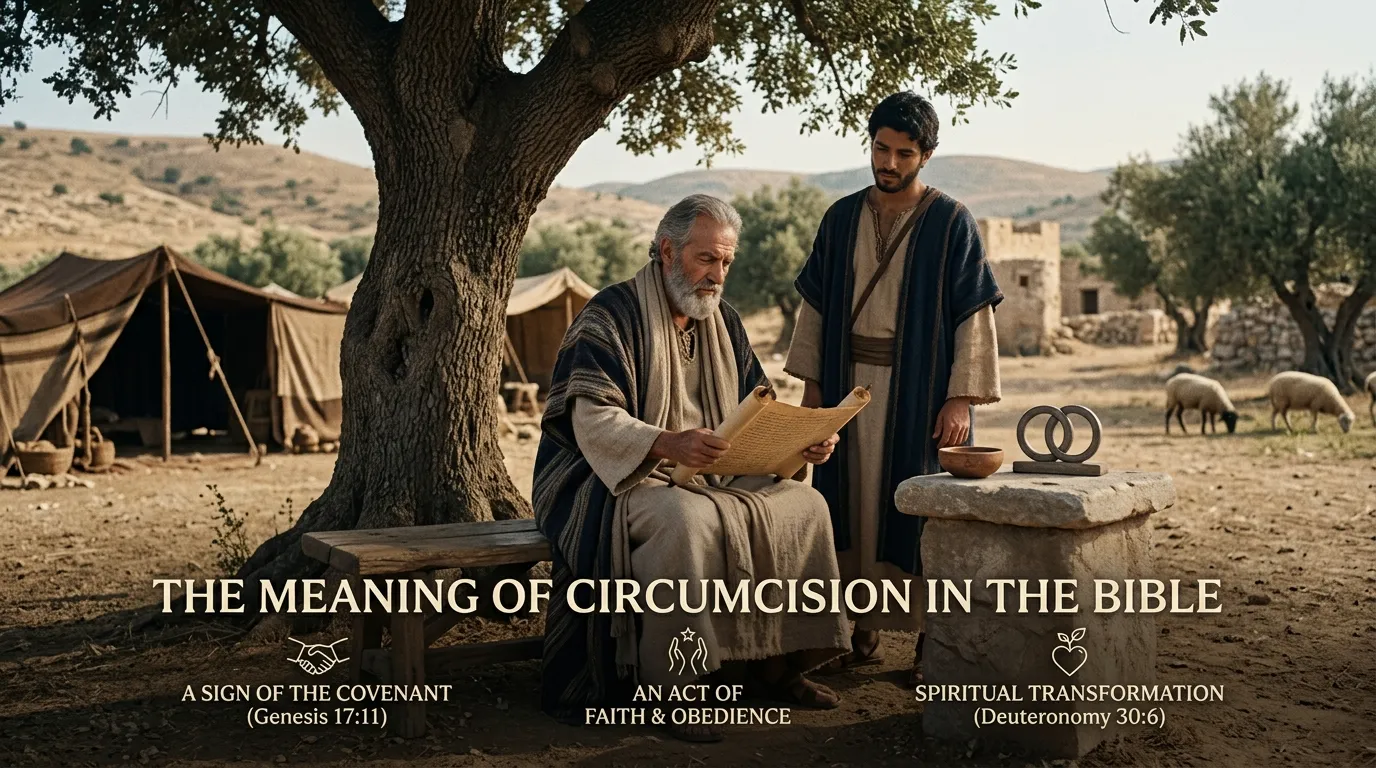
Of all the signs God could have chosen to mark His covenant people, circumcision has to be the most startling. Not a mark on the forehead, not a badge worn on clothing, not a festival or a feast, but a physical act performed on the most private part of the body, on the eighth day of a boy’s life. Readers stumble over it. Skeptics mock it. Even believers sometimes hurry past it. But the Bible treats circumcision as one of the most important signs God ever gave, and its meaning reaches far beyond the physical act into the very heart of the gospel.
A Sign Cut Into the Covenant
The story begins with Abraham. When God established His covenant with the patriarch, He commanded: “You shall be circumcised, and it shall be the sign of the covenant between me and you” (Genesis 17:11). Every male in Abraham’s household, from infant sons to purchased servants, was to bear the mark. It was not optional, and it was not symbolic in a vague sense. It was the covenant made visible in flesh.
Why this sign? The Bible does not give a full explanation, but the placement is surely deliberate. The sign was cut into the organ of generation, the very place where Abraham’s promised descendants would come from. Every time the covenant was in view, so was the promise: through this line, through these descendants, God would bless all nations. The sign pointed forward to the Seed who was coming (Galatians 3:16).
It was also intimate and inescapable. You could not take it off at night or hide it when convenient. It marked a man permanently as belonging to God and His promises. In a world of competing gods and shifting allegiances, circumcision was a lifelong confession: I am the Lord’s. Every father who circumcised his son was preaching the covenant without words.
The Sign Was Never the Whole Story
Here is where the Bible’s teaching takes a turn that surprises many readers. Almost as soon as God commanded the physical sign, He began talking about a deeper one. Through Moses, He told Israel: “Circumcise your hearts, therefore, and do not be stiff-necked any longer” (Deuteronomy 10:16).
Read that again. God commanded an inward circumcision, a cutting away of stubbornness from the heart. The physical act was meant to picture a spiritual reality: a heart cut free from rebellion, set apart for God. The sign on the body was the shadow; the change in the heart was the substance.
Moses returned to the theme at the end of his life, and this time the promise was staggering: “The Lord your God will circumcise your hearts and the hearts of your descendants, so that you may love him with all your heart and with all your soul, and live” (Deuteronomy 30:6). Notice who does the circumcising here. Not the people themselves, but God. The inward cutting is His work, His gift, His surgery on the stubborn human heart.
The Prophets Press the Point
Jeremiah picked up Moses’ language and aimed it at a complacent nation. “Circumcise yourselves to the Lord, circumcise your hearts, you people of Judah and inhabitants of Jerusalem, or my wrath will flare up and burn like fire” (Jeremiah 4:4). The prophet’s logic was brutal and clear: a circumcised body with an uncircumcised heart was worse than useless. It was a lie told in flesh.
This was Israel’s perennial temptation, and it is ours too: to trust the sign while ignoring the reality. Baptized but unchanged. Churchgoing but unrepentant. Bible-reading but hard-hearted. The prophets saw through every version of it. God was never impressed by marks on the body. He was after the heart underneath.
Ezekiel pushed the promise even further into the future: “I will give you a new heart and put a new spirit in you; I will remove from you your heart of stone and give you a heart of flesh” (Ezekiel 36:26). The heart-circumcision Moses commanded and Jeremiah demanded would one day be accomplished by God Himself, in the new covenant. The sign was pointing to a surgery only God could perform.
The Crisis in Galatia: When the Sign Became a Threat
The early church nearly split over circumcision. After Gentiles began believing in Jesus in large numbers, some Jewish Christians insisted they had to be circumcised to be truly saved. It seemed reasonable: circumcision had marked God’s people for two thousand years. Surely the new Gentile believers should bear the mark too.
Paul’s response was explosive. “Mark my words! I, Paul, tell you that if you let yourselves be circumcised, Christ will be of no value to you at all” (Galatians 5:2). He was not attacking the Old Testament sign. He was attacking what it meant to require it now: that Christ’s work was insufficient, that Gentiles had to become Jews to become Christians, that grace needed a supplement.
The Jerusalem council settled it (Acts 15): Gentile believers were not required to be circumcised. The sign that had marked God’s people for millennia was not carried into the new covenant as a requirement. Something greater had replaced it. The shadows were giving way to the reality.
Paul’s Redefinition: The True Circumcision
Paul did not merely set circumcision aside; he redefined it around Christ, relocating the identity of God’s people from flesh to Spirit. “A person is not a Jew who is one only outwardly, nor is circumcision merely outward and physical. No, a person is a Jew who is one inwardly; and circumcision is circumcision of the heart, by the Spirit, not by the written code” (Romans 2:28-29).
Then he turned the language into a description of the church itself: “For it is we who are the circumcision, we who serve God by his Spirit, who boast in Christ Jesus, and who put no confidence in the flesh” (Philippians 3:3). The true circumcision is not an ethnic group or a ritual. It is a people: those who worship by the Spirit, glory in Christ, and refuse to trust in anything they have done.
And in Colossians, Paul gives the deepest statement of all: “In him you were also circumcised with a circumcision not performed by human hands. Your whole self ruled by the flesh was put off when you were circumcised by Christ” (Colossians 2:11). There is a circumcision “not performed by human hands,” done by Christ Himself, in which the old self is cut away. Every believer has been circumcised, not in the flesh, but in the far more important place: the heart.
Timothy: The Exception That Proves the Rule
There is one story that seems to contradict everything Paul taught, and it is worth understanding. When Paul took Timothy, whose mother was Jewish and father Greek, as a missionary companion, “he had him circumcised because of the Jews who lived in that area, for they all knew that his father was a Greek” (Acts 16:3). Wait, did Paul not just say circumcision was nothing? Why do it now?
The answer reveals Paul’s wisdom. With Titus, a Gentile, Paul refused circumcision absolutely, because the false teachers demanded it as a condition of salvation (Galatians 2:3-5). To yield there would have been to surrender the gospel. With Timothy, no one was demanding it for salvation; Paul chose it voluntarily, as a missionary accommodation, so that Jewish audiences would listen to the gospel without stumbling over Timothy’s background.
The principle is timeless: never surrender the gospel’s freeness, but freely surrender your own rights for the gospel’s sake. Paul would not let circumcision be required, but he would let it be used, when love made it useful. That distinction, between requirement and accommodation, still guides Christian mission today.
What Remains for Believers Today
So what does “circumcised” mean for a Christian now? It means marked, set apart, belonging to God, but the mark is inward. The physical rite belonged to the old covenant; the spiritual reality belongs to everyone in Christ. If you are in Christ, you bear the true circumcision: a heart cut free from the dominion of sin by the Spirit’s work.
This reframes how we think about belonging. No ritual, no background, no physical mark makes anyone more God’s than another. What marks God’s people now is the Spirit’s surgery: hearts of stone replaced with hearts of flesh, stubbornness cut away, love for God implanted. The question is never “have you been marked on the outside?” but “has God changed you on the inside?”
And it reframes assurance. Your standing before God does not depend on a sign you bear but on a work Christ has done, in you and for you. The covenant sign of the old era pointed forward to Him; the new covenant reality is Him, dwelling in you by His Spirit. The shadow has given way to the substance, and the substance is Christ Himself. Those curious about the historical and cultural background of the physical practice, across Jewish, Christian, and other traditions, will find the Wikipedia article on circumcision a thorough starting point for further reading.