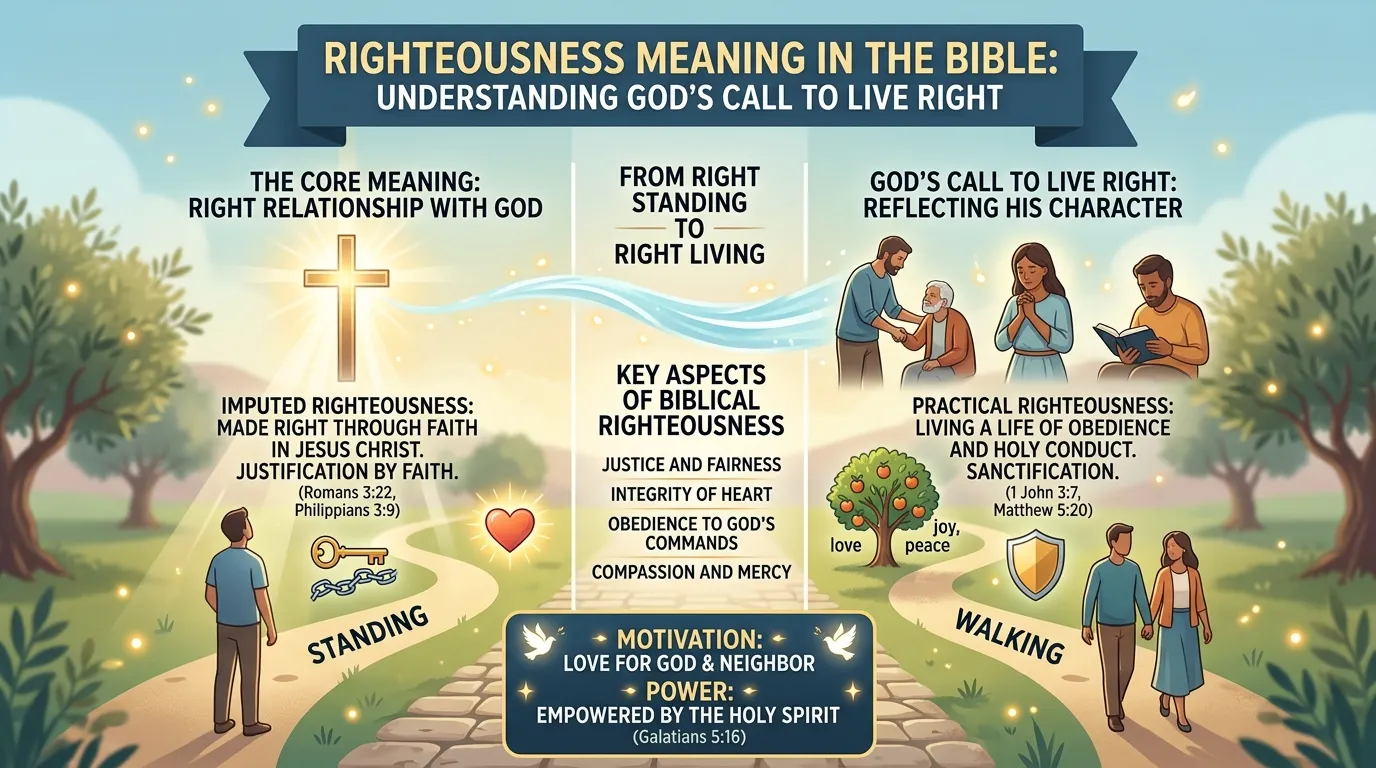
Picture a courtroom. The evidence is laid out, the verdict is read, and the judge does something no earthly judge could ever do: he declares the guilty defendant “not guilty,” and then he goes further, crediting to the defendant’s account a perfect record he never earned. That scene, as strange as it sounds, is the heart of what the Bible means by righteousness. It is not first a description of how good you are. It is a declaration about where you stand.
The Bad News the Doctrine Requires
Righteousness as a doctrine only makes sense against the backdrop of a problem, and the Bible states the problem without flinching: “There is no one righteous, not even one” (Romans 3:10). Paul is quoting the Psalms, and his point is total. Not the worst sinners, not the average person, no one measures up to God’s standard.
This is why every attempt to earn righteousness collapses. The standard is not “better than your neighbor” or “sincere most of the time.” The standard is God’s own perfect character. Jesus said it plainly: “Be perfect, therefore, as your heavenly Father is perfect” (Matthew 5:48). Against that measure, our best deeds look the way Isaiah said they look: “like filthy rags” (Isaiah 64:6).
Most people misunderstand this at first. They hear “no one is righteous” and think God is being harsh. But the diagnosis is actually mercy in disguise. Only when we stop pretending we can qualify ourselves are we ready to receive what God wants to give. The doctrine of righteousness begins where self-righteousness ends.
The Word Behind the Doctrine
The New Testament word for righteousness is dikaiosyne, and it belongs to the courtroom. Its word family includes justification, the verdict of “not guilty,” and the righteous one, the person the verdict describes. In the ancient world, a dikaios person was someone who measured up to the standard, who was “in the right.”
Here is the stunning turn: the New Testament uses this courtroom word not only for God’s character but for something God gives. “The righteousness of God” can mean God’s own righteousness, but Paul also speaks of a righteousness “that comes from God” and is received “by faith” (Philippians 3:9). The verdict is transferable. The standing can be granted.
The Old Testament background deepens this. The Hebrew tsedeq carries the sense of conformity to a standard, but it also carries covenant loyalty. God’s righteousness is His faithfulness to His promises. When He declares sinners righteous, He is not fudging the books; He is keeping His ancient promise to deal with sin once and for all.
Abraham: The First Case Study
Long before Paul wrote Romans, God ran the experiment with Abraham. Genesis 15 records God’s promise that Abraham’s descendants would be as numerous as the stars, and then comes one of the most important sentences in the Bible: “Abram believed the Lord, and he credited it to him as righteousness” (Genesis 15:6).
Notice the order. Abraham did not obey his way into righteousness and then believe. He believed, and God credited righteousness to him. The Hebrew accounting word is deliberate: it is bookkeeping language. God wrote righteousness into Abraham’s ledger, not because Abraham had earned it, but because he trusted the Promiser.
Paul builds his entire doctrine of justification on this verse (Romans 4). His argument is devastating to every works-based religion: if Abraham, the father of the faithful, was justified by believing rather than doing, then doing was never the way. Faith has always been the instrument; grace has always been the source. The gospel did not begin at the cross. It began with a stargazing old man who took God at His word.
The Great Exchange
But how can a just God declare the guilty righteous without compromising His justice? The answer is the cross, and Paul states it in the most concentrated sentence he ever wrote: “God made him who had no sin to be sin for us, so that in him we might become the righteousness of God” (2 Corinthians 5:21).
This is the great exchange. Christ takes our sin; we receive His righteousness. He who knew no sin becomes sin for us, bearing its penalty. We who knew no righteousness become the righteousness of God, wearing His record. Theologians call this imputation, the crediting of Christ’s perfect obedience to the believer’s account.
Think of it as a double transaction. On the cross, our debt was transferred to Christ and paid in full. In justification, His perfect life is transferred to us and counted as ours. God does not lower the standard; He meets it for us in the person of His Son. The judge does not ignore the evidence. He provides the righteousness the evidence demands. This is why Paul can say the gospel reveals a righteousness “that is by faith from first to last” (Romans 1:17): from the first moment of belief to the final day of judgment, the ground of our acceptance never shifts from Christ to ourselves.
By Faith Alone: Why the “Alone” Matters
The Reformers summarized this doctrine with a phrase that still provokes: justification by faith alone. The “alone” is doing heavy work. It means faith is the only instrument by which we receive righteousness, not faith plus works, not faith plus rituals, not faith plus moral improvement.
Paul is explicit: “For it is by grace you have been saved, through faith, and this is not from yourselves, it is the gift of God, not by works, so that no one can boast” (Ephesians 2:8-9). If works contributed even a fraction, boasting would have a foothold. Grace leaves no room for pride, which is precisely the point. Salvation is designed to produce worship, not self-congratulation.
This does not mean works are irrelevant. James insists that genuine faith produces works, the way a living tree produces fruit (James 2:17-18). But the fruit does not make the tree alive; it proves the tree is alive. Works are the evidence of justification, never its basis. Confuse the two and you lose the gospel.
Imputed, Then Imparted: The Two Movements of Grace
It helps to distinguish two things God does, because confusing them causes endless trouble. Imputed righteousness is Christ’s record credited to us the moment we believe. It is complete, perfect, and unchanging. God sees you in Christ, and in Christ there is nothing to condemn (Romans 8:1).
Imparted righteousness is the Holy Spirit’s ongoing work of actually making us holy, the slow transformation of character over a lifetime. This one is incomplete and uneven. Some days you see progress; some days you wonder if anything has changed at all.
The order is everything. Imputed righteousness is the foundation; imparted righteousness is the building. If you reverse them, if you try to become holy enough to be accepted, you will live in either pride or despair, and usually both. But when acceptance comes first, as a gift, holiness follows as a grateful response. We do not behave our way into God’s favor. We behave out of the favor we have already received.
The Hunger That Gets Filled
Jesus pronounced a blessing that only makes sense in light of this doctrine: “Blessed are those who hunger and thirst for righteousness, for they will be filled” (Matthew 5:6). Hunger is the admission of emptiness. You do not hunger for what you already have.
The promise attached to the hunger is absolute: they will be filled. Not “might be,” not “will be if they try hard enough.” The filling is God’s work, God’s gift, God’s certainty. The person who comes to God empty, admitting they have no righteousness of their own, goes away full, clothed in a righteousness that is not their own.
This is the doctrine’s final comfort. Your standing before God does not rise and fall with your performance today. It rests on Christ’s performance two thousand years ago, credited to you by faith. On your worst day, you are as righteous before God as you will ever be, because your righteousness is not yours. It is His.
Standing in Someone Else’s Record
So what does righteousness mean in the Bible? At its doctrinal core, it means a status before God that we could never earn and can never lose, granted through faith in Christ, grounded in His perfect life and atoning death. It is the courtroom verdict that changes everything: not guilty, and more than not guilty, positively righteous, dressed in the record of the Son.
If you have never received this, the invitation is as simple as Abraham’s: believe the Lord. Trust that what Christ did is enough, that His record can become yours, that God keeps His ancient promise to credit righteousness to all who believe. You do not need to clean yourself up first. The whole point is that you cannot, and that He already has. For readers who want to see how this doctrine has been understood across Christian history and philosophy, the Wikipedia article on righteousness offers a broad survey of the concept beyond any single tradition.