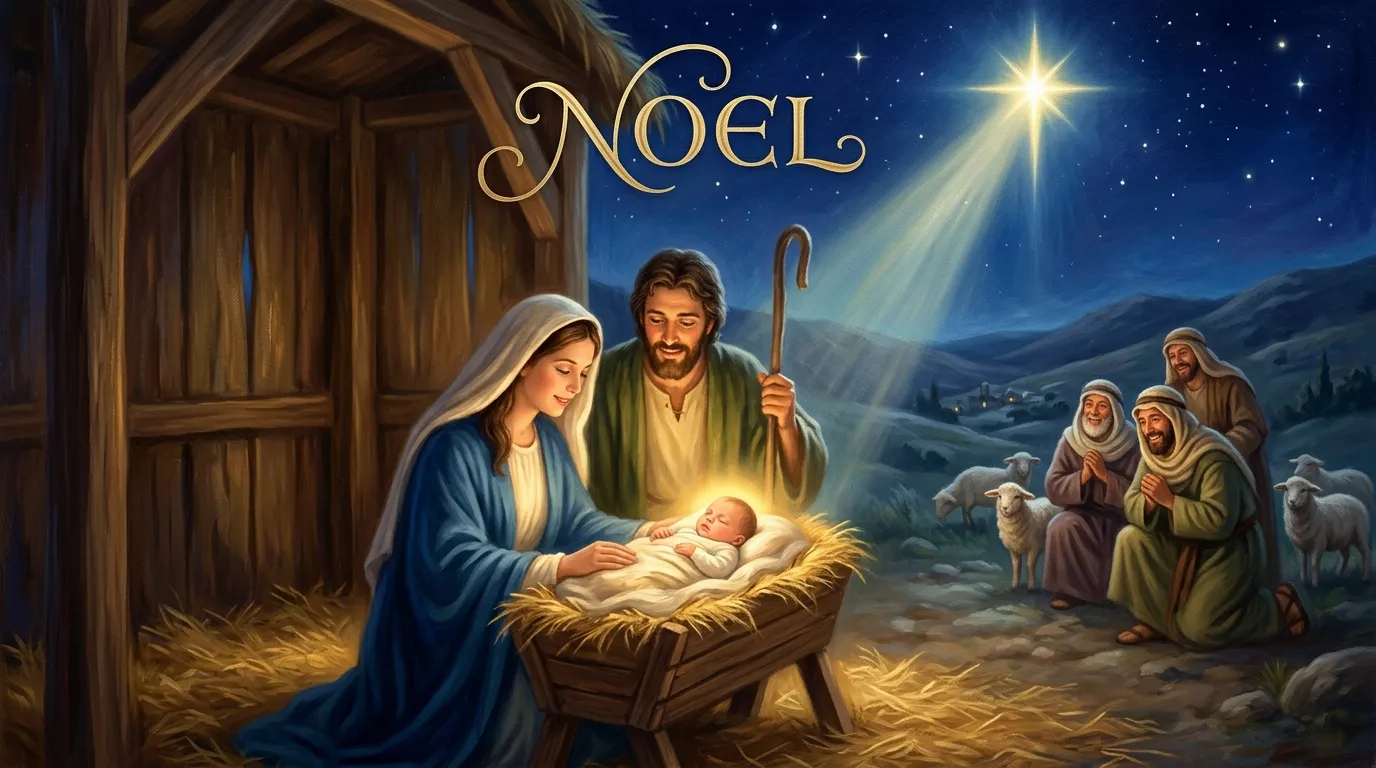
Every December, without fail, it happens. A choir sings “The First Noel,” a radio station plays a centuries-old carol, someone wishes you a “joyeux Noël,” and the word hangs in the winter air like breath on a cold morning. Most English speakers have sung the word hundreds of times without stopping to ask what it actually means, or whether the Bible has anything to say about it. The answer is more interesting than you might expect, and it starts not in Bethlehem but in ancient Rome.
The Road the Word Traveled
Noel is not a Hebrew word, and it is not a Greek word. It comes to English through French: noël, meaning Christmas, which comes from the Latin natalis, meaning “birth” or “birthday.” The Romans used dies natalis for a birthday, and the early Latin-speaking church used natalis Domini, “the birthday of the Lord,” for the feast celebrating Christ’s birth.
Over centuries, as Latin gave way to French, natalis softened into noël, and the word crossed the Channel into English, where it settled into carols and Christmas greetings. So when you sing “Noel,” you are singing a very old word for a very old truth: a birth happened, and it changed everything.
This means the word itself is not in the Bible. No prophet spoke it, no apostle wrote it. But the event it names, the birth of Jesus Christ, is one of the most carefully recorded events in Scripture. The word is a wrapper; the gift inside is entirely biblical.
Why the Bible’s Silence About the Word Does Not Matter
Some Christians worry when a cherished word turns out to be extra-biblical. Should we be suspicious of “Noel” the way we might be suspicious of traditions with no scriptural root? The answer is no, and the reason is simple: the question is never whether a word appears in Scripture, but whether what the word means is true to Scripture.
“Trinity” never appears in the Bible either, yet the church uses it to name a thoroughly biblical reality. “Noel” works the same way. It is shorthand for the incarnation, the doctrine that God the Son took on human flesh and was born of the Virgin Mary. That doctrine is not a thin inference; it is proclaimed outright: “The Word became flesh and made his dwelling among us” (John 1:14).
So sing the word freely. Just make sure you know the weight it carries. Every “Noel” is a confession that God did not stay distant, that He entered the maternity ward of human history, and that a baby’s cry in Bethlehem was the voice of the eternal Son.
The Night the Word Points To: Luke’s Nativity
If Noel means “birth,” then its meaning is written across Luke 2. A decree goes out from Caesar Augustus. A young couple travels to Bethlehem. There is no room in the inn, so the child is laid in a manger, a feeding trough, because heaven’s King would begin His earthly life among animals and end it among criminals, with the poor and the outcast at both ends.
Then Luke does something deliberate. He does not send the birth announcement to the palace in Jerusalem or the temple courts. He sends it to shepherds in a field, men who were religiously marginal and socially invisible. “Today in the town of David a Savior has been born to you; he is the Messiah, the Lord” (Luke 2:11). The greatest news in human history is first entrusted to nobodies, which tells you everything about the kind of kingdom this child came to establish.
And the shepherds’ response becomes the template for every Noel ever sung: they hurried to see, they spread the word, and they returned “glorifying and praising God for all the things they had heard and seen” (Luke 2:20). A carol is just a shepherd’s praise with a melody. Do not rush past the angels’ song, either: “Glory to God in the highest heaven, and on earth peace to those on whom his favor rests” (Luke 2:14). The first Christmas carol was performed by angels, and its theme was glory upward and peace downward. Every Noel since has been an echo of that night-sky chorus.
Matthew’s Side of the Story: The Nations Come
Matthew tells the birth from a different angle, and it deepens what Noel means. Where Luke emphasizes the lowly, Matthew emphasizes the far-off: magi from the east, Gentile scholars following a star, arriving in Jerusalem asking, “Where is the one who has been born king of the Jews?” (Matthew 2:2).
Their gifts are theology in miniature. Gold for a king. Frankincense for deity, the incense of worship. Myrrh for burial, an embalming spice laid at the feet of a newborn, as if even the gifts knew where this story was heading. Matthew is showing that this birth was never a local event. From the beginning, the nations were coming.
And Matthew does not hide the shadow. Herod’s rage, the flight to Egypt, the weeping of Rachel in Ramah (Matthew 2:16-18), all of it sits inside the Christmas story. Noel is not sentimental. Even the location was prophesied seven centuries earlier: “But you, Bethlehem Ephrathah, though you are small among the clans of Judah, out of you will come for me one who will be ruler over Israel” (Micah 5:2). It is the announcement that light has come into a world that will try to extinguish it, and that the light will win.
What the Birth Accomplished: The Theology Inside the Carol
It is worth pausing to say plainly what the incarnation achieved, because “Noel” can become mere atmosphere if we are not careful. The birth of Jesus was God’s answer to the oldest human problem: we were separated from Him, and we could not cross the distance ourselves.
Paul compresses the whole doctrine into a single sentence: “When the set time had fully come, God sent his Son, born of a woman, born under the law, to redeem those under the law, that we might receive adoption to sonship” (Galatians 4:4-5). Notice the logic. To redeem humanity, the Redeemer had to be humanity. He had to be born of a woman, live under the law’s demands, and keep it perfectly where we had failed. Christmas is the first chapter of the atonement.
This is why the church has always treated the virgin birth as non-negotiable. If Jesus were merely a great teacher born in the usual way, His death could save no one. But as the eternal Son, conceived by the Holy Spirit (Luke 1:35), His life had infinite worth and His death could bear infinite weight. Every time you sing “Noel,” you are affirming the miracle that makes salvation possible.
Carols as Theology: Why the Church Sings This Word
There is a reason “Noel” survives mainly in song. The church has always taught its deepest truths through music, because melody carries doctrine into the memory in a way prose cannot. “The First Noel” is not entertainment; it is a creed you can hum. Its verses walk through the angels, the shepherds, and the wise men, and its refrain turns the whole congregation into witnesses.
This is an old pattern. The earliest Christians sang hymns about Christ’s incarnation (Philippians 2:5-11 reads like one). The medieval church taught the illiterate through carols. The Reformers put doctrine into hymns so ordinary people could carry it home. When you sing “Noel” this December, you are standing in a line of worshippers stretching back two thousand years, all saying the same thing: God came.
So sing it like you mean it. Let the word slow you down. Behind the shopping and the lights and the noise, there is a manger, and in the manger there is God, and that is worth a whole season of singing.
Celebrating With Understanding
What should a believer do with all this? First, let the season re-center you. Christmas is not ultimately about family togetherness or generosity, good as those are. It is about the incarnation. If your December has no room for wonder at God becoming flesh, the wrapping has replaced the gift.
Second, follow the shepherds’ pattern: see, tell, praise. Go to the story yourself, read Luke 2 slowly as if for the first time, and notice the quiet details, like Mary treasuring these things and pondering them in her heart (Luke 2:19). Tell someone what it means to you, the way the shepherds “spread the word concerning what had been told them about this child” (Luke 2:17). And praise, because a birth like this one deserves more than acknowledgment. It deserves worship.
Finally, remember that Noel is not only a December word. The incarnation is a year-round reality. The same Jesus who lay in the manger now sits at the Father’s right hand, still human, still bearing the marks of His love for you. Christmas morning is past, but its meaning never expires. For the linguistic journey of the word itself, from Latin natalis through French to the English carol tradition, the Wikipedia article on Noel traces the history in helpful detail.










