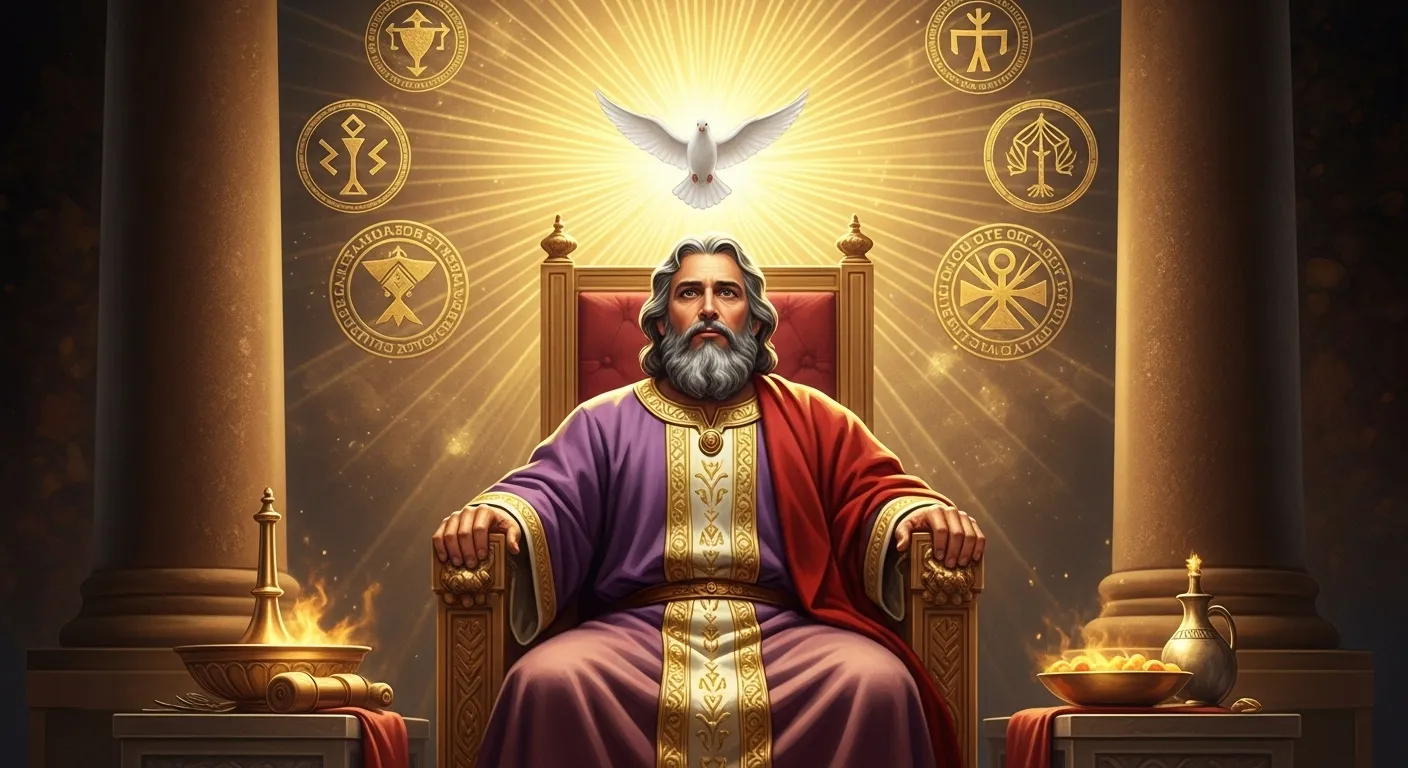
The young king went up to Gibeon to sacrifice — a thousand burnt offerings, the chronicler notes, as if to show the scale of his devotion (1 Kings 3:4). That night, God came to him in a dream: “Ask what I shall give you.” Solomon’s answer is the most famous request in the Old Testament: “Give your servant therefore an understanding mind to govern your people, that I may discern between good and evil” (3:9). Not long life. Not riches. Not the death of his enemies. Wisdom — and God was pleased.
What followed was the most brilliant reign Israel ever knew — and the most tragic collapse. Solomon’s story is the Bible’s great study in how the wisest man alive can still lose his way, and what that means for the rest of us who are not nearly so wise. His name itself preached his calling: Solomon (Hebrew Shlomo) is built on shalom — peace. He was the king of peace, given wisdom, crowned with glory — and he became the warning no one wanted.
The Judgment of the Two Mothers
Wisdom announced itself almost immediately. Two prostitutes came before the king, both claiming the same living baby. Solomon’s verdict was shocking: “Divide the living child in two, and give half to the one and half to the other” (1 Kings 3:25). The true mother cried out — give her the child, only don’t kill him — and the fraud exposed herself by agreeing to the division. “Give the living child to the first woman,” Solomon ordered (3:27).
“And all Israel heard of the judgment that the king had rendered, and they stood in awe of the king, because they perceived that the wisdom of God was in him to do justice” (3:28). Note what the wisdom did: it did not merely solve a puzzle — it discerned hearts. The sword was never meant to fall; it was meant to reveal. True wisdom, Solomon’s first act teaches, is not cleverness but discernment — the ability to see what is really in people. Leaders, parents, and counselors take note: the gift is not for winning arguments but for doing justice.
The House for the Name
Solomon’s defining achievement was the temple — seven years in the building (1 Kings 6:38), the most magnificent structure Israel ever raised. But the building was not the point; the prayer was. At the dedication, Solomon knelt before the altar, spread his hands toward heaven, and prayed one of the longest prayers in the Bible (8:22-53) — and its theology is stunning.
“But will God indeed dwell on the earth? Behold, heaven and the highest heaven cannot contain you; how much less this house that I have built!” (8:27). The wisest king knew the temple could not contain God. It was a meeting place, not a box. And the prayer’s great theme was forgiveness for the future: when Israel sinned and was defeated, exiled, or plagued — “if they pray toward this place… then hear in heaven… and forgive” (8:33-34, 46-50). Solomon built for a day he hoped would never come, and his prayer prepared grace for it in advance.
Then the glory came: “the glory of the LORD filled the house of the LORD” (8:11), and fire fell, and the people bowed with their faces to the ground (2 Chronicles 7:1-3). God signed the building. It was the high-water mark of the kingdom — and, as we shall see, the beginning of the long ebb.
The Queen Who Came to Test
Word of Solomon’s wisdom reached Sheba, and its queen came “to test him with hard questions” (1 Kings 10:1). She saw the house he had built, the food on his table, the seating of his officials — and “there was no more breath in her” (10:5). “The half was not told me,” she confessed. “Happy are your men! Happy are your servants, who continually stand before you and hear your wisdom!” (10:7-8).
Her final words are the visit’s real verdict — and they were not about Solomon at all: “Blessed be the LORD your God, who has delighted in you and set you on the throne of Israel! Because the LORD loved Israel forever, he has made you king” (10:9). The wisest use of wisdom is to make people praise God, not you. The queen came to test a king and left blessing his God. That is what gifts are for — and it is precisely what Solomon would later forget.
The Slow Drift
Here the story turns, and the Bible tells it with devastating calm. “Now King Solomon loved many foreign women” (1 Kings 11:1) — 700 wives, 300 concubines — “and his wives turned away his heart” (11:3). Not in a day. Not in a scandal. Slowly. Political marriages became religious compromises; religious compromises became high places for Chemosh and Molech (11:7); high places became a divided heart: “his heart was not wholly true to the LORD his God” (11:4).
The man who prayed the temple’s dedication prayer built shrines to idols. The man who asked for discernment lost the ability to discern his own drift. The man whose name meant peace left a kingdom that would split in two within a generation of his death (12:16-20). No one is immune. That is the warning, and it is aimed squarely at the wise, the gifted, the blessed — at everyone who thinks it couldn’t happen to me. Solomon proves it can happen to anyone: wisdom without obedience is a lighthouse with the lamp removed.
The mechanism matters more than the scandal. Solomon did not wake up one morning an idolater. He accumulated small compromises — each marriage a treaty, each treaty a shrine, each shrine a step. Spiritual drift is never dramatic at the start; it is administrative. Guard the small compromises. The big fall is only the last one.
The Old Man’s Epilogue
Tradition ascribes Ecclesiastes to Solomon — “the words of the Preacher, the son of David, king in Jerusalem” (Ecclesiastes 1:1) — and whether every word is his or the book is the church’s meditation on his legacy, its verdict reads like Solomon’s epitaph: “Vanity of vanities! All is vanity” (1:2). Wealth, pleasure, projects, wisdom itself — “all was vanity and a striving after wind” (2:11).
But the book does not end in despair. It ends in return: “The end of the matter; all has been heard. Fear God and keep his commandments, for this is the whole duty of man” (12:13). After the experiment with everything, the conclusion is the beginning — the simple obedience the young king at Gibeon had embodied. The wisest man alive spent a lifetime learning what the simplest believer knows on day one: fear God, keep His commandments. It is the most expensive lesson in the Bible, and Solomon paid full price so we wouldn’t have to.
The Greater Son of David
Solomon’s story does not end with Solomon. Jesus pointed beyond him: “The queen of the South will rise up at the judgment with this generation and condemn it, for she came from the ends of the earth to hear the wisdom of Solomon, and behold, something greater than Solomon is here” (Matthew 12:42).
Something greater than Solomon is here. A King with Solomon’s wisdom and none of Solomon’s drift. A temple-builder who said “destroy this temple, and in three days I will raise it up” — “he was speaking about the temple of his body” (John 2:19-21). A Son of David whose kingdom will never divide, whose heart will never turn, whose shalom will never end (Isaiah 9:7). Solomon is the Bible’s great almost — the almost-perfect king who shows us why we needed a perfect one.
So what does Solomon mean in the Bible? He is wisdom given, glory achieved, and the warning that gifts are not character. Seek wisdom as he did at Gibeon. Build for God’s glory as he did at the dedication. But guard your heart as he did not — “above all,” as his own proverb says, “keep your heart with all vigilance, for from it flow the springs of life” (Proverbs 4:23). For the historical Solomon — the archaeology, the chronology, and the debates — Wikipedia’s article on Solomon provides a thorough survey of what history and Scripture together tell us.










