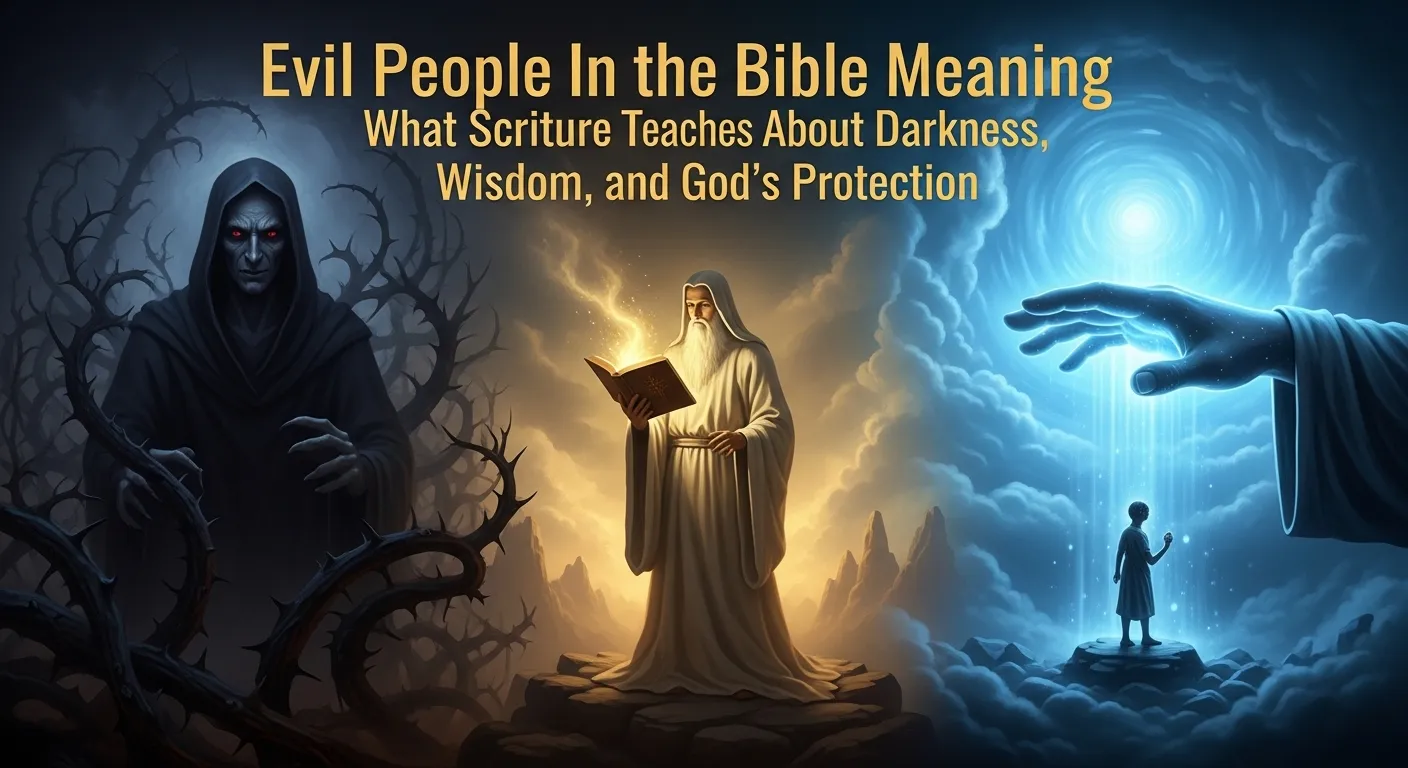
The choir director who wrote Psalm 73 nearly lost his faith over this exact question. Asaph looked around and saw people who mocked God, cheated their neighbors, and grew richer every year. He admitted it plainly: “My feet had almost slipped… for I envied the arrogant when I saw the prosperity of the wicked” (Psalm 73:2–3). He did not pretend the problem away. He brought it into the sanctuary, and there he learned how to see evil people the way God sees them — not as puzzles to solve or enemies to hate, but as a warning, a mirror, and an occasion for faith.
That is the right starting place, because Scripture never ignores evil people. It studies them with unusual honesty. From the first family on earth to the last hours of Jesus, the Bible gives us long portraits of men and women who hardened their hearts, chose cruelty, and left wreckage behind. The meaning of evil people in the Bible is not meant to frighten you or make you cynical. It is meant to sharpen your discernment, protect your own heart, and deepen your confidence in a God who sees everything and judges rightly.
Cain’s Question and the Pattern It Reveals
The first evil person in Scripture is a brother. Cain killed Abel out of jealousy, and when God confronted him, Cain asked the question every wicked heart asks in one form or another: “Am I my brother’s keeper?” (Genesis 4:9). Genesis 4 is short, but it establishes the pattern that every later portrait follows. Sin begins not with an act but with a refusal — Cain refused to master the sin crouching at his door (Genesis 4:7), and the refusal became a murder.
Follow the pattern forward and the faces change but the anatomy stays the same. Pharaoh in Exodus hardens his own heart repeatedly before God completes the hardening (Exodus 8:15, 32) — Scripture shows both his choice and its consequence. Jezebel in 1–2 Kings uses royal power to silence prophets, steals Naboth’s vineyard through false witnesses, and promotes Baal worship until the nation bleeds idolatry. Haman in Esther nurses one man’s refusal to bow into a plot to exterminate an entire people. Judas Iscariot sits at the table with Jesus, hears the same teachings, watches the same miracles, and then sells the Son of Man for thirty pieces of silver — the price of a slave (Matthew 26:14–16; Exodus 21:32).
Notice what the Bible does with each of them. It does not flatten them into cartoon villains. It shows their motives plainly: jealousy (Cain), pride and economic interest (Pharaoh), appetite for control (Jezebel), wounded ego (Haman), greed and disillusionment (Judas). Sin has a genealogy, and Scripture traces it so readers can recognize the early symptoms in themselves. The apostle John gives the universal diagnosis: “For all have sinned and fall short of the glory of God” (Romans 3:23). The difference between an evil person in the biblical sense and an ordinary sinner is not the presence of sin but the posture toward it — a hardened heart keeps refusing, while a softened heart keeps repenting.
What Evil People Are Not — A Necessary Correction
Before going further, Scripture demands an honest correction, because this topic has been misused. The Bible’s evil people are not the difficult neighbor, the annoying relative, the political opponent, or the person who hurt you in a church dispute. Jesus was crucified partly because religious leaders confidently labeled the wrong people as evil — they called Him a blasphemer and a friend of sinners, and they were wrong on both counts (Luke 7:34; Mark 14:64).
The Gospels show Jesus eating with tax collectors and prostitutes while reserving His harshest words for the polished, outwardly religious men who used Scripture as a weapon (Matthew 23). That should make every reader careful. An “evil person” in the biblical sense is someone who persistently, knowingly works harm and refuses correction — the false teacher described in 2 Peter 2, the slanderer of Proverbs 6:16–19, the one who “plots evil in his heart” and “spreads strife” (Proverbs 6:14). Scripture also distinguishes between the person and the power behind them: “For our struggle is not against flesh and blood” (Ephesians 6:12). People can be captured by evil without becoming identical to it, and that distinction is what keeps discernment from curdling into hatred.
This matters practically. If you have been wounded by someone, the Bible does not ask you to declare them permanently evil and write them off. It asks you to tell the truth about the harm, set wise boundaries, pray for them (Matthew 5:44), and leave the final judgment to the one Judge who sees hearts (Romans 12:19). Labeling someone “evil” is easy; dealing with them biblically is hard — which is precisely why Scripture gives instructions rather than slogans.
The Warnings Scripture Attaches to Them
So why does the Bible give evil people so much page space? Because each portrait is a road sign. Consider three warnings that run through them all.
First, evil is contagious, so choose your company carefully. “Bad company corrupts good character,” Paul writes (1 Corinthians 15:33), and Proverbs says the same a thousand ways: “Do not make friends with a hot-tempered person… or you may learn their ways” (Proverbs 22:24–25). Jezebel did not just sin privately; she made Baal worship the state religion and taught a generation to call evil good. The people around an evil person are always its first casualties.
Second, small compromises become settled character. No one in Scripture wakes up one morning as a finished villain. Pharaoh’s heart hardens one plague at a time. Judas’s theft begins with pilfering from the money bag before it becomes betrayal (John 12:6). The writer of Hebrews warns believers to encourage one another daily “so that none of you may be hardened by sin’s deceitfulness” (Hebrews 3:13). The trajectory matters more than the moment: evil people are what happens when the crouching sin of Genesis 4:7 is fed for years.
Third, God sees, and God will act — on His timetable. Asaph’s crisis in Psalm 73 resolves when he enters the sanctuary and “understood their final destiny” (Psalm 73:17). Pharaoh’s empire drowns in the sea. Haman hangs on the gallows he built for Mordecai. Jezebel’s body is trampled at Jezreel exactly as Elijah prophesied. Judas’s silver buys a field of blood. The Bible is not naive about the temporary success of the wicked; it is simply certain about the ending. “Do not fret because of those who are evil,” David writes, “for like the grass they will soon wither” (Psalm 37:1–2).
How to Live Among Them Without Becoming One
This is where the topic turns practical, and Scripture is remarkably specific. The Bible never counsels either naivety or vengeance. It counsels wisdom — a third way.
- Guard your own heart first. “Above all else, guard your heart, for everything you do flows from it” (Proverbs 4:23). The danger is not only being harmed by evil people but being reshaped by them — answering cruelty with cruelty, deceit with deceit. The heart you protect is the one evil cannot reach.
- Do not repay evil for evil. Romans 12:17–21 is the New Testament’s complete manual: “Do not be overcome by evil, but overcome evil with good” (Romans 12:21). This is not weakness; it is the strategy of the cross itself, where Jesus answered the ultimate evil with the ultimate good.
- Set boundaries without bitterness. Paul tells the Corinthians to expel the unrepentant (1 Corinthians 5), tells Timothy to turn away from certain people (2 Timothy 3:5), and tells Titus to warn a divisive person twice and then “have nothing to do with them” (Titus 3:10). Distance is sometimes the biblical answer — enforced calmly, without hatred.
- Pray for them, genuinely. Jesus commands it: “Love your enemies and pray for those who persecute you” (Matthew 5:44). This is not a feeling you manufacture; it is an obedience you practice. Prayer keeps your heart from hardening into the very thing you oppose, and it acknowledges that the worst person you know is still a person Christ died for.
- Rest in God’s protection, not your own vigilance. Psalm 91 promises that the one who dwells in the shelter of the Most High will find refuge; Romans 8:31 asks the unanswerable question, “If God is for us, who can be against us?” You do not have to outsmart every evil person. You have to stay close to the God who already sees them.
There is one more instruction, and it is the most uncomfortable: examine yourself. When Nathan told David, “You are the man!” (2 Samuel 12:7), the king who had murdered and covered it up wept and repented instead of hardening. That is the fork in the road every reader faces. The stories of evil people in Scripture are mirrors before they are windows. Each one asks the same quiet question Cain heard at the door of his tent: will you master it, or will it master you?
The Bible’s final word on this subject is neither fear nor fury. It is hope held inside realism. Evil people are real, their damage is real, and God’s judgment of them is real — but so is His power to protect His children, to convert a persecutor like Saul into an apostle like Paul, and to bring every wrong into the light at last. Live wisely, love genuinely, guard your heart, and leave the vengeance to the Lord. History — and eternity — is on the side of the righteous. Students of the subject often consult the Wikipedia overview of evil to see how philosophers and theologians through the centuries have wrestled with the same question Asaph asked in the sanctuary: why do the wicked prosper, and what does justice ultimately look like?










