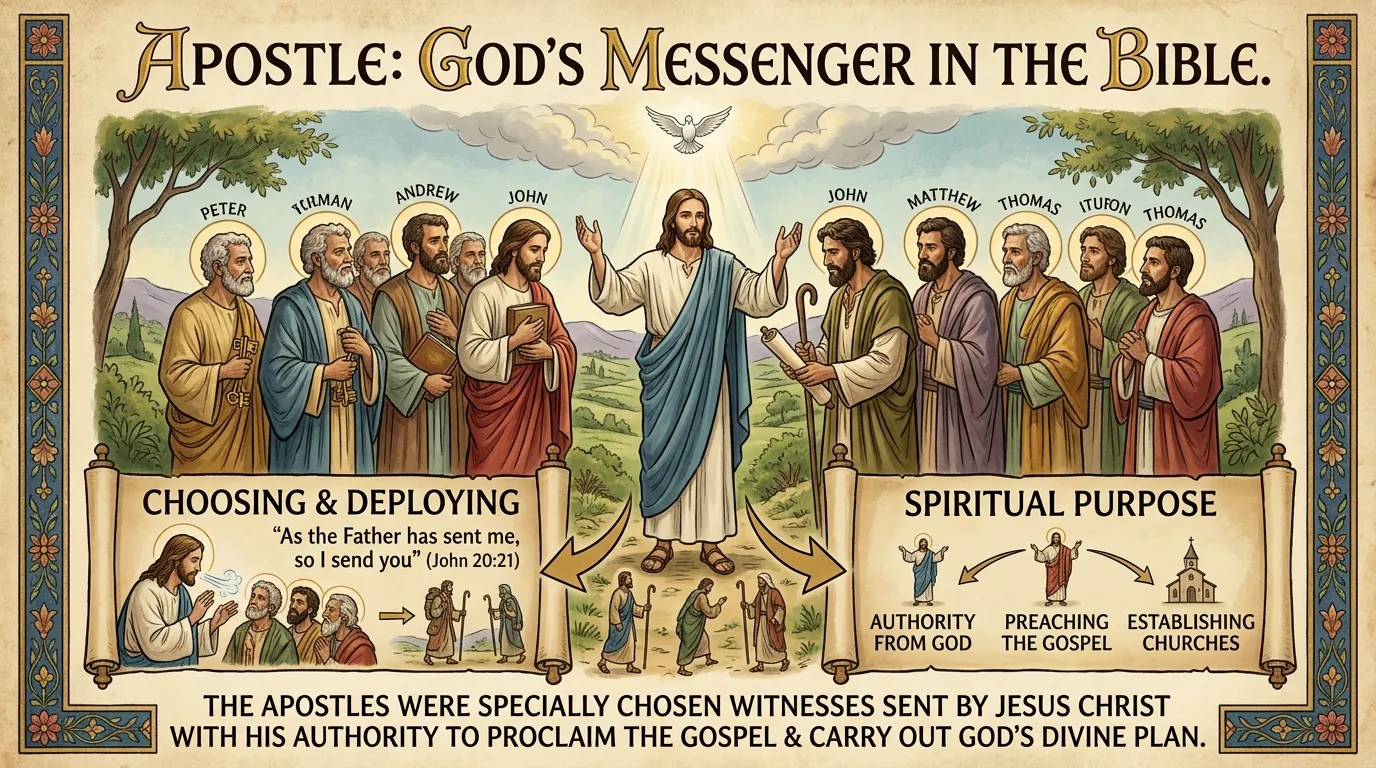
Before it was a church title, apostle was an ordinary word for an unremarkable job. In the Greek of the ancient world, an apostolos was simply someone sent — a messenger, an envoy, a delegate dispatched with someone else’s authority. Naval fleets were “sent out”; ambassadors were “sent” to foreign courts. The word carried no halo. It described a function: you go because someone greater told you to go, and you speak because someone greater gave you the message.
Jesus took this workaday word and filled it with eternal weight. When he appointed the Twelve, Mark says he did so “that they might be with him and he might send them out to preach” (Mark 3:14). Note the order — with him first, sent second. Apostleship in the Bible is never a self-appointed platform. It is a sending, and the sending presupposes the being-with. Every true apostle in Scripture is first a companion of Christ and only then his courier.
Apostolos: The Word Before the Title
The New Testament uses apostolos about eighty times, and nearly always of people commissioned directly by the risen Christ. The verb behind it, apostellō — “to send” — appears over 130 times, and Jesus applies it to himself constantly: “as the Father has sent me, even so I am sending you” (John 20:21). That single sentence is the charter of all Christian mission. Jesus is the Sent One, par excellence — the Apostle of our confession, as Hebrews 3:1 daringly calls him — and every human apostle is a ripple from that sending.
This is why the qualifications for replacing Judas were so strict: the candidate had to have “accompanied us during all the time that the Lord Jesus went in and out among us, beginning from the baptism of John until the day when he was taken up from us” — and become “a witness to his resurrection” (Acts 1:21–22). An apostle was not a gifted organizer or a charismatic speaker. An apostle was an eyewitness, authorized to testify: I saw him dead, and I saw him alive.
The Twelve and the Unlikely Thirteenth
The Twelve are the foundation stones — so literally that the New Jerusalem’s wall “had twelve foundations, and on them were the twelve names of the twelve apostles of the Lamb” (Revelation 21:14). Their names are listed four times in the New Testament, always with Peter first and Judas last, as if Scripture itself cannot forget either the rock or the wound.
And then there is Paul — the apostle who breaks every pattern. Not one of the Twelve. Not a companion of Jesus’ earthly ministry. A persecutor of the church, confronted by the risen Christ on the Damascus road and commissioned on the spot: “he is a chosen instrument of mine to carry my name before the Gentiles and kings and the children of Israel” (Acts 9:15). Paul spends half his letters defending an apostleship nobody voted him into — “an apostle… through Jesus Christ and God the Father” (Galatians 1:1), “last of all, as to one untimely born” (1 Corinthians 15:8). His existence proves that apostleship is Christ’s appointment, not the church’s election.
Scripture also applies the word more broadly — Barnabas (Acts 14:14), James the Lord’s brother (Galatians 1:19), and possibly Andronicus and Junia (Romans 16:7) — suggesting a wider circle of “sent ones” around the foundational Twelve. The inner ring is fixed and unrepeatable; the outer pattern of being sent keeps rippling outward.
What Apostles Actually Did
Strip away the stained glass and the apostolic job description is strikingly concrete:
- They witnessed. “You will be my witnesses in Jerusalem and in all Judea and Samaria, and to the end of the earth” (Acts 1:8). Testimony to the resurrection was the non-negotiable core.
- They founded. The church is “built on the foundation of the apostles and prophets, Christ Jesus himself being the cornerstone” (Ephesians 2:20). Foundations are laid once; everything else is built on them.
- They suffered. Paul’s résumé of apostleship is a catalog of beatings, shipwrecks, and sleepless nights (2 Corinthians 11:23–28). In the kingdom, authority is authenticated by scars, not by applause.
- They confirmed the message with signs. “The signs of a true apostle were performed among you with utmost patience, with signs and wonders and mighty works” (2 Corinthians 12:12) — miracles as God’s seal on the message, not as the apostles’ personal power.
Counterfeits: Paul’s Warning in 2 Corinthians
Where God sends true messengers, someone always counterfeits the credentials. Paul’s anguished warning to Corinth is the Bible’s sharpest passage on the subject: “such men are false apostles, deceitful workmen, disguising themselves as apostles of Christ. And no wonder, for even Satan disguises himself as an angel of light” (2 Corinthians 11:13–14). The test was never charisma, success, or confidence — the false apostles had all three. The test was the message (did they preach “another Jesus”? v. 4) and the life (did they serve or exploit? vv. 7–9, 20).
John gives the same test in miniature: “do not believe every spirit, but test the spirits to see whether they are from God” (1 John 4:1). The apostolic age’s rule still governs every age: measure the messenger by the message, and measure the message by Christ.
Does the Office Continue?
Christians answer this differently, and honesty requires saying so. What all agree on: the foundational office — eyewitnesses of the risen Christ laying the church’s once-for-all foundation — is closed. Nobody today meets the Acts 1 qualifications, and Revelation’s twelve foundations have twelve names, not thirteen. What continues unambiguously is the pattern: Christ still sends his people — “as the Father has sent me, even so I am sending you” was spoken to the whole room, not just the Twelve. Missionaries, church planters, and gospel couriers of every kind stand in the long shadow of the apostles’ sending, even while the apostles’ unique office remains theirs alone.
The safest summary is Paul’s own, from the letter where he most needed the title: apostleship is “not from men nor through man, but through Jesus Christ” (Galatians 1:1). Sent-ness, not self-importance. Message, not platform. Scars, not spotlights. That is what the word meant before the church gilded it — and it is what the word still means wherever Christ is truly sending people today.
The Apostles’ Deposit: What They Left Behind
The apostles are gone; their deposit remains. Paul tells Timothy to guard “the good deposit entrusted to you” (2 Timothy 1:14) — the body of apostolic teaching, delivered once and preserved in the New Testament. “Built on the foundation of the apostles and prophets” (Ephesians 2:20) means the church never outgrows its foundation; it builds on it. Three things about that deposit matter enormously:
It is complete. Jude urges believers to “contend for the faith that was once for all delivered to the saints” (Jude 3) — once for all, not progressively supplemented by new revelations of equal authority. The apostolic witness closed with the apostolic age, and the church’s job since has been transmission and application, not addition. This is why the New Testament canon — the church’s recognition of the apostolic writings — is so precious: it is the sent-ones’ message in permanent form.
It centers on Christ. The apostles’ preaching, summarized in Acts, is relentlessly Christ-focused: his death “for our sins in accordance with the Scriptures,” his burial, his resurrection, his exaltation, and the call to repent and believe (1 Corinthians 15:3–4; Acts 2:36–38). They never preach themselves — “what we proclaim is not ourselves, but Jesus Christ as Lord, with ourselves as your servants for Jesus’ sake” (2 Corinthians 4:5). Any “apostolic” ministry that centers the minister has abandoned the apostles.
It produces a pattern of life. “They devoted themselves to the apostles’ teaching and the fellowship, to the breaking of bread and the prayers” (Acts 2:42). Doctrine, community, worship, prayer — the fourfold rhythm of the first church, and still the church’s health checklist. Where the apostles’ teaching is truly received, these four flourish; where they wither, the teaching has been lost no matter what the signage says.
This is the apostles’ enduring gift: not a perpetual office but a perpetual message. The sent-ones were sent, they spoke, and their words — “the word of God, which is at work in you believers” (1 Thessalonians 2:13) — are still working. Every sermon faithful to the text, every missionary carrying the gospel to a new place, every believer sharing Christ with a neighbor stands in the apostolic succession that matters most: succession of the message.
So when you meet the word apostle in your reading, hear the sending in it. Behind every epistle stands a person who was with Jesus, saw him risen, and could not stay silent — “we cannot but speak of what we have seen and heard” (Acts 4:20). Their commission became our Scripture; their witness became our faith. The sent-ones finished their course (2 Timothy 4:7). The message they carried is now in your hands — which makes you, in the deepest sense, the next one sent.
For the broader history — how the concept developed from the first century through church tradition, and how different communions understand apostolic succession — the encyclopedia’s article on apostles provides a thorough overview. Scripture itself, though, keeps the definition wonderfully simple: one who was with him, saw him risen, and was sent to say so.










