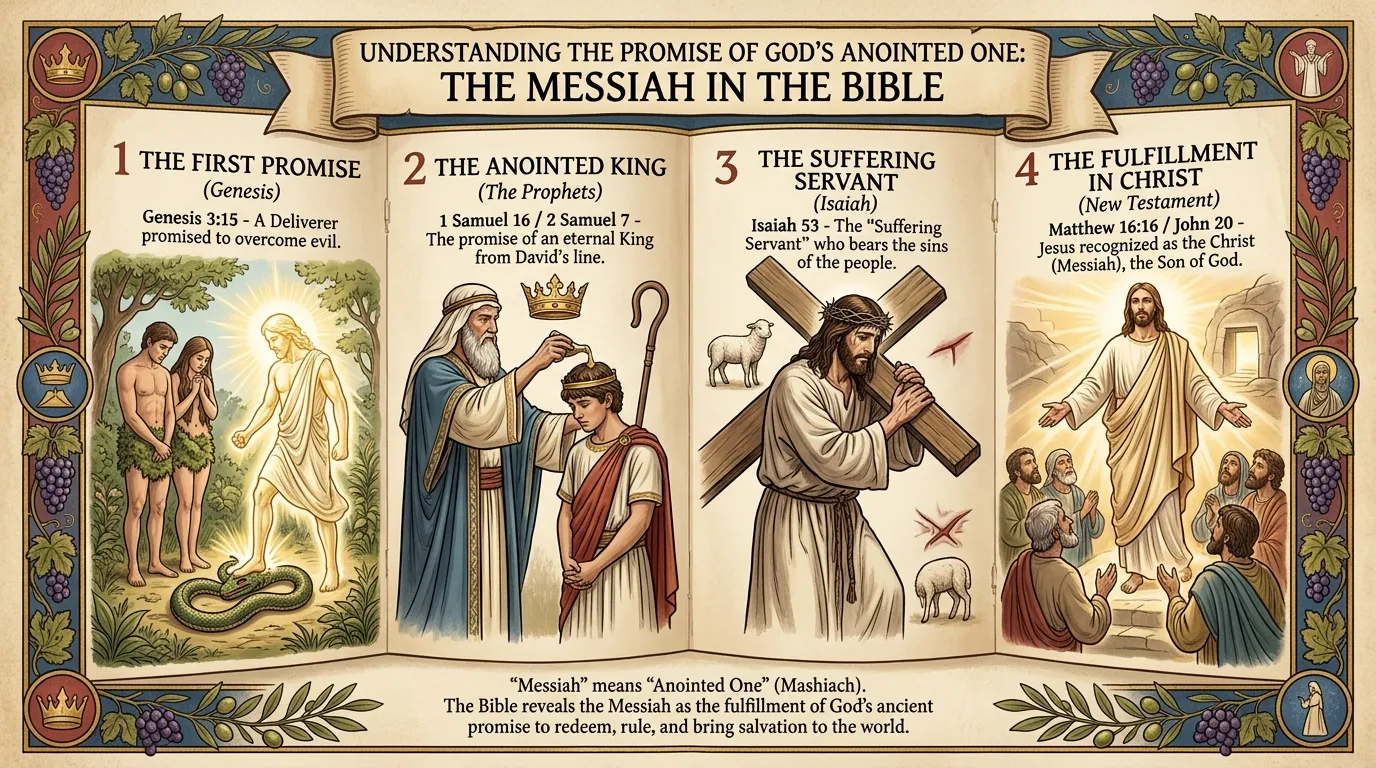
No title in Scripture carries a longer wait behind it. From the first pages of Genesis to the last pages of Malachi, across roughly a thousand years of prophecy, God’s people watched the horizon for one promised figure — the Messiah, the Anointed One, the one who would finally set everything right. By the time Jesus of Nazareth arrives, the expectation is white-hot: crowds ask John the Baptist point-blank, “Are you the Christ?” (John 1:25), and Andrew runs to his brother with the news of the ages: “We have found the Messiah” (John 1:41). To understand the word is to understand the whole plot of the Bible.
A Promise in the Garden
The messianic thread starts astonishingly early — in the wreckage of Eden itself. Before God pronounces judgment on Adam and Eve, he speaks to the serpent: “I will put enmity between you and the woman, and between your offspring and her offspring; he shall bruise your head, and you shall bruise his heel” (Genesis 3:15). Theologians call this the protoevangelium — the first gospel. In the very hour of humanity’s fall, God promises a descendant of the woman who will crush the serpent’s head at the cost of his own wounding. Every later messianic prophecy is a zoom lens on this verse: a coming offspring, a decisive victory, a terrible cost.
The promise narrows as the story moves. To Abraham: “in your offspring shall all the nations of the earth be blessed” (Genesis 22:18). To Judah: “the scepter shall not depart from Judah” (Genesis 49:10). To David, the great covenant promise: “I will establish the throne of his kingdom forever” (2 Samuel 7:13) — a son of David who will reign without end. By the time the prophets take up the theme, the identikit is detailed: of David’s line, from Bethlehem (Micah 5:2), preceded by a forerunner (Malachi 3:1), and yet somehow eternal — “whose coming forth is from of old, from ancient days” (Micah 5:2).
Mashiach: What “Anointed” Promised
The Hebrew word mashiach simply means “anointed one” — smeared with oil as a sign of divine appointment. Kings were anointed (1 Samuel 10:1), priests were anointed (Leviticus 8:12), and prophets could be (1 Kings 19:16). Cyrus the Persian is even called God’s mashiach (Isaiah 45:1) — anointed for a task, not for worship.
But over the centuries, the Anointed One — with the definite article — became shorthand for the ultimate king-priest-prophet, the one who would combine all three offices in a single person. The Psalms feed this hope: “The kings of the earth set themselves… against the Lord and against his Anointed” (Psalm 2:2), and God’s answer is to install his king on Zion. Daniel gives the hope a timetable and a shocking detail — the Anointed One will be “cut off and shall have nothing” (Daniel 9:26). Victory through being cut off: the paradox is planted centuries before the cross.
The Expectation Jesus Walked Into
First-century Israel wanted the Messiah desperately — but most wanted him as a political deliverer. When Jesus feeds the five thousand, the crowd tries “to take him by force to make him king” (John 6:15). When he enters Jerusalem, they carpet his path shouting “Hosanna to the Son of David!” (Matthew 21:9) — a coronation chant. Even his own disciples, after the resurrection, ask: “Lord, will you at this time restore the kingdom to Israel?” (Acts 1:6). The categories were right; the shape was wrong. They expected a throne without a cross.
Jesus spends his ministry gently breaking and remaking the category. He accepts Peter’s confession — “You are the Christ, the Son of the living God” (Matthew 16:16) — and immediately predicts his suffering and death, earning Peter’s rebuke and his own famous counter-rebuke: “Get behind me, Satan!” (16:23). The Messiah would conquer, yes — but “the Son of Man came not to be served but to serve, and to give his life as a ransom for many” (Mark 10:45). Conquest by self-giving: that was the plot twist no one saw coming.
Why the Cross Looked Like Failure
At the crucifixion, the mockery writes itself in messianic language: “He saved others; let him save himself, if he is the Christ of God, his Chosen One” (Luke 23:35). “Let the Christ, the King of Israel, come down now from the cross” (Mark 15:32). To every observer, the cross was the definitive disproof — messiahs do not die; messiahs win.
The resurrection is God’s rebuttal, and the early church’s preaching never lets go of the logic. Peter at Pentecost: “God has made him both Lord and Christ, this Jesus whom you crucified” (Acts 2:36). Paul’s summary: Christ died, was buried, was raised — “in accordance with the Scriptures” (1 Corinthians 15:3–4). The cross was not plan B. It was the bruised heel of Genesis 3:15, the cut-off Anointed of Daniel 9, the suffering servant of Isaiah 53 — “he was pierced for our transgressions” — all along.
The Servant Songs: Isaiah’s Close-Up Portrait
If the prophets give us the identikit, Isaiah gives us the face. His four “Servant Songs” (Isaiah 42, 49, 50, 52–53) paint the Messiah in strokes no one else attempted. The Servant will bring justice to the nations — but “a bruised reed he will not break, and a faintly burning wick he will not quench” (42:3). Power exercised as gentleness: that is the messianic signature.
The final song is the most staggering passage in the Old Testament. The Servant is despised and rejected, “wounded for our transgressions… and with his wounds we are healed” (53:5). He is led like a lamb to slaughter, assigned a grave with the wicked, and yet — “he shall see his offspring; he shall prolong his days” (53:10). Death, then life beyond it. Isaiah wrote it seven centuries before Calvary, and the early church could hardly believe their luck: Philip finds the Ethiopian eunuch reading this very chapter and “beginning with this Scripture he told him the good news about Jesus” (Acts 8:35). The portrait had been hanging in the gallery all along, waiting for its subject to step into the frame.
Confessing the Messiah Today
The question Jesus put to his disciples still hangs in the air over every reader: “But who do you say that I am?” (Matthew 16:15). The messianic hope is not ancient trivia; it is a present-tense claim that reorganizes a life around it. A few implications the New Testament draws out:
- Allegiance. “No one can say ‘Jesus is Lord’ except in the Holy Spirit” (1 Corinthians 12:3). Confessing the Messiah means transferring final loyalty — from self, from tribe, from empire — to him.
- Suffering with hope. The Messiah’s path ran through the cross to the crown; his followers should expect the same sequence. “If we suffer, we shall also reign with him” (2 Timothy 2:12).
- Mission. The risen Messiah’s last words commission his people: “repentance for the forgiveness of sins should be proclaimed in his name to all nations” (Luke 24:47). Those who have found the Messiah become, like Andrew, people who run to tell their brothers.
The Messiah’s Two Arrivals
The New Testament resolves the ancient tension — conquering king or suffering servant? — with a timeline: both, in order. The first coming accomplished redemption through suffering; the second will accomplish restoration through reign. “Behold, he is coming with the clouds, and every eye will see him” (Revelation 1:7). The church lives between the arrivals — saved by the first, waiting for the second, announcing both.
That is why Christ — the Greek translation of mashiach — became Jesus’ virtual surname: Jesus Christ is not first-name-last-name but name-plus-title, Jesus the Messiah. Every time the church says it, it confesses the whole story: the promised one came, the promised one died, the promised one rose, and the promised one is coming again. The longest wait in history ended in a manger — and it ends, finally, on a throne.
The Messiah’s Pattern in Miniature: Your Story
The Messiah’s shape — suffering first, glory after — turns out to be the template for every believer’s life. Peter, who watched the Messiah suffer, writes to suffering Christians: “Christ also suffered for you, leaving you an example, so that you might follow in his steps” (1 Peter 2:21). Paul puts it as a principle: “through many tribulations we must enter the kingdom of God” (Acts 14:22). The cross-then-crown sequence is not only Christ’s biography; it is the Christian’s itinerary.
This reframes hardship entirely. The suffering you are enduring is not evidence that the Messiah has abandoned the script — it is evidence you are in the script. “If we suffer, we shall also reign with him” (2 Timothy 2:12). The Messiah walked the road first, from the manger’s poverty to the cross’s agony to the tomb’s silence to the resurrection’s dawn. Those united to him walk the same road in the same order — and arrive at the same destination: “when Christ who is your life appears, then you also will appear with him in glory” (Colossians 3:4).
Beyond the biblical portrait, the title has a vast history in Jewish and Christian thought — competing expectations, medieval debate, modern theology — and the encyclopedia’s article on the Messiah maps that larger landscape. Scripture’s own claim, though, is the one Andrew ran to share: the wait is over, and his name is Jesus.










