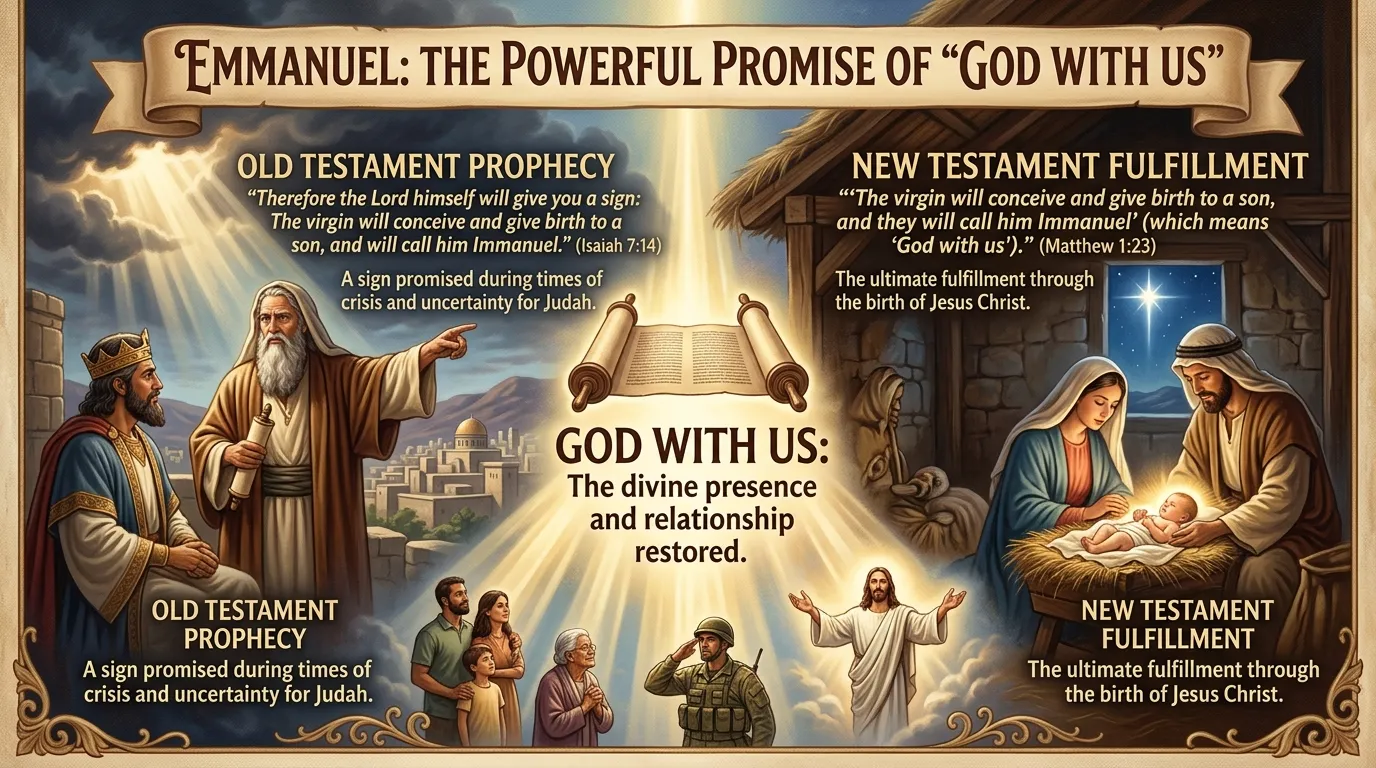
It was the worst week of King Ahaz’s life. Two armies — Syria and the northern kingdom of Israel — were marching on Jerusalem, and “his heart and the heart of his people shook as the trees of the forest shake before the wind” (Isaiah 7:2). Into that panic walks the prophet Isaiah with an offer from God himself: ask for a sign, any sign, as deep as Sheol or as high as heaven. Ahaz, hiding his unbelief behind false piety, refuses. So God gives a sign anyway — and it is not about armies at all: “Behold, the virgin shall conceive and bear a son, and shall call his name Immanuel” (Isaiah 7:14). God with us. In the middle of a military crisis, heaven’s answer is a baby’s name.
A Sign for a Terrified King
To feel the weight of Isaiah 7:14, you have to sit inside Ahaz’s fear. Jerusalem’s water supply, its walls, its alliances — every earthly security was failing at once. God’s sign bypasses all of it. He does not promise Ahaz a bigger army or a cleverer strategy. He promises a child whose very name declares the one thing fear cannot survive: God is with us.
The Hebrew is Immanu-El — immanu, “with us,” plus El, God. Names in Isaiah’s world were sermons you could speak in a single breath, and this one preached the oldest promise in Scripture to a king who had forgotten it. The immediate context points to a child born in Isaiah’s own day — a ticking clock proving that God would deal with the invading kings before the boy knew right from wrong (7:15–16). But the name was always too big for one baby. Like so many prophecies, it had a near horizon and a far horizon — and Matthew would later show us the far one.
Matthew’s Bold Claim
Seven centuries later, an angel appears to a frightened carpenter in a dream: “Joseph, son of David, do not fear to take Mary as your wife, for that which is conceived in her is from the Holy Spirit. She will bear a son, and you shall call his name Jesus, for he will save his people from their sins.” Then Matthew adds the editorial comment that changed Christmas forever: “All this took place to fulfill what the Lord had spoken by the prophet: ‘Behold, the virgin shall conceive and bear a son, and they shall call his name Immanuel’ (which means, God with us)” (Matthew 1:20–23).
Notice Matthew’s care: the child’s given name is Jesus — “he will save” — but his called name, his identity-name, is Immanuel. Salvation and presence belong together. God does not save from a distance; he saves by arriving. The virgin birth is not a biological curiosity — it is the mechanism of Immanuel. For God to be truly with us, he had to become one of us, and that required an entrance no ordinary birth could provide.
God With Us: The Thread Through Scripture
Immanuel is not an isolated Christmas ornament; it is the summary of the entire Bible’s plot. Trace the thread:
- Eden: God walks with humanity in the garden (Genesis 3:8) — presence before the fall.
- The tabernacle: “Let them make me a sanctuary, that I may dwell in their midst” (Exodus 25:8). God pitches his tent inside the camp.
- The temple: Solomon’s dedication prayer marvels that God would “dwell on earth” (1 Kings 8:27) — and yet the glory fills the house.
- The incarnation: “The Word became flesh and dwelt among us” (John 1:14) — literally, tabernacled among us. The tent becomes a person.
- The Spirit: “I will ask the Father, and he will give you another Helper, to be with you forever” (John 14:16). Immanuel internalized.
- The new creation: “Behold, the dwelling place of God is with man. He will dwell with them” (Revelation 21:3). Immanuel, forever, without interruption.
From garden to city, the story arcs toward unbroken presence. Every earlier dwelling was partial, mediated, or temporary. The baby named Immanuel is the hinge on which the whole arc turns.
What Changes When God Is With
A name is a promise, and promises demand response. If God is truly with us, several things follow that fear hates and faith loves:
Fear loses its arithmetic. Ahaz’s problem was math — two armies versus one city. Immanuel changes the equation: “If God is for us, who can be against us?” (Romans 8:31). The presence of God does not always remove the threat, but it always outnumbers it.
Loneliness loses its finality. There are places human companionship cannot go — the hospital room at 3 a.m., the grief no one else understands, the guilt no one else knows. “Even though I walk through the valley of the shadow of death, I will fear no evil, for you are with me” (Psalm 23:4). Immanuel is God’s answer to the valley.
Obedience gains its motive. We do not obey to attract God’s presence; we obey because we already have it. “Teaching them to observe all that I have commanded you. And behold, I am with you always, to the end of the age” (Matthew 28:20). The Great Commission’s hardest assignment comes wrapped in the gospel’s sweetest promise — the book of Matthew both opens and closes with God with us.
Immanuel Among the “With-Us” Promises
Scripture loves to attach God’s presence to his people’s crises as if it were a signature. To a fugitive Jacob: “Behold, I am with you and will keep you wherever you go” (Genesis 28:15). To an overwhelmed Moses: “My presence will go with you, and I will give you rest” (Exodus 33:14). To a young warrior facing giants: “Be strong and courageous… for the Lord your God is with you wherever you go” (Joshua 1:9). To a frightened prophet in a cistern’s shadow: “Do not fear… for I am with you” (Jeremiah 1:8).
Immanuel gathers all these scattered promises into a single proper name — and then into a single person. What was once a word of comfort spoken to the faithful becomes a child placed among them. The trajectory matters: God moved from telling his people he was with them to showing them, in flesh they could touch. “That which we have heard, which we have seen with our eyes, which we looked upon and have touched with our hands” (1 John 1:1). Immanuel is the promise you can hold.
The Name We Still Pray
Centuries of Christians have kept Immanuel alive in carol and liturgy — “O come, O come, Emmanuel” is a twelfth-century chant still sung every December — because the church keeps needing what Ahaz needed: a sign that God has not left the field. Every Christmas, the name preaches again to the terrified: your crisis is real, but it is not the deepest reality. The deepest reality has a name, and the name means he is here.
So when fear shakes your heart like trees in the wind, borrow Ahaz’s sign — the one he refused and God gave anyway. Speak the old Hebrew over your situation: Immanu-El. Not God was with us, not God will be with us when things improve, but God with us — in the manger, in the valley, in the ordinary Tuesday. That is the whole gospel in two words.
Singing Immanuel: The Church’s Memory
The church has never let the name go. The Advent chant “O Come, O Come, Emmanuel” dates to the twelfth century — a paraphrase of the ancient “O Antiphons,” seven titles of the Messiah sung in the week before Christmas. For eight hundred years, Christians have begun every December by pleading with Emmanuel to “ransom captive Israel.” The carol is theology set to a haunting minor key: the God who is with us is the God who rescues us, and Advent is the season of remembering both.
Charles Wesley’s “Hark! The Herald Angels Sing” presses the doctrine further: “Veiled in flesh the Godhead see; hail th’ incarnate Deity.” And “O Holy Night” places the singer at the manger: “the thrill of hope, the weary world rejoices.” Christmas carols are, disproportionately, Immanuel songs — because Christmas is the feast of God’s arrival. Every December, the church re-learns what Ahaz forgot: when everything shakes, God does not send a memo. He comes himself.
Keep the name alive beyond December. Name your fears before him specifically — the diagnosis, the debt, the difficult person — and answer each with the two-word sermon: God with us. Write it where you will see it. Teach it to your children as the answer to nighttime fears: “I am with you” is God’s most repeated promise in Scripture, appearing in some form over a hundred times. A promise repeated that often is a promise he desperately wants believed.
For the historical and theological background — the Isaiah context, the virgin-birth debates, and the name’s use across Christian tradition — the encyclopedia’s entry on Immanuel collects the key scholarship in one place. Scripture’s own verdict, though, needs no supplement: the sign God gave a shaking king is the Son he gave the world.










