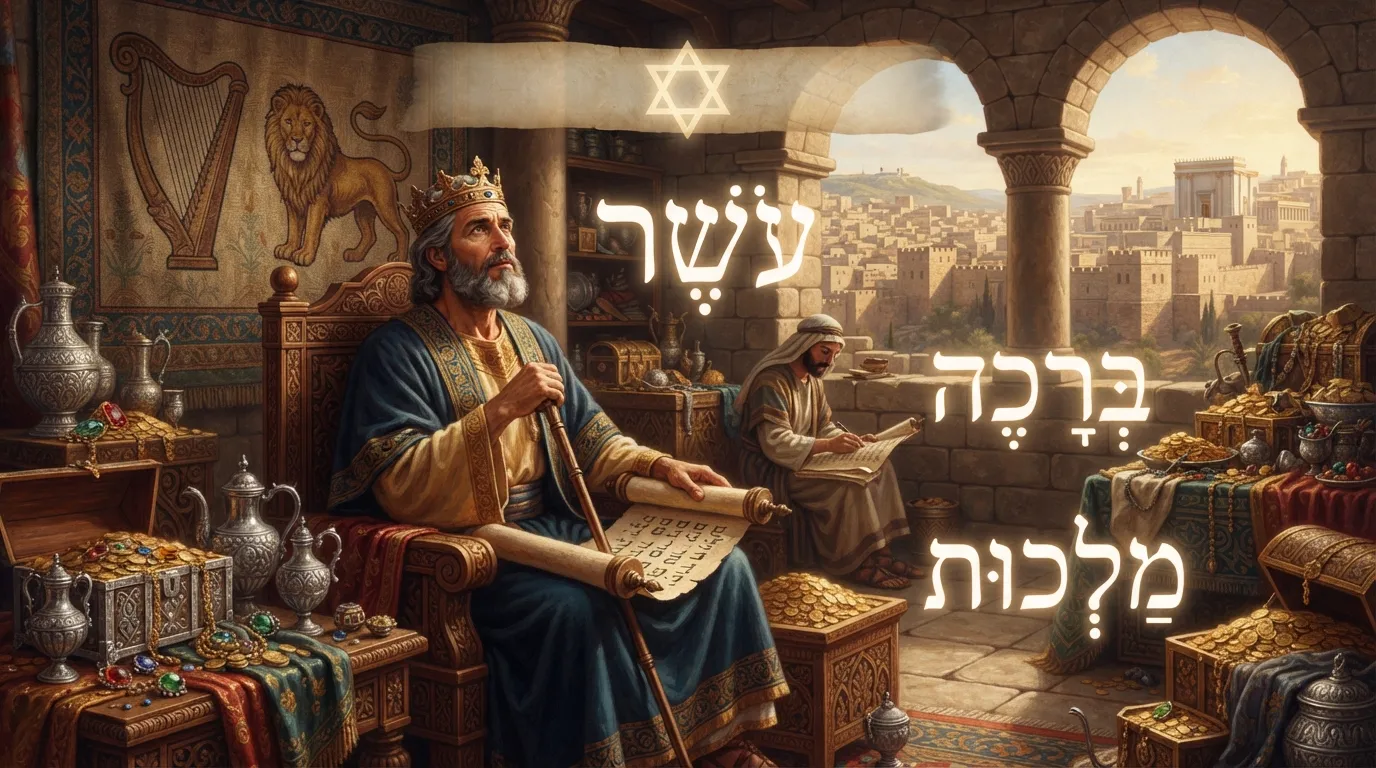
David started with a sling and a shepherd’s bag. He ended with a treasury so vast that his gift for the temple alone — 3,000 talents of gold and 7,000 talents of silver from his personal fortune — would be worth billions in today’s money. Between those two points lies one of the Bible’s most searching lessons about wealth: it is a gift, a test, and a trust, all at once. David’s story shows all three.
The Bible never treats David’s wealth as the point of his life. He is remembered as a shepherd, a warrior, a poet, a king, a sinner, a penitent, and a man after God’s own heart. His wealth is part of the story, but it is not the moral of it. What makes David’s wealth worth studying is not its size. It is what David believed about it, what he did with it, and what it did to him.
From Shepherd’s Bag to King’s Treasury
David’s rise is the Bible’s great rags-to-riches story, and the Bible insists it was God’s doing. “David became greater and greater, for the LORD, the God of hosts, was with him” (2 Samuel 5:10). He was the youngest son of Jesse, overlooked by his own father, anointed in secret, and hunted for years before he ever wore a crown. His wealth did not come from inheritance, speculation, or exploitation. It came through a calling he did not choose, victories he did not win alone, and a kingdom he did not build by himself.
The wealth itself was staggering. As king, David controlled tribute from surrounding nations, trade routes, mines, and the spoils of war. 1 Chronicles records storehouses, overseers of treasuries, and officials in charge of olive groves, vineyards, flocks, and camels — an entire royal economy. But the Bible’s emphasis is not on the inventory. It is on the attitude: David never spoke of “my wealth.” He spoke of what God had given.
That distinction is the first lesson. Wealth becomes dangerous the moment it is called “mine.” The moment a person believes their riches are self-made, self-owned, and self-justifying, wealth stops being a gift and becomes a god. David’s repeated refrain — “Who am I, and what is my people, that we should be able thus to offer willingly? For all things come from you, and of your own have we given you” (1 Chronicles 29:14) — is the antidote to that delusion. Everything is received. Everything is returned.
The Temple Gift: Wealth Turned to Worship
David’s defining act with his wealth was not building a palace. It was giving it away. In 1 Chronicles 29, as the preparations for the temple reached their peak, David stood before the assembly and gave from his own treasure — gold, silver, and precious stones — for the house of God. Then he asked the people to give, and they gave “willingly, with a whole heart.” The scene is one of the most joyful in the Bible: a king and a people, competing in generosity.
David’s prayer over the offering is the Bible’s theology of wealth in miniature: “Yours, O LORD, is the greatness and the power and the glory and the victory and the majesty, for all that is in the heavens and in the earth is yours. Yours is the kingdom, O LORD, and you are exalted as head above all. Both riches and honor come from you, and you rule over all” (1 Chronicles 29:11–12). Wealth, in David’s mouth, is not a measure of God’s approval. It is a measure of God’s ownership. The giver owns everything; the gift is just a loan.
Notice what David did not do with his wealth. He did not hoard it. He did not use it to buy loyalty, though kings routinely did. He did not build monuments to himself. He invested it in the one project that would outlast him: a house for God’s name, built by his son. The wealth that lasts is the wealth that is given to what lasts.
The Bathsheba Warning: Wealth and Power Corrupt Together
David’s story is not a prosperity sermon, because the same wealth that funded the temple also funded his corruption. The man who had once refused to kill Saul when he had the chance — because Saul was the LORD’s anointed — later used his royal power to take Bathsheba and arrange the death of her husband Uriah. Wealth and power did not make David evil. They removed the constraints that had kept his evil in check.
That is the second lesson, and it is the one prosperity teaching always omits. Wealth amplifies whatever is already in the heart. In a generous heart, it amplifies generosity. In a lustful heart, it amplifies lust. In a proud heart, it amplifies pride. David’s fall did not begin with an affair; it began with a king who stayed home from war, walked on his roof, and discovered that there was nothing he could not have. Wealth whispers that every desire is a right, and every appetite is an entitlement. The whisper is a lie.
David’s repentance is as instructive as his sin. When Nathan confronted him, David did not spin, blame, or cover up. He said, “I have sinned against the LORD” (2 Samuel 12:13). He wrote Psalm 51, the Bible’s great prayer of repentance. He accepted the consequences, which were severe and lifelong. The man after God’s own heart was not the man who never fell. He was the man who fell and came back — broken, honest, and dependent on mercy.
Stewardship: The Real Meaning of David’s Wealth
Put the two halves together — the temple gift and the Bathsheba fall — and the theology of David’s wealth emerges. Wealth is stewardship: a trust from God, to be managed for God’s purposes, with an account to be given. The steward does not own the estate. He manages it for the owner’s benefit, and he will be judged on his faithfulness, not on his balance sheet.
Stewardship has three practical marks in David’s life. First, generosity: the steward gives willingly, regularly, and joyfully, because he knows the estate is not his. Second, contentment: the steward does not measure his worth by his holdings. David, who had everything, wrote, “The LORD is my shepherd; I shall not want” (Psalm 23:1). The shepherd-king’s contentment did not come from his treasury. It came from his Shepherd. Third, humility: the steward knows that wealth is not proof of God’s favor and poverty is not proof of His absence. Some of the godliest people in the Bible were poor, and some of the wickedest were rich.
The Census: When Counting Became a Sin
David’s relationship with wealth took one more dark turn near the end of his reign. In 2 Samuel 24, David ordered a census of Israel’s fighting men — a count that Scripture presents as an act of pride and distrust. The census was, in effect, an audit of his power: how many soldiers, how much strength, how big the kingdom. It was the moment David stopped trusting God’s promise and started measuring his own resources. God judged the census with a plague, and David repented, buying the threshing floor of Araunah to build an altar — a site that would later become the temple.
The census story is the bookend to the temple gift. In the temple gift, David gave his wealth away in worship. In the census, he counted his wealth in pride. The same man, the same treasury, two opposite postures. The difference was not the money. It was the heart. Wealth in the hands of a worshiping heart becomes an offering. Wealth in the hands of a proud heart becomes an idol. David’s life contains both, and the contrast is the warning: no one is past the point where wealth can corrupt them, and no failure is past the point where repentance can restore them.
David’s final words on the subject come in his deathbed charge to Solomon: “Keep the charge of the LORD your God, walking in his ways and keeping his statutes” (1 Kings 2:3). He did not tell his son to protect the treasury. He told him to keep the covenant. The king who had everything left his son the only advice that mattered: the wealth will not save you. God will.
That last point is the one to carry into your own finances. If you are wealthy, David’s story is a warning and an invitation: do not trust in riches, do not use them to feed your appetites, and do not wait until you feel generous to give. If you are poor, David’s story is a comfort: your Shepherd is the same God who provided for David when he had nothing, and the measure of your life is not your bank balance but your faithfulness. Either way, the question is the same: who owns what you have? David’s answer, spoken over a mountain of gold, was: God does. For the life and reign of the king behind this story, see the biography of David in biblical and historical perspective.










