Thirteen guests at the Last Supper. Thirteen steps on a gallows. A thirteenth floor missing from a hotel. The number 13 carries more superstition than almost any other number in the Western world — and Christians often ask whether the Bible is the source of the fear. Did God mark 13 as unlucky? Does seeing it mean something is wrong? Is it a symbol of rebellion, or of love, or of nothing at all?
The honest answer is less dramatic than the folklore: the Bible never assigns the number 13 a fixed symbolic meaning. It appears in Scripture as a number in ordinary stories, measurements, and genealogies — sometimes in connection with rebellion, sometimes in connection with covenant, and sometimes in connection with nothing more than counting. The superstition around 13 comes mostly from later traditions, not from the Bible. What Scripture does offer is a method: read each passage in context, and resist the urge to turn numbers into secret codes.
The Claim: “Thirteen Means Rebellion”
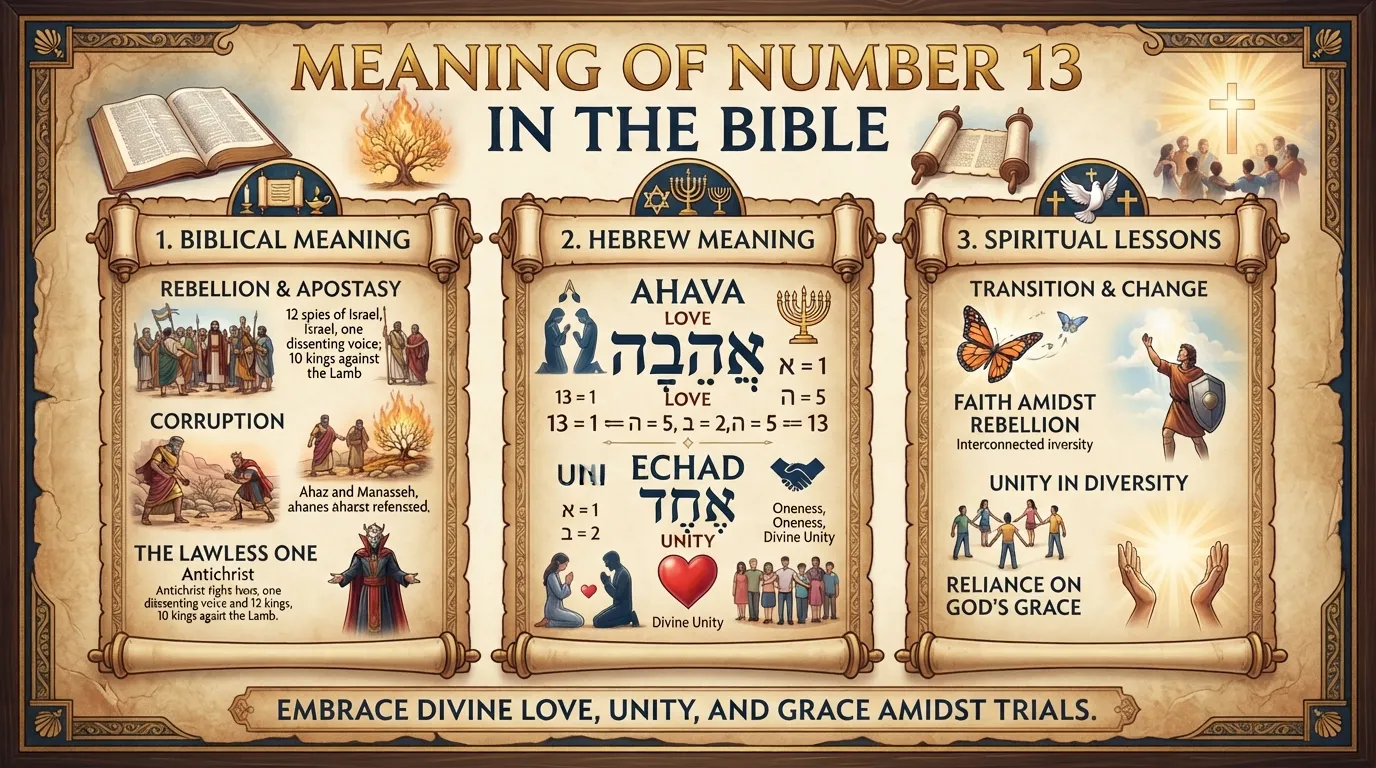
The most common biblical case for 13-as-rebellion comes from Genesis 14:4: the kings of the Jordan valley “served Chedorlaomer twelve years, and in the thirteenth year they rebelled.” It is a real verse, and the rebellion really happened in the thirteenth year. But notice what the verse does not say. It does not say “the number 13 means rebellion.” It says a rebellion happened in a thirteenth year. That is history, not symbolism. To turn it into a universal meaning for the number is to go beyond the text.
The same caution applies to other negative associations. Judas is sometimes called the thirteenth guest at the Last Supper — but the Bible never numbers the guests that way, and the tradition comes from later art and folklore, not from the Gospels. The idea that 13 is inherently evil owes more to medieval superstition and to the modern horror of Friday the 13th than to any biblical teaching. Christians who fear the number are fearing a tradition, not a text.
There is a related claim that 13 represents lawlessness because it follows 12 — the number of tribes, apostles, and divine government — and therefore “breaks” the order of 12. The reasoning is poetic but not biblical. Scripture never says that 12 is the number of order and 13 is the number of disorder. It never sets up that arithmetic. The argument is built on pattern-spotting, not on exegesis.
The Evidence: Where 13 Actually Appears
Look at the passages where 13 appears, and the picture is far more mixed than the superstition suggests.
Ishmael was 13 when circumcised. “Ishmael his son was thirteen years old when he was circumcised in the flesh of his foreskin” (Genesis 17:25). The verse records a fact about the covenant sign. It attaches no symbolic meaning to the age. To read rebellion or blessing into Ishmael’s age is to add something the text does not contain.
Solomon’s palace took 13 years to build. “Solomon was building his own house thirteen years, and he finished his entire house” (1 Kings 7:1). The temple took seven years; the palace took thirteen. Some interpreters have moralized the difference — Solomon spent nearly twice as long on his own house as on God’s — and the contrast is suggestive. But the text presents the numbers as construction records, not as coded messages about the number 13.
The thirteenth year and rebellion. Genesis 14:4, discussed above, is the strongest biblical link between 13 and rebellion, and even it is a historical statement, not a definition.
Thirteen in the tribal lists. Jacob had twelve sons, but the tribe of Joseph split into Ephraim and Manasseh, making thirteen tribal allotments in the land. The Levites, who received no land, complicate the count further. The Bible’s own arithmetic refuses to make 13 a tidy symbol. It is simply what the counting produced.
The pattern across these passages is consistent: the Bible uses 13 the way it uses most numbers — as a number. Sometimes it counts years, sometimes people, sometimes measurements. It does not pause to explain what the number means, because it does not mean anything beyond the count.
The Counter-Claim: “Thirteen Means Love”
On the positive side, some teachers point to Hebrew word values. In Hebrew numerology (gematria), the word for love, ahavah, has a numerical value of 13. So does the word for one, echad — the word in the Shema: “The LORD our God, the LORD is one” (Deuteronomy 6:4). From this, some conclude that 13 symbolizes love and unity — God is one, and His oneness is expressed in love.
The observation is beautiful, and it is worth appreciating as devotional reflection. But it should be held lightly. Gematria was a later interpretive technique, not the way the biblical authors explain their own numbers. The Bible never says “13 means love because ahavah equals 13.” The connection is a human discovery about the Hebrew language, not a doctrine Scripture teaches. It can inspire, but it should not be preached as biblical fact — and it certainly should not be used to make decisions, predict the future, or claim a divine message from a clock or a license plate.
The same caution applies to every numerological system. Numbers in Scripture sometimes carry symbolic weight — 7 for completeness, 12 for the people of God, 40 for testing — but even those meanings are established by repeated biblical usage, not by arithmetic tricks. A symbol has to earn its meaning through the text. Thirteen has not earned one.
The Verdict: A Number, Not a Message
So what should a Christian do when the number 13 keeps appearing — in a dream, on a clock, on a date? The biblical response is refreshingly ordinary: don’t panic, don’t build a doctrine, and don’t make a decision based on a number. Use the moment as a prompt to pray, examine your life, and return to Scripture. If something in your life needs repentance, repent — not because of the number, but because of the conviction. If something needs wisdom, seek wisdom — not from numerology, but from God, who “gives generously to all without reproach” (James 1:5).
There is also a pastoral point. People who fear 13 are usually not afraid of arithmetic. They are afraid of what might happen — of loss, of death, of being out of control. The Bible’s answer to that fear is not a better numerology. It is a better God. “God gave us a spirit not of fear but of power and love and self-control” (2 Timothy 1:7). The believer who trusts in Christ does not need to fear numbers, dates, or omens, because the future is not governed by digits. It is governed by a Father who numbers the hairs on our heads and promises that nothing can separate us from His love.
How Christians Should Think About Numbers
The number 13 debate is part of a larger question: how should Christians think about numbers in the Bible? Scripture does use some numbers symbolically. Seven appears in creation, in the seals and trumpets of Revelation, and in the phrase “seventy times seven.” Twelve appears in the tribes, the apostles, and the gates of the New Jerusalem. Forty appears in the flood, the wilderness, and Jesus’ fasting. These patterns are real, and they are established by repeated, consistent usage across the whole canon.
But even with those numbers, the symbolism is descriptive, not magical. Seven does not make a thing holy. Twelve does not make a thing complete. The numbers serve the story; they do not control it. And the Bible never invites readers to build a private numerology — to find hidden meanings in dates, license plates, or clock times. That practice, however sincere, turns the Bible into a puzzle book and God into a code. The Bible is not a code. It is a revelation, written in plain language, meant to be understood by ordinary people.
The healthiest approach to biblical numbers is the simplest: read them in context, note the patterns Scripture itself emphasizes, and resist the urge to go further. If a number’s meaning is not clear from the passage, it is better to say “we don’t know” than to invent one. The Bible has enough real meaning without adding imaginary meanings to its numbers.
The number 13, in the end, is a test of how we read the Bible. Will we read it for what it says — carefully, in context, letting the text speak — or will we read into it what our fears and fascinations suggest? The Bible is not a puzzle book of hidden codes. It is a story of God’s redemption, told in history, poetry, law, and prophecy. The numbers serve the story. They are not the story. And the story’s message is far better than any superstition: God is sovereign, Christ has conquered, and no number — thirteen or any other — has power over those who belong to Him. For a survey of how 13 has been viewed in culture, religion, and mathematics, see the article on 13 as a number and its many associations.










