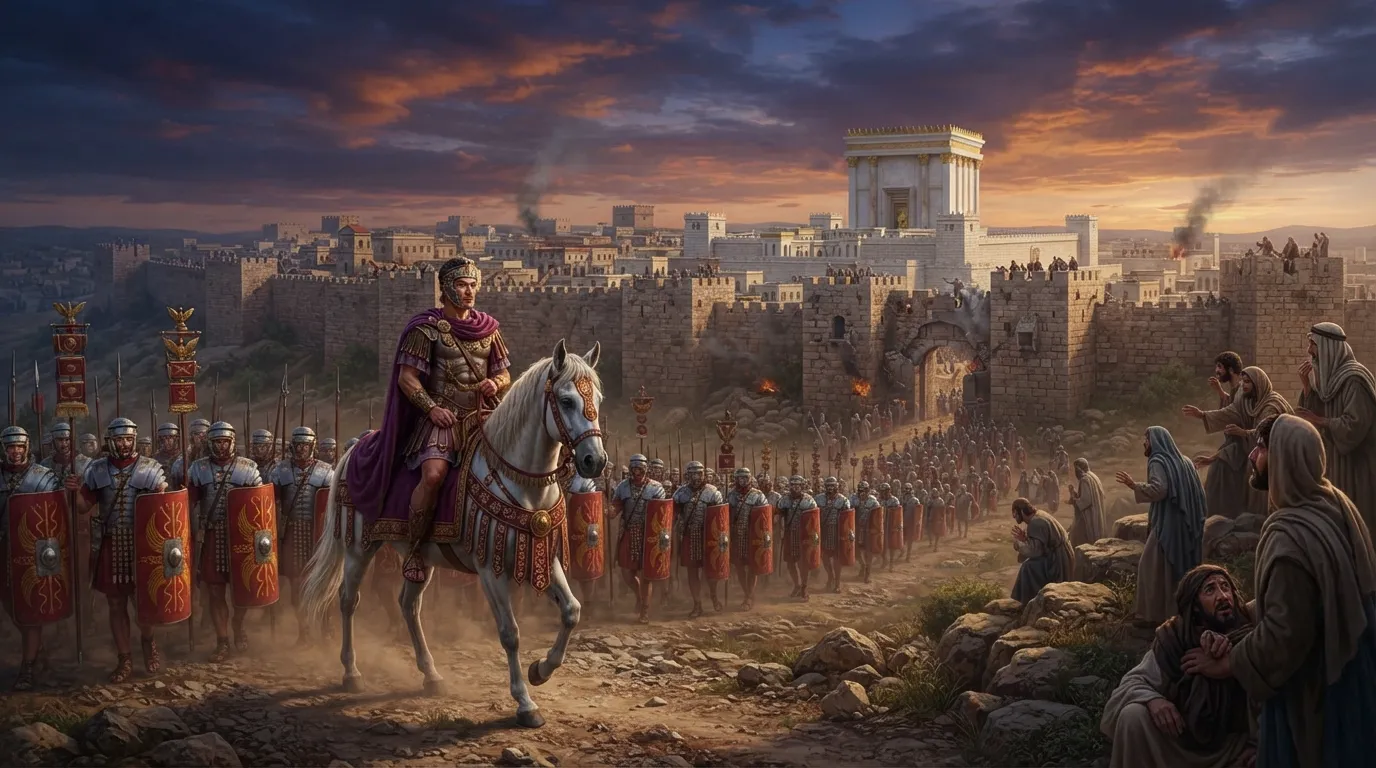
In 37 BC, after a siege that lasted five months, Jerusalem fell to Herod the Great. He had Roman legions at his back, a claim to the throne granted by the Roman Senate, and a rival — Antigonus, the last Hasmonean king — entrenched inside the city. When the walls finally broke, the slaughter was so severe that Herod had to restrain his own Roman allies to keep them from annihilating the city he wanted to rule. Jerusalem had a new king. He was not anointed by God. He was installed by Rome. And he would rule for thirty-three years with a mixture of brilliance, cruelty, and paranoia that shaped the world into which Jesus was born.
One thing to state plainly: the Bible does not narrate Herod’s conquest of Jerusalem. No biblical book describes the siege of 37 BC. The details come from Josephus, the first-century Jewish historian, and from Roman records. What the Bible does is introduce Herod as an established ruler — the king on the throne when the Messiah arrived. The conquest is background; the Bible’s focus is what Herod’s reign meant for God’s plan.
How Herod Got the Throne
The road to Jerusalem ran through Rome. Herod’s father, Antipater, had been a power broker in Judea, and Herod inherited his political skill. When the Parthians invaded and installed Antigonus as king, Herod fled to Rome, where the Senate — with the backing of Mark Antony and Octavian (the future Augustus) — declared him “King of the Jews” in 40 BC. It took him three more years, with Roman military support, to actually take the city.
The siege of Jerusalem in 37 BC was brutal. The city was defended by Antigonus’s forces and by Jews loyal to the Hasmonean dynasty, which had ruled Judea for a century. Herod’s army, reinforced by Roman legions under Sosius, surrounded the city. After five months, the walls fell. Antigonus was captured, taken to Antioch, and executed — the first time Rome had ever executed a captive king. Herod was now master of Jerusalem.
His first act as king was a marriage. He wed Mariamne, a Hasmonean princess, to give his reign a thread of legitimacy. He would later murder her. That pattern — using people, then destroying them — defined his rule. He executed his wife, her brother, her grandfather, his mother-in-law, and eventually three of his own sons. Augustus reportedly joked that it was safer to be Herod’s pig than his son.
The King on the Throne When Christ Was Born
The New Testament opens Herod’s story not at the conquest but at the birth of Jesus. “Now after Jesus was born in Bethlehem of Judea in the days of Herod the king, behold, wise men from the east came to Jerusalem” (Matthew 2:1). The Magi came asking, “Where is he who has been born king of the Jews?” The question struck Herod like a threat. He had spent his life eliminating rivals to his throne. Now heaven announced a newborn King, and Herod did what he always did: he tried to kill the threat.
Herod’s response reveals his character. First, he was “troubled, and all Jerusalem with him” (Matthew 2:3) — the whole city knew what Herod’s fear meant. Then he consulted the chief priests and scribes, who told him the Messiah would be born in Bethlehem (Micah 5:2). Then he deceived the Magi, pretending he wanted to worship the child. When they returned home by another way, warned by God in a dream, Herod unleashed the massacre of the innocents — ordering the killing of all male children in Bethlehem two years old and under (Matthew 2:16).
That atrocity, recorded only by Matthew, fits everything else known about Herod. A man who murdered his own sons would not hesitate to murder strangers’ children. Theologians have sometimes called this the darkest irony of the Christmas story: the King of Peace was born under the reign of a king of terror, and the first blood shed because of Jesus’ birth was the blood of innocent children.
Prophecy and Providence in a Pagan Reign
Herod’s conquest and reign raise a theological question: Why did God allow a ruthless, Rome-installed tyrant to rule His chosen people at the very moment the Messiah arrived? The answer is woven through Scripture’s pattern of sovereignty. God has always worked through — and in spite of — pagan rulers. He used Pharaoh, Nebuchadnezzar, Cyrus, and Caesar. Herod was no exception.
Consider what Herod’s reign provided. First, it fulfilled the prophecy of Jacob: “The scepter shall not depart from Judah… until tribute comes to Shiloh” (Genesis 49:10). By the time of Jesus, the legitimate Davidic monarchy had been gone for centuries; the scepter had effectively departed, and the true King arrived. Second, Herod’s building projects — including the Temple expansion and the network of roads and cities — created the physical infrastructure through which the gospel would later travel. Third, the Pax Romana, the Roman peace enforced by rulers like Herod, meant that the apostles could travel safely across the empire with the gospel. The very empire that crucified Jesus became the highway for His message.
Herod’s reign also demonstrates the futility of opposing God’s plan. Herod had armies, spies, fortresses, and a willingness to kill anyone. He could not kill one baby in Bethlehem. The child escaped to Egypt, and Herod died a miserable death — Josephus describes a gruesome illness — shortly after. The tyrant who conquered Jerusalem could not conquer God’s purpose. The child he tried to murder would one day be called King of Kings.
The Massacre and the Flight to Egypt
Matthew records that when the Magi outwitted Herod, he ordered the killing of every male child in Bethlehem two years old and under (Matthew 2:16). The act was evil, but it was also characteristically Herodian: disproportionate, paranoid, and aimed at eliminating a threat that existed mostly in his own mind. Meanwhile, Joseph, warned by God in a dream, fled with Mary and the child to Egypt — the same Egypt that had once enslaved Israel, now serving as a refuge for its Savior. Matthew sees prophecy in the flight: “Out of Egypt I called my son” (Matthew 2:15, quoting Hosea 11:1). The child Herod tried to kill would retrace Israel’s own story — down into Egypt, out of Egypt, through the wilderness of temptation, and finally to a cross and an empty tomb. Herod’s massacre is remembered in the church as the Holy Innocents, and it stands as a permanent indictment of power that murders children to protect itself.
Herod’s Death: The End of the Tyrant
Herod died in 4 BC, shortly after the events surrounding Jesus’ birth, in Jericho, of a gruesome and painful illness that Josephus describes in detail. His final days were as paranoid as his reign: he ordered the execution of his son Antipater, altered his will repeatedly, and, according to Josephus, ordered the arrest of prominent men throughout Judea to be executed at the moment of his death so that the nation would mourn — a command that was mercifully not carried out. He died hated, feared, and alone, despite his wealth and his buildings. His kingdom was divided among his sons by Rome. The man who conquered Jerusalem could not conquer death, and the child he failed to kill would outlive every monument he built.
What Herod’s Conquest Teaches
First, power is not legitimacy. Herod had the throne, the army, the Senate’s decree, and the palace. He did not have God’s anointing. The crowds who cheered him feared him. The throne he conquered could not give him what he wanted most: security. He died paranoid and hated, having killed everyone he suspected — which was nearly everyone.
Second, God is sovereign over the worst rulers. The Jews who lived under Herod might have wondered whether God had abandoned them to a tyrant. He had not. He was working through the tyrant’s reign to bring the Messiah at exactly the right time — “when the fullness of time had come” (Galatians 4:4). The timing of Christ’s birth, under Roman rule, under Herod’s throne, in the city of David, was not an accident. It was providence.
Third, opposition to Christ is always futile. Herod is the first in a long line of rulers who tried to suppress Jesus — Nero, Diocletian, and countless others since. Every one of them is gone. The child of Bethlehem remains. As Psalm 2 promised, the One who sits in the heavens laughs at the plots of kings — and the conspiracy against His Anointed always ends the same way.
Herod conquered Jerusalem with Roman swords and held it with terror. But the true King of Jerusalem needed no swords and no siege. He entered the city on a donkey, wept over it, died outside its walls, and rose again — and His kingdom, unlike Herod’s, will never end. For the historical record of Herod’s reign, his rise to power, and his building projects, see the Wikipedia article on Herod the Great.










