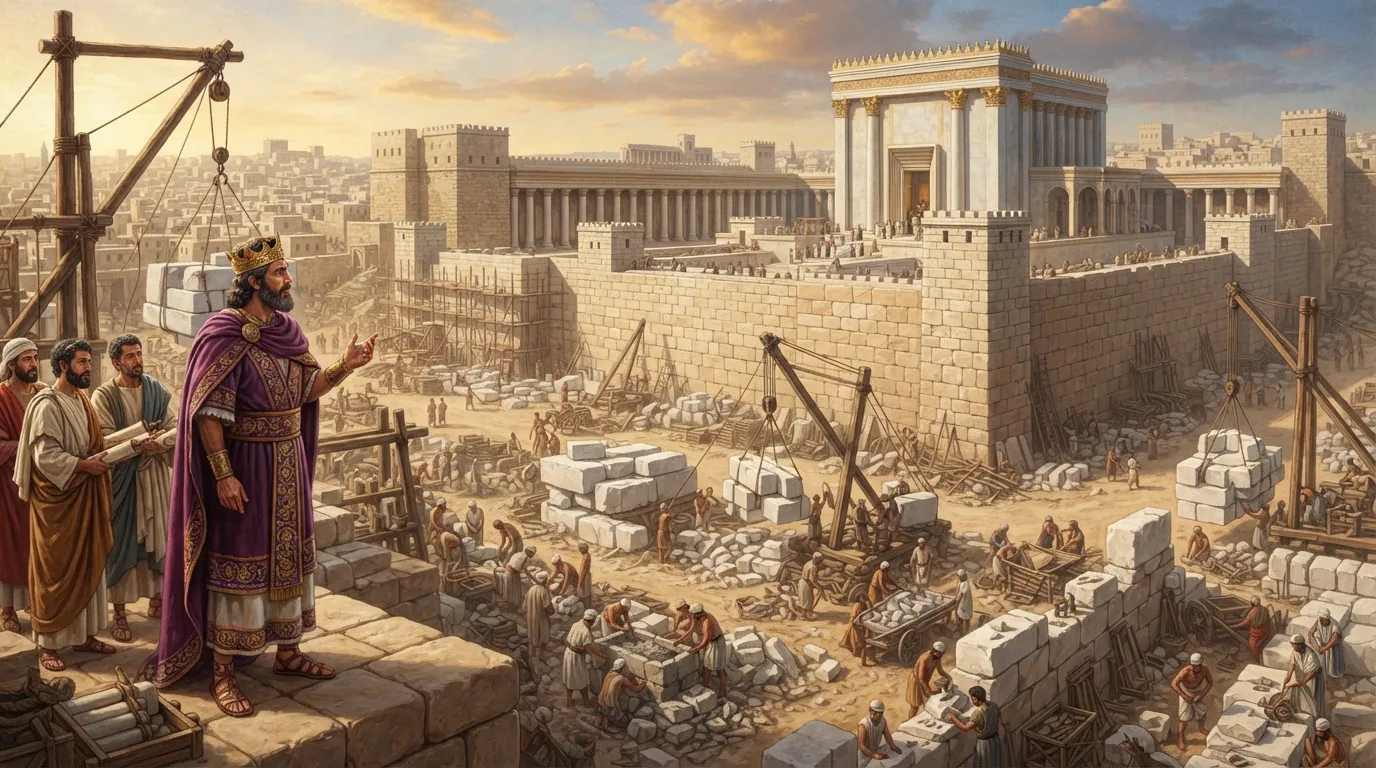
Herod the Great was a murderer, a tyrant, and a paranoid who killed his own wife and three of his sons. He was also the man who gave Jerusalem the most magnificent temple it ever had. That contradiction is the key to understanding Herod’s Temple. It was one of the wonders of the ancient world — white stone, gold plating, courtyards that could hold thousands — built by a king whose heart was as far from God as any heart could be. The Bible’s message about Herod’s Temple is blunt: a beautiful building proves nothing about the builder’s soul.
Herod began the project around 20–19 BC. He did not build a temple from nothing. The temple of Zerubbabel, built after the return from exile, already stood on the mount. Herod renovated, expanded, and beautified it on a staggering scale — doubling the size of the Temple Mount platform with massive retaining walls, one of which survives today as the Western Wall. The work continued long after Herod’s death. When Jesus began His ministry, the Jewish leaders said, “It has taken forty-six years to build this temple” (John 2:20), and construction continued into the AD 60s, only a few years before the Romans destroyed it.
Why Would a Tyrant Build a Temple?
Herod’s motives were not devotional. He was an Idumean — a descendant of Edom — ruling Jews who doubted his legitimacy. He had been appointed “King of the Jews” by Rome, not anointed by God. He had murdered members of the Hasmonean royal family to secure his throne. He needed credibility, and nothing bought credibility like a grand temple.
Herod was also a builder by nature. He built the fortress-palace of Masada, the port city of Caesarea Maritima with its enormous artificial harbor, the Herodium, and palaces at Jericho. The Temple was his masterpiece — a political investment dressed as piety. He wanted the Jews to accept him, the Romans to respect him, and history to remember him. In all three aims, the Temple served him well.
But there is a deeper irony. Herod, who tried to kill the infant Jesus in Bethlehem (Matthew 2:16), built the very temple where Jesus would teach, cleanse, and declare Himself. The man who sought to destroy the Messiah built the stage on which the Messiah’s ministry would unfold. God used a tyrant’s vanity to prepare a house for His Son.
The Temple Jesus Knew
The Temple of Herod’s day was a complex of courts, each with its own access rules. The Court of the Gentiles was open to everyone — a vast outer courtyard where money changers and animal sellers operated. Inside that was the Court of Women, then the Court of Israel, then the Court of Priests, then the sanctuary itself, with the Holy Place and the Most Holy Place.
It was in this temple that Mary and Joseph presented the infant Jesus, where Simeon took Him in his arms and declared Him “a light for revelation to the Gentiles, and for glory to your people Israel” (Luke 2:32). It was here that the twelve-year-old Jesus stayed behind, astonishing the teachers with His understanding (Luke 2:46–47). It was here that Jesus drove out the money changers, saying, “My house shall be called a house of prayer, but you make it a den of robbers” (Matthew 21:13). It was here that He watched a poor widow drop two small coins into the treasury and said she had given more than all the rich (Mark 12:43).
The Temple was also where Jesus made His most startling claim about a building. When the Jews demanded a sign, He said, “Destroy this temple, and in three days I will raise it up” (John 2:19). They thought He meant Herod’s stone edifice. John explains: “He was speaking about the temple of his body” (John 2:21). The real temple was not the building Herod had beautified. It was the body of Jesus — the place where God truly dwelt among people (John 1:14).
“Not One Stone Will Be Left”
As Jesus and His disciples left the Temple one day, the disciples pointed out the magnificent buildings. Jesus answered, “You see all these, do you not? Truly, I say to you, there will not be left here one stone upon another that will not be thrown down” (Matthew 24:2). Within a generation, it happened. In AD 70, Roman legions under Titus besieged Jerusalem, burned the Temple, and dismantled it so thoroughly that the gold melted between the stones led soldiers to pry every stone apart to recover it. Jesus’ prophecy was fulfilled with terrifying precision.
The destruction of Herod’s Temple ended the sacrificial system forever. No temple has stood on the mount since. The early church understood why: the sacrifices had been fulfilled in Christ’s once-for-all offering (Hebrews 10:10–14). The building was no longer needed, because the reality it pointed to had arrived.
The Court of the Gentiles and the Money Changers
The outer court of Herod’s Temple, the Court of the Gentiles, was the one place where non-Jews could come to pray — the space Isaiah had envisioned when he called the temple “a house of prayer for all peoples” (Isaiah 56:7). By Jesus’ day, that court had been turned into a marketplace. Money changers converted Roman coins into temple currency for a fee. Merchants sold animals for sacrifice at inflated prices. The noise, the haggling, and the crowds made prayer nearly impossible for the very Gentiles the court was meant to serve. That is why Jesus’ cleansing of the temple was so pointed: “My house shall be called a house of prayer, but you make it a den of robbers” (Matthew 21:13). He was not objecting to commerce in general. He was objecting to commerce that crowded out worship — and crowded out the outsiders. A temple that excludes the nations to enrich the insiders has lost its purpose, no matter how beautiful its stones.
Herod’s Other Buildings: The Builder King
The Temple was Herod’s most famous project, but it was only one of many. He rebuilt the port city of Caesarea Maritima, constructing a massive artificial harbor with hydraulic concrete — one of the engineering marvels of the ancient world. He built the fortress-palace of Masada on a plateau above the Dead Sea, with storerooms, baths, and palaces. He built the Herodium, a palace-fortress with an artificial hill, where he would be buried. He built theaters, amphitheaters, and a hippodrome in Jerusalem itself — Greco-Roman entertainment venues that scandalized many Jews. Herod’s building program was a statement: Judea was part of the Roman world, and its king could match any ruler in splendor. Yet within a century, Masada fell to Rome, Caesarea’s harbor silted, the Herodium crumbled, and the Temple burned. The builder king’s monuments outlasted him by only a few decades. What endures is not what Herod built, but what happened in the Temple he built: the teaching, the cleansing, the cross, and the resurrection of the One who called His own body the true temple.
The Stones Themselves: What Archaeology Shows
The scale of Herod’s Temple project is confirmed by the stones still visible today. The Western Wall — a retaining wall of the Temple Mount platform — contains individual stones weighing over 100 tons, fitted together with remarkable precision. The platform itself, expanded by Herod to roughly 36 acres, was one of the largest in the ancient world. When the disciples marveled at the “great stones” of the Temple (Mark 13:1), they were not exaggerating. The stones were enormous, the craftsmanship extraordinary, and the gold plating — which Josephus said gleamed so brightly in the sun that it blinded the eyes — made the Temple visible from miles away. Herod built for permanence. He achieved beauty. But permanence was an illusion: within a century, the gold was stripped, the stones were toppled, and the platform stood empty of the house it was built to hold.
The Temple That Remains
The New Testament takes the language of the Temple and applies it to two new realities. First, to the church: “You are God’s temple and God’s Spirit dwells in you” (1 Corinthians 3:16). The community of believers, not a building, is now the dwelling place of God. Second, to the individual believer: “Your body is a temple of the Holy Spirit within you” (1 Corinthians 6:19). Every Christian carries the presence that once dwelt behind the veil.
That is the final lesson of Herod’s Temple. A man with a murderous heart built the most beautiful house of worship in the ancient world, and God let it stand for a season — and then let it fall. Buildings do not guarantee God’s presence. Ornate worship does not prove a sincere heart. What God has always wanted is not a house made with hands but a people made holy by His Spirit. Herod built with stone and gold. God builds with living stones — “a spiritual house, to be a holy priesthood” (1 Peter 2:5). And unlike Herod’s temple, that house will never be torn down. For the history of the Temple’s construction, scale, and destruction, see the Wikipedia article on the Second Temple.










