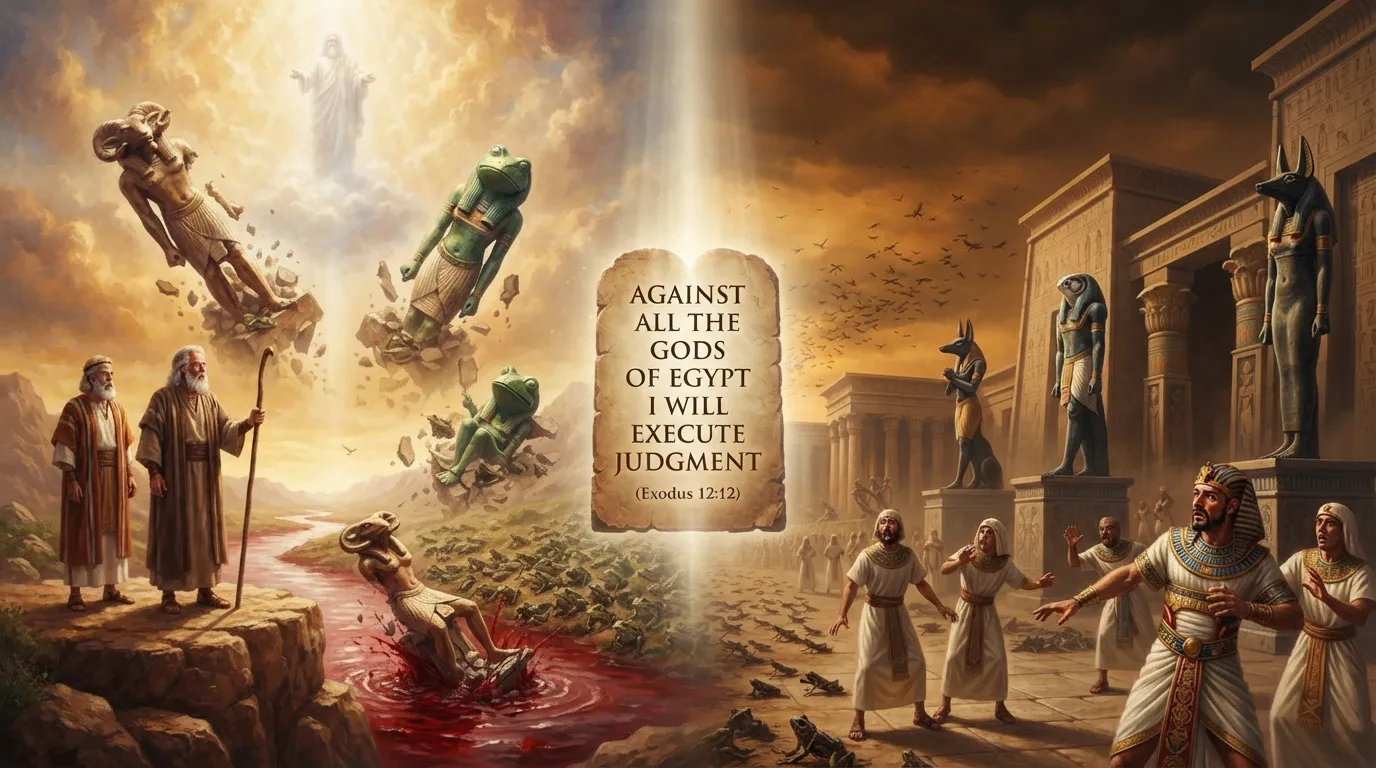
The indictment was read before the final plague: “Against all the gods of Egypt I will execute judgments: I am the LORD” (Exodus 12:12). It is one of the most startling sentences in the Bible. God does not merely say He will judge Pharaoh, or Egypt’s army, or its economy. He says He will judge its gods. The Exodus, in other words, was not only a political liberation. It was a theological verdict — a public trial in which every power Egypt trusted was weighed, exposed, and found wanting.
To understand that verdict, we need to see Egypt as Israel saw it: not as a museum of pyramids, but as the superpower of the ancient world, a civilization whose religion, politics, and economics were fused into one system. Pharaoh was not only a king; he was worshiped as divine. The Nile was not only a river; it was a god. The sun, the cattle, the frogs, the sky — Egypt’s world was crowded with deities, each guarding a slice of reality. The Exodus systematically dismantled that world, plague by plague, until nothing was left standing but the LORD.
The Charge: “I Am the LORD”
The phrase “I am the LORD” runs through Exodus like a drumbeat. God tells Moses, “The Egyptians shall know that I am the LORD, when I stretch out my hand against Egypt” (Exodus 7:5). The contest was about knowledge: who is truly God? Egypt’s answer was a pantheon. Israel’s answer was a Person — the covenant God who had revealed Himself to Abraham, Isaac, and Jacob, and who had heard the cries of slaves.
The Hebrew words behind Exodus 12:12 sharpen the point. The word for “gods” is elohim, a term that can refer to the true God or, as here, to the supposed divine beings Egypt worshiped. The word for “judgments” comes from the root shaphat — to judge, to govern, to render a verdict. This was not a brawl between rival gods. It was a courtroom: the one true Judge rendering a verdict on pretenders. And the verdict ends with the Judge’s signature: “I am the LORD.”
That framing matters, because it rules out a common misunderstanding. Scripture does not present the Exodus as a contest between equals, with Yahweh barely winning. It presents it as the Creator demonstrating, to a nation that worshiped creation, that creation answers to Him. The gods of Egypt were not rivals. They were exhibits.
The Evidence: Plague by Plague
Exodus does not give a verse-by-verse chart matching each plague to a specific god, and honest interpreters should not invent one. But the pattern is unmistakable: the plagues strike precisely the domains Egypt’s gods were supposed to govern.
The Nile turned to blood — the river that was Egypt’s lifeblood, worshiped as a god, became undrinkable. Frogs swarmed the land — and the frog-headed goddess Heqet, associated with fertility and childbirth, could not call them off. The dust became gnats, and Egypt’s magicians, who had imitated the first two signs, admitted defeat: “This is the finger of God” (Exodus 8:19). Livestock died — a blow against Apis the bull and Hathor the cow-goddess, patrons of strength and provision. Boils broke out on man and beast, afflicting the priests who prided themselves on ritual purity. Hail devastated the crops, thundering from a sky that Egypt’s gods could not control. Locusts stripped what remained. Darkness covered the land for three days — a direct assault on Ra, the sun god, the supreme deity of the Egyptian pantheon. The sun that Egypt worshiped simply went out, and no priest could switch it back on.
Then came the final plague: the death of the firstborn, including Pharaoh’s own son. Pharaoh, worshiped as the living god Horus, could not protect his own household. The man who called himself divine buried his heir. The gods of Egypt had been judged in the most public way possible: they could not save their own worshipers.
The Verdict: No God but God
The judgment had two purposes, and Exodus names both. The first was revelation: Egypt would know that the LORD is God. The second was liberation: Israel would be set free. The two are inseparable. God did not free Israel merely by overpowering Pharaoh’s army; He freed them by breaking the spiritual system that held them captive. Slaves do not only need open doors. They need to believe that the gods of their masters are not gods at all.
That is why the Passover matters. The Israelites were not saved by being better than the Egyptians, or by fighting harder. They were saved by the blood of a lamb on their doorposts — by trusting God’s word and sheltering under His provision. Judgment passed over the houses marked by blood, Egyptian and Israelite alike. The same blood that judged Egypt’s gods saved God’s people. The cross would later make that pattern explicit: judgment and mercy, met at the same place.
The verdict also echoed forward. The first commandment — “You shall have no other gods before me” (Exodus 20:3) — was given to a people who had watched every other god fail. It was not an abstract rule. It was a conclusion drawn from evidence. Israel had seen the gods of the world’s greatest empire exposed as powerless, and they were told: do not go back to worshiping what cannot save you.
The Gods We Still Worship
Nobody in the modern world worships Ra or Heqet. But the judgment of Egypt’s gods is not ancient history, because idolatry did not die with the pharaohs. It changed costumes. The gods of our age are wealth, status, pleasure, politics, technology, romance, and the self — each promising security, identity, or salvation, each demanding sacrifice, each unable to deliver when the darkness comes.
The Exodus test still applies: whatever you trust to save you will be judged. If your god is money, a market crash will expose it. If your god is reputation, one scandal will expose it. If your god is a person, that person’s failure will expose it. If your god is your own strength, your first serious illness will expose it. The gods of Egypt fell because they were not gods. The gods of the modern world fall for the same reason.
The Firstborn and the First Commandment
The final plague deserves closer attention, because it is the one that most directly judged Egypt’s gods. The death of the firstborn struck at the heart of Egyptian religion and royalty. Pharaoh was worshiped as the living Horus, the son of Ra, and his firstborn son was the heir of that divinity. When the firstborn died — from Pharaoh’s palace to the prisoner’s cell — the message was absolute: the gods of Egypt could not protect even the house of the god-king. The man who claimed to be divine buried his own heir. No temple ritual, no priestly incantation, no sacrifice could reverse it. The judgment was total because the claim had been total.
The Israelites, too, lost their firstborn in principle — the plague would have fallen on them as well — but they were spared by the blood of the lamb. That detail is crucial. Israel was not spared because they were better. They were spared because they trusted God’s word and sheltered under His provision. The same blood that judged Egypt’s gods saved God’s people. Judgment and mercy met at the same doorpost.
Why the First Commandment Comes Next
It is no accident that the first commandment — “You shall have no other gods before me” — was given to a people who had just watched every other god fail. The commandment was not an abstract rule imposed on a blank slate. It was a conclusion drawn from evidence. Israel had seen the gods of the world’s greatest empire exposed as powerless, and they were told: do not go back to worshiping what cannot save you. The Exodus was the proof; the commandment was the application.
The same logic applies today. The modern world’s gods — wealth, power, pleasure, politics, technology, self — all make the same promise Egypt’s gods made: trust us, and we will save you. And they fail the same way. The Exodus invites every generation to watch the idols fall and to conclude, with Israel: there is no God but the LORD, and He alone is worthy of worship.
The good news of Exodus is that the God who judges false gods is the same God who delivers His people. He did not judge Egypt’s gods to prove a point and leave Israel in the desert. He judged them to bring His people home. The same God still does both: He exposes the idols that enslave us, and He leads us out of their house, toward a land where He alone is worshiped — and where worship, at last, is safe. For background on the religious world the Exodus confronted, see the overview of ancient Egyptian religion and its gods, temples, and practices.










