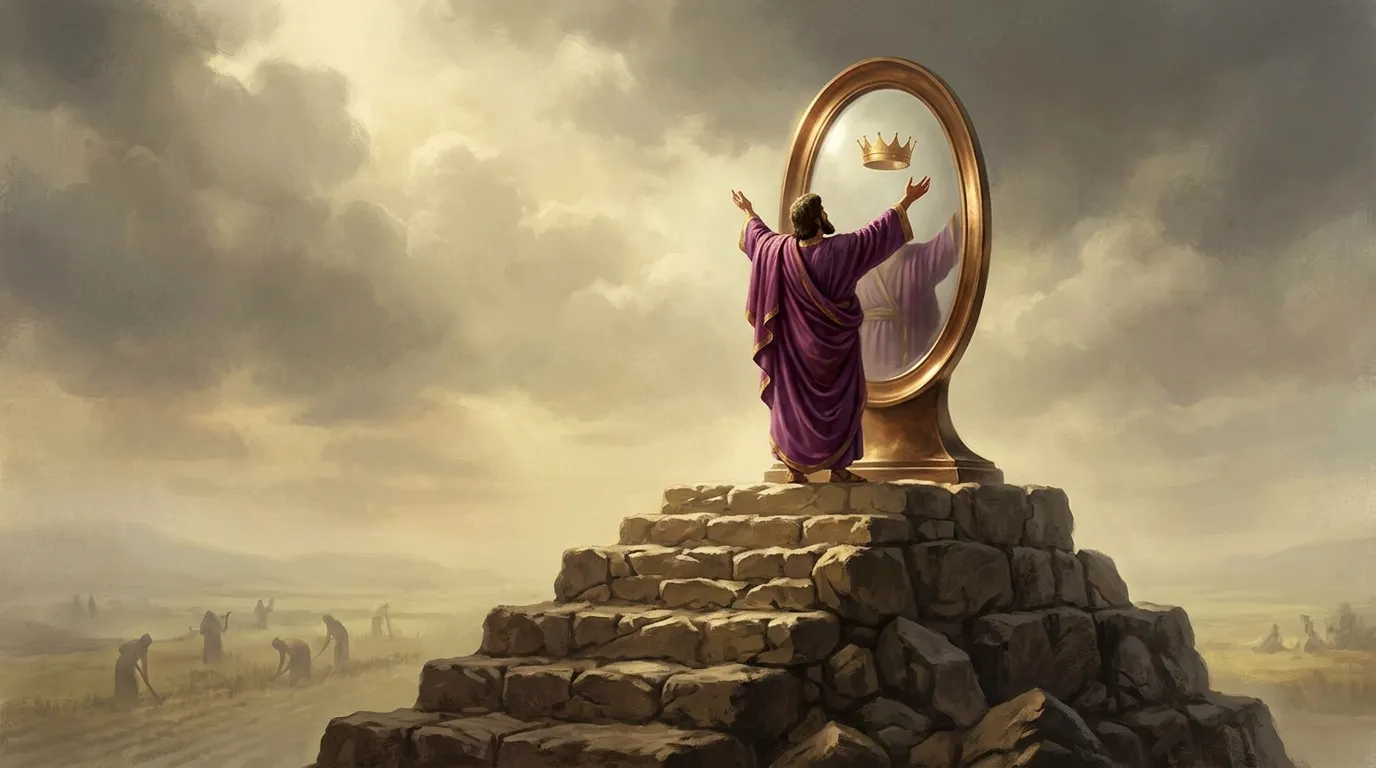
It begins in heaven, before the world was made. A covering cherub, blazing with beauty and wisdom, looks at his own splendor and decides it is enough to make him equal with God. Five times he says, “I will” — I will ascend above the heights of the clouds, I will be like the Most High (Isaiah 14:13–14). That ancient rebellion is the Bible’s opening lesson on pride: it is the sin that tried to dethrone God, and it remains the one sin that stands most directly against Him. Scripture warns that God opposes the proud but gives grace to the humble (James 4:6; 1 Peter 5:5). To understand what pride means in the Bible, we must follow its story through the people it destroyed and the humility that finally overcame it.
Lucifer: The First Prideful Fall
Ezekiel 28 describes the king of Tyre in language that reaches beyond any earthly ruler to the anointed cherub himself: “You were the seal of perfection, full of wisdom and perfect in beauty” (Ezekiel 28:12). His heart became proud because of his beauty, and his wisdom was corrupted for the sake of his splendor (Ezekiel 28:17). The pattern is set from the very first appearance of pride — it begins with a gift, then worships the gift instead of the Giver.
Isaiah 14 gives us the inner monologue of that fall. The being called the morning star, the son of the dawn, is cast down to the earth because his heart lifted him up. Notice where pride struck: not in something ugly or broken, but in something glorious. Pride rarely attacks our failures; it feeds on our strengths. The cherub was not wrong about his beauty — he was wrong about who deserved the credit. The Bible’s first lesson on pride is therefore a warning for the gifted, the successful, and the admired: your greatest endowment can become your greatest danger the moment you claim it as your own achievement.
Jesus Himself referenced this original fall when He told His disciples, “I saw Satan fall like lightning from heaven” (Luke 10:18). Pride is not a minor character flaw in Scripture; it is the root of the first rebellion and the standing posture of God’s chief adversary. Every later example of pride in the Bible is an echo of this first one.
Nebuchadnezzar: The King Who Became an Animal
Centuries later, the same sin found a throne. King Nebuchadnezzar of Babylon stood on the roof of his royal palace and surveyed his empire: “Is not this the great Babylon I have built as the royal residence, by my mighty power and for the glory of my majesty?” (Daniel 4:30). The words were barely out of his mouth when a voice from heaven answered him. His sanity was taken from him, and for seven years he lived like a beast in the field — eating grass like an ox, his hair growing like eagles’ feathers, his nails like birds’ claws.
Daniel had warned him. The king had been given a dream of a great tree cut down to a stump, and Daniel interpreted it plainly: the tree was Nebuchadnezzar, and the cutting down was coming judgment unless he broke off his sins. A full year of mercy passed, and the king did not repent. Then the words of self-glorification sealed his fate. The story is devastating in its symmetry: the king who exalted himself above men was reduced below them, until he acknowledged that “the Most High is sovereign over all kingdoms on earth” (Daniel 4:32).
When his reason returned, Nebuchadnezzar’s testimony closes the chapter: “Now I, Nebuchadnezzar, praise and exalt and glorify the King of heaven, because everything he does is right and all his ways are just. And those who walk in pride he is able to humble” (Daniel 4:37). It is the Bible’s clearest confession from a proud man restored — pride does not only invite judgment; it blinds the proud person to the judgment until it falls. The lesson for every reader is the one Daniel gave the king before it was too late: pride announces its downfall, and humility is the only way out.
Herod: Struck Down for Accepting Worship
In the New Testament, the story of Herod Agrippa I in Acts 12 is brief and chilling. Seated on his throne in royal robes, he delivered an oration to the people of Tyre and Sidon, and they shouted back, “This is the voice of a god, not of a man.” Scripture records what happened next with stark simplicity: “Immediately, because Herod did not give praise to God, an angel of the Lord struck him down, and he was eaten by worms and died” (Acts 12:23).
The key phrase is “because Herod did not give praise to God.” His crime was not merely arrogance of speech; it was theft of glory. The crowd offered him worship that belonged to God alone, and he accepted it. Pride, at its core, is always a glory problem — it takes what belongs to the Creator and spends it on the creature. Herod’s end shows how seriously heaven takes that theft. Where Nebuchadnezzar was given seven years to learn humility, Herod’s refusal to redirect the crowd’s praise brought immediate judgment.
This story also warns against the subtler, everyday version of the same sin: the compliment we absorb without deflecting, the success we quietly attribute to our own brilliance, the platform we build for our own name. Herod did not ask for worship; he simply failed to refuse it. Sometimes pride is not what we say — it is what we allow.
Peter: The Pride That Denied Christ — and Was Restored
Not every biblical story of pride ends in worms and judgment. Simon Peter’s pride was the ordinary, relatable kind: the confident disciple who was sure he knew his own heart. “Even if all fall away, I will not,” he told Jesus on the night of the betrayal (Mark 14:29). When Jesus predicted Peter’s denial, Peter insisted even more vehemently: “Even if I have to die with you, I will never disown you” (Mark 14:31).
Hours later, a servant girl’s question undid him. Three times Peter denied knowing Jesus, and then the rooster crowed, and the Lord turned and looked straight at him. Peter went outside and wept bitterly (Luke 22:61–62). This is the anatomy of pride in its most common form — not the tyrant’s boast from a palace roof, but the sincere overconfidence of a man who believed his devotion was stronger than his weakness.
What makes Peter’s story the Bible’s great hope for the proud is what happened next. On the shore of the Sea of Galilee, the risen Christ did not lecture Peter about his failure. Three times He asked, “Do you love me?” — matching the three denials — and each time He recommissioned him: “Feed my lambs… Take care of my sheep… Feed my sheep” (John 21:15–17). Peter’s pride was broken, but Peter was not discarded. The same disciple who boasted he would never fall became the humble shepherd who wrote that God opposes the proud but shows favor to the humble (1 Peter 5:5). Broken pride, surrendered to Christ, becomes usable humility.
Christ’s Humility: The Antidote to Pride
All of these stories point to the climax of Scripture’s teaching on pride: the humility of Jesus Christ. Philippians 2:3–8 is the Bible’s definitive passage on the subject. “Do nothing out of selfish ambition or vain conceit. Rather, in humility value others above yourselves, not looking to your own interests but each of you to the interests of the others.” Then Paul holds up Christ as the pattern: though He was in very nature God, He did not consider equality with God something to be grasped, but made Himself nothing, taking the very nature of a servant, being made in human likeness. And being found in appearance as a man, He humbled Himself by becoming obedient to death — even death on a cross.
The contrast with Lucifer is deliberate and devastating. The cherub was a creature who grasped at equality with God; Christ was God Himself who refused to grasp at it, and instead descended. Pride climbs; humility descends. Pride says “I will ascend”; Christ said, in effect, “I will go down” — down to a manger, down to a carpenter’s shop, down to wash His disciples’ feet, down to a Roman cross.
And notice the result: “Therefore God exalted him to the highest place and gave him the name that is above every name” (Philippians 2:9). This is the great reversal at the heart of the gospel — the One who humbled Himself is exalted, while every proud power that exalted itself is brought low. The kingdom of God runs on the opposite logic of the world: “Whoever exalts himself will be humbled, and whoever humbles himself will be exalted” (Matthew 23:12).
What Pride Looks Like in Daily Life
Scripture describes pride not only in kings and cherubim but in the ordinary habits of the heart. The Proverbs warn that pride goes before destruction and a haughty spirit before a fall (Proverbs 16:18), and that when pride comes, then comes disgrace, but with humility comes wisdom (Proverbs 11:2). The proud person, according to the Bible, refuses correction, despises others (Luke 18:9–14, the Pharisee and the tax collector), and trusts in self rather than in God.
Consider how these show up today: the inability to apologize, the need to be right in every argument, the quiet contempt for those we consider beneath us, the restless comparison that measures our worth against others. The Pharisee in Jesus’ parable prayed, “God, I thank you that I am not like other people” (Luke 18:11) — and went home unjustified, while the tax collector who beat his breast and begged for mercy went home justified. Pride can wear religious clothes. It is not the opposite of religion; it is often religion’s most dangerous corruption.
The Bible’s diagnostic question is simple: whom do you credit? The proud heart credits itself. The humble heart credits God. Everything else — boasting, contempt, unteachability — flows from that single fork in the road.
How Scripture Says to Fight Pride
The Bible does not leave us with only warnings; it gives a way out. First, confess it honestly. The proud person hides his sin; the humble one brings it into the light (Psalm 32:5). Second, practice gratitude deliberately — thanksgiving is pride’s natural enemy, because every genuine “thank you” admits that something good came from outside yourself. Third, serve others in hidden ways, following Christ’s example of washing feet (John 13:1–17). Fourth, receive correction without defensiveness, remembering that whoever heeds discipline shows the way to life.
Above all, look at Christ. The Christian answer to pride is not self-loathing or false modesty — it is worship. A heart full of Christ’s humility has no room left for self-exaltation. When we see what He gave up and what He endured, our achievements shrink to their proper size, and our failures lose their power to define us. Pride dies in the presence of the cross because the cross proves two things at once: we are more loved than we dared hope, and more sinful than we dared admit.
The story of pride in the Bible runs from Lucifer’s “I will ascend” to Christ’s descent to the cross — and it ends with an invitation. Humble yourself under God’s mighty hand, and He will lift you up in due time (1 Peter 5:6). The proud fall; the humble are raised. That is the spiritual message Scripture repeats from Genesis to Revelation, and it is as urgent now as it was on the palace roof in Babylon.
Readers interested in the wider history of how pride has been understood — from classical philosophy to modern psychology — will find the Wikipedia article on pride a useful companion to the biblical portrait drawn above.










