Read the book of Joshua like a campaign map and you will get the wrong story. Red arrows sweeping across Canaan, circled cities, casualty counts — the modern reader reaches for the general’s handbook, and Joshua the son of Nun looks like the commander. But the campaign record of Israel’s conquests carries an insistence no other war chronicle in Scripture carries: the general didn’t fight. The walls did not fall to battering rams, the rivers did not part under Israelite engineering, and the sun did not wait at Joshua’s command alone. The victories were God’s doing — the promise was old, the orders were specific, and the Operator was heaven.
Crossing the River
Every campaign opens with an entry operation, and Israel’s was a miracle on a river. The text is careful about timing: “the Jordan overflows all its banks throughout the time of harvest” (Joshua 3:15). Flood season — the worst possible moment. But as soon as the feet of the priests bearing the ark touched the water, “the waters coming down from above stood and rose up in a heap very far away” (Joshua 3:16), and Israel crossed on dry ground (Joshua 3:17). The Ark went first. The entry into the land was not a forced river crossing. It was a procession.
Then came the memorial. Twelve men, one from each tribe, carried stones from the riverbed to Gilgal — and the stated purpose was catechism, not nostalgia:
When your children ask in time to come, “What do those stones mean to you?” then you shall tell them that the waters of the Jordan were cut off before the ark of the covenant of the LORD… So these stones shall be to the people of Israel a memorial forever. (Joshua 4:6-7)
What happened next at Gilgal is the part most readers skim past, and it is the key to the entire conquest. The men born in the wilderness were circumcised, the people kept the Passover (Joshua 5:10), and the manna ceased the morning after they ate of the land’s produce (Joshua 5:12). The covenant was renewed before any battle was fought. Do not skip the Gilgal moments. Israel’s mission was a covenant mission, not first a military campaign.
Marching Instead of Besieging
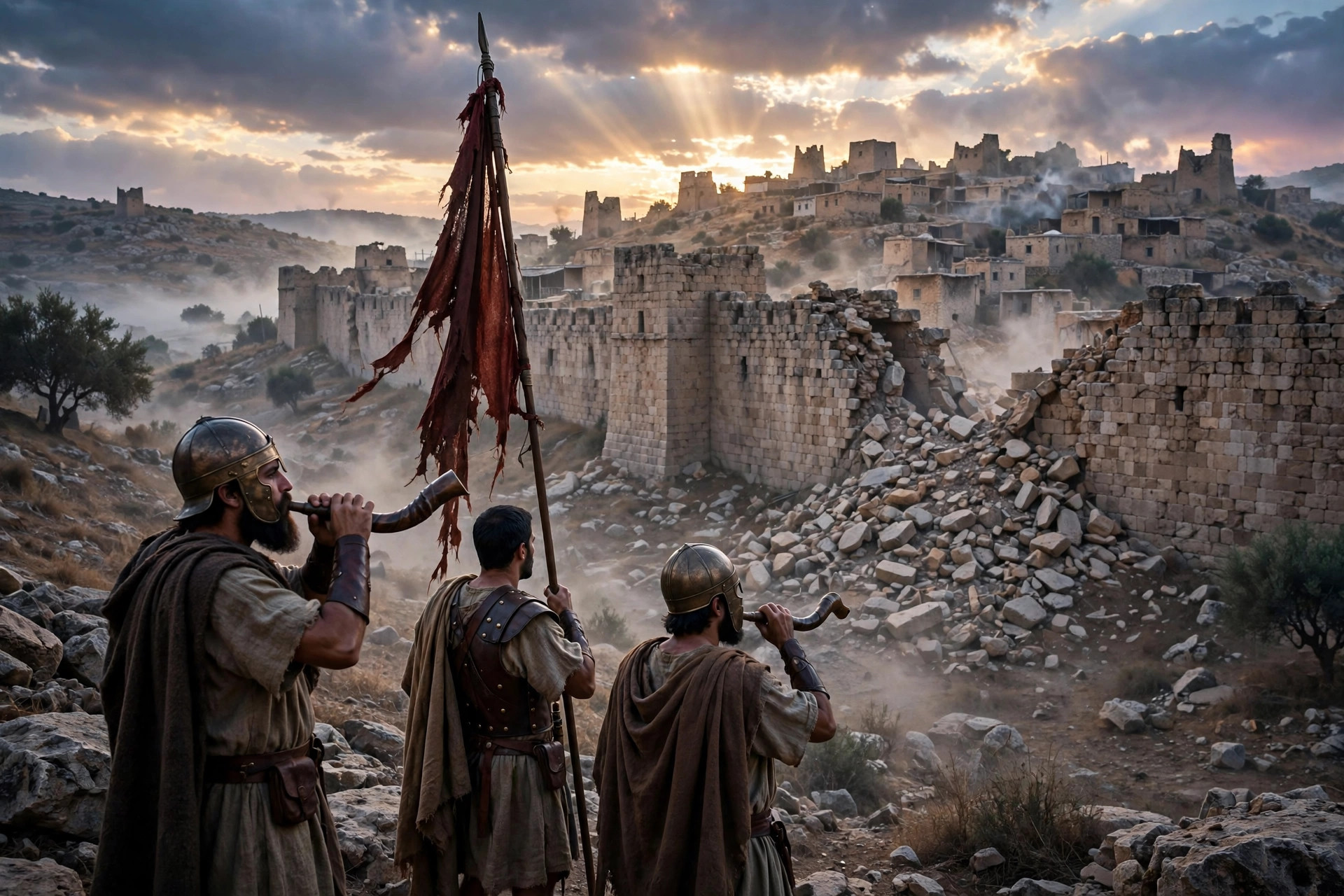
The operational plan for Jericho would have gotten any field commander relieved. Six days, the army marched around the city once — silently, behind the ark, with priests blowing rams’ horns. On the seventh day they circled seven times, the priests blew a long blast, the people shouted, and “the wall fell down flat” (Joshua 6:20). No ramps. No siege engines. The marching was not a tactic. It was a demonstration: the fortress fell to obedience, not to ordnance.
The New Testament files this campaign under faith, not strategy: “By faith the walls of Jericho fell down after they had been encircled for seven days” (Hebrews 11:30). The promise behind the campaign was older than the army by centuries — given to Abraham (Genesis 15:18-21), repeated to Isaac (Genesis 26:3) and Jacob (Genesis 28:13). The men marching around Jericho were executing a centuries-old directive. Moses, the original field commander, was excluded from the operation himself — barred from the land because of the waters of Meribah (Numbers 20:12).
The commander who replaced him bore a name worth noticing. Yehoshua means “Yahweh is salvation” — the Hebrew form of Jesus. The correspondence is not accidental: just as Yehoshua led Israel across the Jordan into the rest of the promised land, so Jesus leads God’s people into their rest (Hebrews 4:8-9). The real rest comes through the greater Joshua.
The Day the Sun Waited
At Gibeon, with daylight failing, Joshua spoke — and the text records it as a public address, not a private prayer:
Sun, stand still at Gibeon, and moon, in the Valley of Aijalon. And the sun stood still, and the moon stopped, until the nation took vengeance on their enemies. (Joshua 10:12-13)
The narrator’s assessment is the boldest claim in the whole campaign record: “There has been no day like it before or since, when the LORD heeded the voice of a man, for the LORD fought for Israel” (Joshua 10:14). Read that last clause again. That is the running marginal note of the entire conquest: Israel marched, shouted, and pursued — but the fighting was done by the Commander they couldn’t see. The northern campaign at the waters of Merom closed out the major coalition warfare (Joshua 11), and the briefing summary sounds like total victory: “So Joshua took the whole land, according to all that the LORD had spoken to Moses… And the land had rest from war” (Joshua 11:23). But “the whole land” must be read the way the text reads it — the territory as promised and apportioned. Pockets of resistance remained. The conquest was decisive but not exhaustive.
Achan — The Enemy Inside
No campaign history is complete without its worst defeat, and Israel’s came at Ai — a small town, an easy target, a catastrophe. After Jericho’s fall, the spies assessed Ai as needing only two or three thousand men. Israel was routed, thirty-six men fell, and “the hearts of the people melted and became as water” (Joshua 7:5). The answer, when Joshua demanded it, was Achan: at Jericho everything had been placed under the ban, and he had taken a beautiful cloak, two hundred shekels of silver, and a bar of gold, and hidden them in his tent. One man’s secret plunder — and the whole army lost. “Israel has sinned; they have transgressed my covenant that I commanded them” (Joshua 7:11). One tent, one hidden stash, the defeat of an entire column. The after-action lesson is as clear as a reprimand: hidden sin brings public defeat. Achan was judged in the Valley of Achor, and only then did Ai fall, under God’s explicit tactical orders (Joshua 8). Confess quickly — buried compromise does not stay buried; it surfaces as battlefield failure.
Why It Was Commanded
This is the hard part of the briefing, and it deserves honesty rather than evasion. Why would a holy God order the destruction of the Canaanite peoples? The text itself gives four reasons, and they must be heard together. First, the judgment had waited. When God promised the land to Abraham, He added that his descendants would return “in the fourth generation, for the iniquity of the Amorites is not yet complete” (Genesis 15:16). The conquest was not an impatient land grab; it came after four hundred years of moral rope. The Amorites’ sin had reached its full measure — judgment was overdue, not premature.
Second, the sin was horrific. The Canaanite religions practiced child sacrifice — “they burn their sons and their daughters in the fire to their gods” (Deuteronomy 12:31) — and temple prostitution woven into the worship of Baal and Asherah. Leviticus 18 catalogs the practices and then says of the land itself: “the land became unclean… and the land vomited out its inhabitants” (Leviticus 18:25). This was divine judgment on entrenched, violent evil.
Third, Israel was to be protected from spiritual corruption: “for they would turn away your sons from following me, to serve other gods” (Deuteronomy 7:4). When Israel disobeyed, the warning proved exactly right — Judges opens with Israel intermarrying, adopting Canaanite worship, and serving the Baals and Ashtoreths (Judges 2:11-13). Partial obedience brought partial peace, and the nations left in the land became exactly what God said they would: thorns and snares.
Fourth, God has sovereign right as Creator: “Behold, to the LORD your God belong heaven and the heaven of heavens, the earth with all that is in it” (Deuteronomy 10:14); “The earth is the LORD’s and the fullness thereof” (Psalm 24:1). The Canaanites were not permanent owners being robbed; they were tenants under judgment, and the Landlord reassigned the lease. And this matters decisively: it was a specific, unrepeatable command, given to one nation, for one window of redemptive history. Our conquest today is spiritual: “For the weapons of our warfare are not of the flesh but have divine power to destroy strongholds” (2 Corinthians 10:4). Anyone who reaches for Joshua to justify violence has misread the briefing.
The Map After the War
After the campaigns, the land was apportioned tribe by tribe. But the map tells two stories at once. Joshua 11:23 declares that Joshua had taken the whole land; the very next book opens with the tribes failing to finish the job. Judah could not drive out the Jebusites from Jerusalem; Manasseh, Ephraim, Zebulun, Asher, and Naphtali each left Canaanite enclaves intact (Judges 1). The limits of the conquest were not a failure of God’s promise but a failure of Israel’s follow-through — and the consequence was plain: the remaining nations would become “thorns in your sides” (Judges 2:3). The pattern is worth memorizing: God keeps promises even across centuries — Abraham to Joshua is more than four hundred years of waiting fulfilled — but partial obedience brings partial peace.
A devotional-honesty note belongs here. Applying the conquest devotionally — “taking possession of the promises,” “marching around your Jericho,” being “more than conquerors through him who loved us” (Romans 8:37) — is legitimate illustration; these events are “written down for our instruction” (1 Corinthians 10:11). But an illustration is not an interpretation. Don’t present illustrations as the text’s meaning. And these conquests never justify violence today — “Love your enemies and pray for those who persecute you” (Matthew 5:44) is the standing order of the new covenant.
The campaign’s lessons run through every phase of the briefing. God keeps promises even across centuries — the grant to Abraham was executed by Joshua with interest. Obedience precedes victory: don’t skip the Gilgal moments. Hidden sin brings public defeat — one compromised tent can rout an army, so confess quickly. Partial obedience brings partial peace — Judges 2 is the receipt for the unfinished conquest. And our battles are spiritual now: “we do not wrestle against flesh and blood, but against the rulers, against the authorities, against the cosmic powers over this present darkness, against the spiritual forces of evil in the heavenly places” (Ephesians 6:12). The geography has changed. The Commander has not.
How Long Did the Conquest Take?
Caleb provides the timeline. He was forty years old when he spied out the land at Kadesh Barnea, and he tells Joshua, “I am still as strong today as I was in the day that Moses sent me… And now, behold, I am this day eighty-five years old” (Joshua 14:7, 10). Forty-five years elapsed between the spying mission and the allotment of the land — thirty-eight of those were the wilderness wandering. That leaves roughly seven years for the main campaigns of the conquest — by ancient standards, a remarkably short war.
Did Israel Conquer All the Land?
No — and the Bible is explicit about it. Judges 1 catalogs the failures tribe by tribe: the Jebusites held Jerusalem, the Canaanites held Gezer, Megiddo, and the coastal plains where their iron chariots gave them the advantage. God explained the remainder: the nations left would test Israel (Judges 3:2) and become thorns in its side because Israel had broken the covenant (Judges 2:3). The promise of the land was fully God’s gift; the possession of it was conditional on obedience — and Israel’s obedience was partial, so the peace was partial too.
For a literary and historical overview of the campaign narratives themselves, the Wikipedia page on the Book of Joshua is a useful starting point.










