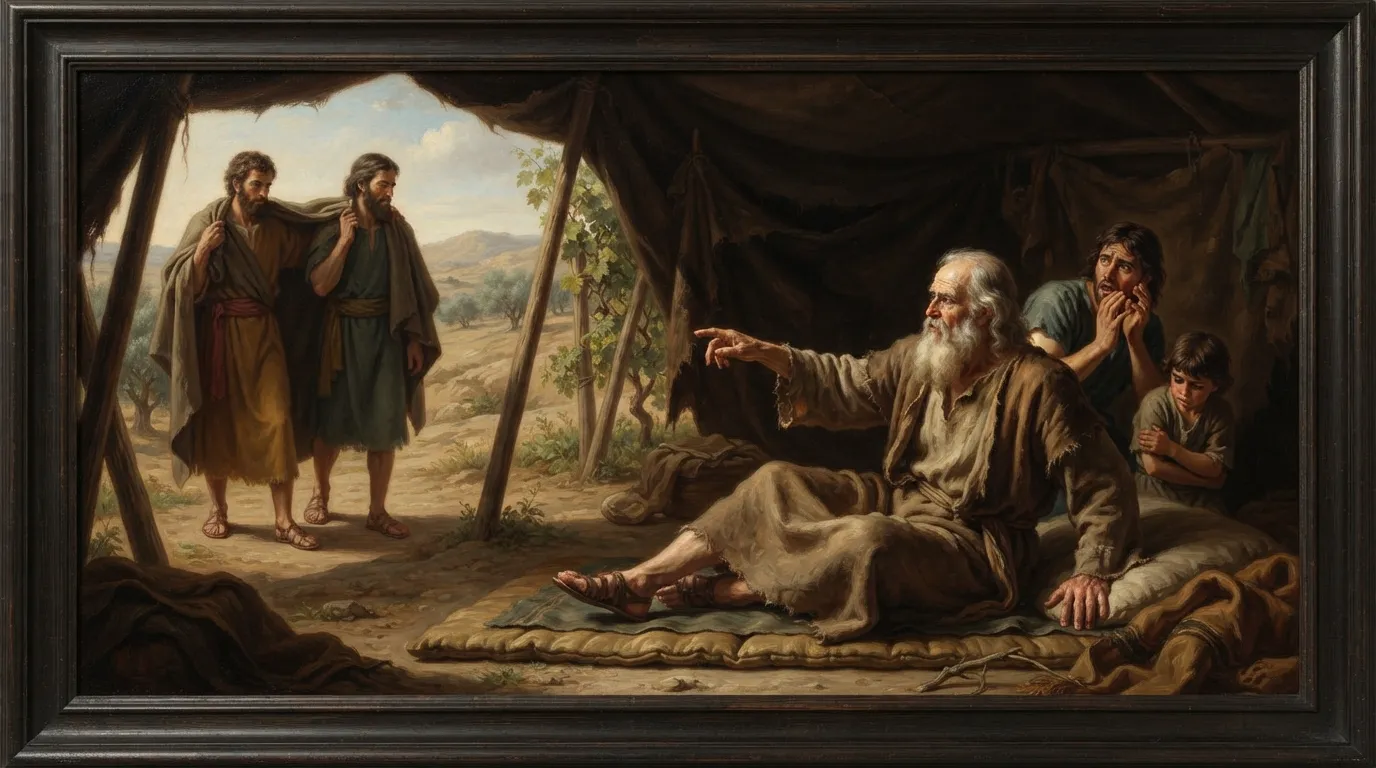
Genesis 9:20–27 is one of the shortest and most argued-over passages in the Bible. In eight verses, Noah plants a vineyard, gets drunk, lies uncovered, is seen by his son Ham, is covered by his other two sons, wakes up, and pronounces a curse — not on Ham, but on Ham’s son Canaan. Readers have stumbled over the same questions for centuries: Why Canaan? What exactly did Ham do? And does this passage teach that children are punished for their parents’ sins?
The passage is difficult, and honesty requires admitting that Scripture does not answer every question it raises. But it answers the important ones, and the answers correct some of the worst misuses of this text in history. Read carefully, Genesis 9 is a story about dishonor and dignity, about consequences that ripple through families, and about the Bible’s insistence that every person answers for their own sin.
What the Text Actually Says
After the flood, Noah became a farmer and planted a vineyard. He drank wine, became drunk, and lay uncovered in his tent. Ham “saw the nakedness of his father and told his two brothers outside” (Genesis 9:22). Shem and Japheth took a garment, walked backward into the tent so as not to look, and covered their father. When Noah woke and learned what Ham had done, he said: “Cursed be Canaan; a servant of servants shall he be to his brothers” (Genesis 9:25). He then blessed Shem and spoke of Japheth dwelling in the tents of Shem.
Several details matter. First, Noah’s drunkenness is recorded without excuse. The man who was “righteous” and “blameless in his generation” (Genesis 6:9) is shown failing — a reminder that the flood did not wash sin out of the human heart. The Bible does not protect its heroes from their own stories. Second, the text does not describe any sexual act by Ham. Some interpreters have speculated about one, but the passage says Ham saw and told. The contrast Scripture draws is between Ham’s response and his brothers’ response: exposure versus covering, mockery versus dignity.
Third, the curse falls on Canaan, Ham’s son. The text does not explain why in so many words, and interpreters have proposed several possibilities: that Canaan was present and complicit, that the curse is prophetic — anticipating the future Canaanites’ wickedness and their eventual subjugation by Israel — or that the naming is deliberate because the passage is setting up the story of the land of Canaan that Israel would later enter. What the text does not say is that every descendant of Ham was cursed. The curse names one person, Canaan, whose descendants became the peoples of the land Israel would later confront.
Two Responses to a Father’s Shame
The heart of the passage is the contrast between the two responses. Ham saw his father’s shame and broadcast it. Shem and Japheth protected their father’s dignity without even looking. The Hebrew culture of the time placed enormous weight on honoring parents — the fifth commandment would later make it explicit — and Ham’s failure was not that he accidentally saw something, but that he treated his father’s humiliation as gossip.
This is a pattern that still plays out in families. Every family has a moment when a parent’s weakness is exposed — addiction, failure, moral collapse, mental illness, old age. The children face the same choice Ham and his brothers faced: expose or cover. Covering does not mean pretending nothing happened, denying the problem, or enabling continued sin. Noah’s drunkenness was real and wrong, and covering it did not make it right. Covering means refusing to use a person’s shame as entertainment, leverage, or revenge. It means protecting dignity while dealing honestly with the problem.
Ham’s other failure is worth naming: he told his brothers outside the tent instead of going to his father. He chose an audience over a solution. The same choice faces anyone who learns something shameful about another person: you can take it to the person, or you can take it to everyone else. The Bible’s pattern — from Matthew 18 onward — is always the first: go to the person first. Gossip dressed up as concern is still gossip.
Why Canaan? The Honest Limits of the Text
The hardest question is why Canaan bears the curse rather than Ham. Responsible interpreters disagree, and the text’s silence should make us cautious. What can be said with confidence is that the passage functions as a kind of prologue to the rest of Genesis. The Canaanites — Canaan’s descendants — become the peoples whose land Abraham’s descendants would eventually inherit, and whose practices (including child sacrifice and ritual sexual sin, condemned in Leviticus 18) would become the moral justification for their displacement. The curse in Genesis 9 reads, in that light, as a prophetic anticipation: the line of Canaan would fall into servitude and judgment because of its own later wickedness, not merely because of Noah’s words.
That reading is supported by the way the rest of Scripture treats the passage. Nowhere does the Bible use Genesis 9 to teach that an entire race is cursed, that slavery is divinely ordained, or that children inherit guilt. Those ideas were imposed on the text centuries later to justify the transatlantic slave trade, and they are among the most shameful misreadings in the history of biblical interpretation. The text says nothing about skin color — a point that should not need making, but must, because the misuse was so persistent. Ham is not a racial category. The “curse of Ham” as a doctrine of racial inferiority is a fabrication with no biblical support.
What the Passage Does Not Teach
The Bible explicitly rejects the idea that children are punished for their parents’ sins as a general rule. “Fathers shall not be put to death because of their children, nor shall children be put to death because of their fathers. Each one shall be put to death for his own sin” (Deuteronomy 24:16). Ezekiel 18:20 states it again: “The son shall not suffer for the iniquity of the father.” Exodus 20:5, sometimes quoted to support generational curses, speaks of the consequences of sin rippling through generations — which is observably true, since addiction, abuse, and brokenness do echo in families — not of God punishing innocent children for their ancestors’ guilt.
So Genesis 9 cannot be used to claim that any person alive today is under Noah’s curse, or that any people group is divinely destined for servitude. The curse was specific, prophetic, and fulfilled in the ancient history of Canaan. To extend it beyond the text is to do exactly what the passage warns against: to use Scripture as a weapon rather than as truth.
Reading a Hard Passage Honestly
Genesis 9 leaves us with three sober lessons. First, sin has consequences that outlive the moment. Noah’s single episode of drunkenness fractured his family and echoed into the history of nations. Second, how we respond to another person’s shame reveals our character more than our words do. Ham talked; his brothers acted. Third, God’s story is not derailed by human failure. Noah failed, Ham failed, and yet the covenant continued through Shem’s line — the line that would lead to Abraham, to David, and to Christ. The Bible’s God is not a God who needs perfect people. He is a God who works through broken ones, and who judges sin while keeping His promises.
The Covenant That Followed
What happens immediately after the curse is easy to miss, and it changes the tone of the whole passage. In Genesis 9:8–17, God makes a covenant — not only with Noah and his family, but with “every living creature” — and He seals it with the rainbow. Never again, God promises, will a flood destroy the earth. The sign is a bow in the clouds, and notably, the bow points upward. In the ancient world, the bow was a weapon of war. God hangs up His weapon. The God who judged the world promises mercy to the world, and He binds Himself to that promise with a sign in the sky.
The placement matters. The curse on Canaan and the covenant with creation sit side by side in the same chapter. Judgment and mercy, held together. The passage refuses to let us read only one half. A reader who takes only the curse gets a harsh, narrow God. A reader who takes only the rainbow gets a sentimental one. Genesis 9 gives us both: a God who judges sin seriously, and a God who commits Himself to mercy on a cosmic scale.
The covenant also answers the fear that Genesis 9 leaves behind — the fear that one family’s failure could doom the world. God’s promise is not conditioned on human perfection. It is conditioned on God’s character. Noah failed within a chapter of the flood, and God still kept His word. That is the gospel in seed form: God’s faithfulness does not depend on ours, and His mercy is wider than our worst moment.
For readers who want the historical background on how this passage has been read — and misread — across the centuries, the article on the Curse of Ham traces its interpretation and its tragic misuse in detail.










