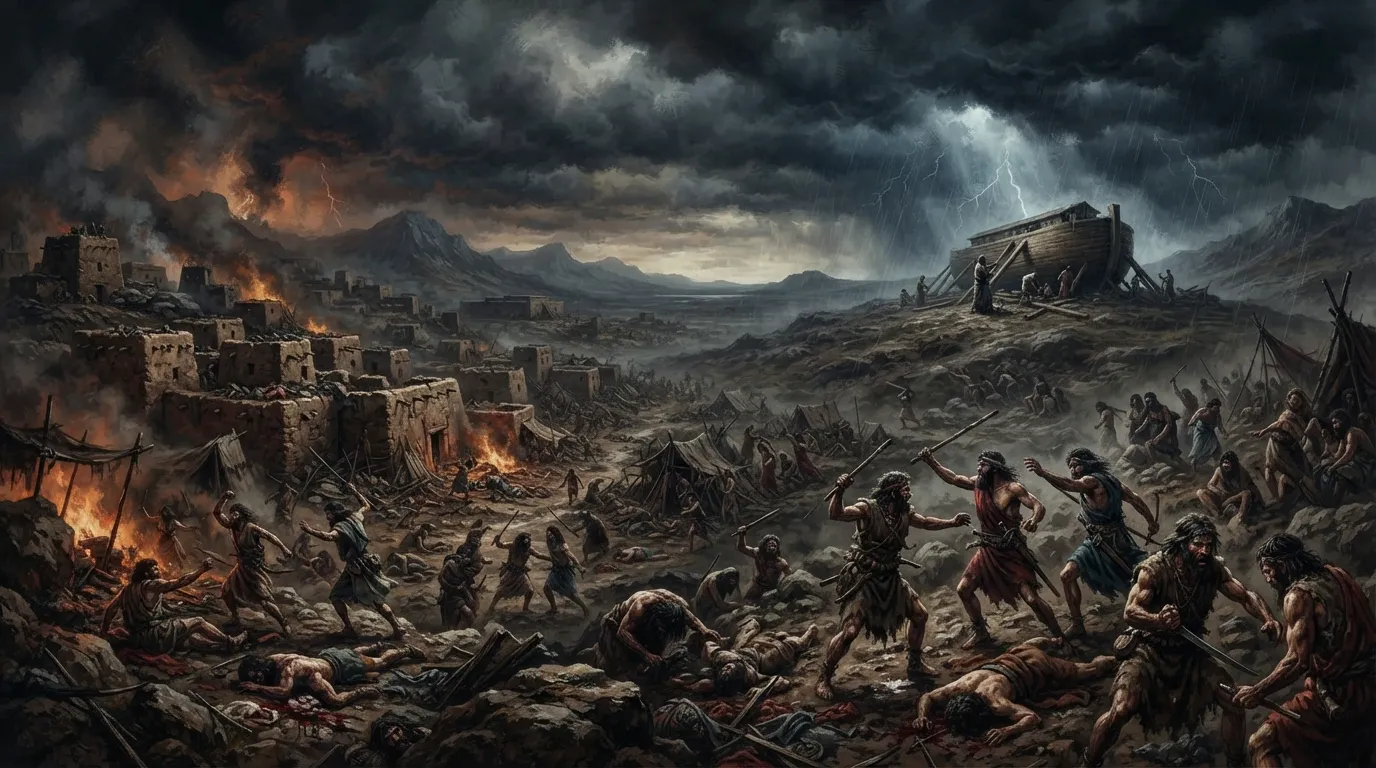
“The earth was filled with violence.” That is the Bible’s diagnosis of the world before the flood, in one sentence: Genesis 6:11. Not “the earth had some violence.” Filled. The Hebrew word is chamas — a word that means more than fistfights. It covers cruelty, oppression, injustice, the strong crushing the weak, and a society where wrong has become the normal way of doing business. Genesis 6 is not a story about a bad day. It is a story about a world that had become unrecognizable from what God made it to be.
The passage raises hard questions: How did humanity get there so fast? What does God’s response — the flood — teach about His character? And what does this ancient catastrophe have to do with us? The answers run through the whole Bible, because Genesis 6 is not a detour. It is the first full portrait of the human problem that the rest of Scripture exists to solve.
From One Murder to a World of Violence
The road to Genesis 6 is short and steep. In Genesis 3, Adam and Eve disobey God. In Genesis 4, their son Cain murders his brother Abel — the first death in the Bible is a murder, and the first murder is a brother killing a brother over worship. Within a few generations, Cain’s descendant Lamech is boasting about his revenge: “I have killed a man for wounding me, a young man for striking me. If Cain’s revenge is sevenfold, then Lamech’s is seventy-sevenfold” (Genesis 4:23–24). Violence has already become a boast. It is no longer shameful; it is a status symbol.
By Genesis 6, the infection is total. “The LORD saw that the wickedness of man was great in the earth, and that every intention of the thoughts of his heart was only evil continually” (Genesis 6:5). Notice the inward turn of the diagnosis. The problem is not only what people did; it is what people thought. The heart — the control center of desires, plans, and intentions — had become a factory of evil. Violence was the visible symptom. The disease was the heart.
Genesis 6:1–4 adds a mysterious element — the “sons of God” and the Nephilim — that has generated endless speculation. Whatever the precise identity of these figures, the passage’s main point is clear: the corruption was comprehensive, crossing every boundary, and the resulting world was one in which the strong did whatever they wanted and the weak had no recourse. The text does not invite us to solve the mystery of the Nephilim. It invites us to feel the weight of a world where God’s good creation had become a place of terror.
What “Filled With Violence” Really Means
The word chamas deserves attention, because it shapes the whole passage. In the Old Testament, chamas describes not only physical assault but also the violence of unjust courts, oppressive rulers, and cruel neighbors. The prophets use it for the violence of those who “devise wickedness” and “shed innocent blood.” It is violence as a system, not only as an act — the kind of violence that lives in laws, markets, households, and hearts at once.
That is why the flood account cannot be read as God punishing a few bad people. The corruption was structural. “The earth was corrupt in God’s sight” (Genesis 6:11). The whole social order had rotted. When violence becomes the operating system of a civilization — when the powerful take what they want, the courts protect the guilty, and the vulnerable have no appeal — there is no policy fix. The Bible’s verdict is that the world had to be unmade and remade.
This also explains why the flood is presented as judgment and grief together. Genesis 6:6 says “the LORD regretted that he had made man on the earth, and it grieved him to his heart.” The flood is not God losing His temper. It is God grieving over what His good world had become, and acting to stop evil from consuming everything. Judgment in Scripture is never God’s delight; it is God’s sorrowful surgery on a world that would otherwise die of its disease.
Why the Flood? Justice, Grief, and a Fresh Start
Modern readers often struggle with the flood more than any other story in Genesis, and the struggle is legitimate. How could a good God drown a world? Scripture’s answer is that the world had already drowned itself in violence, and God’s judgment was the verdict on a civilization that had chosen cruelty as its way of life. The flood is not the story of God destroying an innocent world. It is the story of God refusing to let violence have the last word.
Two details keep the story from becoming a tale of mere destruction. First, Noah “found favor in the eyes of the LORD” (Genesis 6:8). Grace appears in the middle of judgment. God did not simply end the world; He preserved a family, and through them, the human race and the animal kingdom. The ark is the Bible’s first picture of salvation: God provides a way through judgment for those who trust Him. Second, after the flood, God made a covenant — with Noah, with all humanity, and with every living creature — never again to destroy the earth by water, and He set the rainbow as the sign (Genesis 9:8–17). Judgment had a limit. Mercy had the last word.
The flood also sets the pattern for the rest of the Bible. Again and again, God judges sin and saves a remnant: Israel in Egypt, the exiles in Babylon, the church in a fallen world. The ark points forward to Christ, as 1 Peter 3:20–21 explicitly says: just as Noah’s family was saved through water, believers are saved through the resurrection of Jesus. The flood is not a story about God giving up on humanity. It is a story about God refusing to give up on it.
Jesus and the Days of Noah
Jesus Himself returned to the days of Noah as a picture of the end of the age: “As were the days of Noah, so will be the coming of the Son of Man. For as in those days before the flood they were eating and drinking, marrying and giving in marriage, until the day when Noah entered the ark, and they were unaware until the flood came and swept them all away” (Matthew 24:37–39). The point is not that eating and marrying are evil. The point is normalcy. The world before the flood was not expecting judgment. Life went on, business as usual, while the ark was being built in plain sight.
That is the warning for every generation, including ours. A society can become so accustomed to violence — in its entertainment, its politics, its streets, its homes — that it no longer notices the water rising. The days of Noah are not a prediction that every generation will be as bad as that one. They are a warning that judgment comes when people are most confident it will not, and that the time to enter the ark is before the rain starts.
What This Means for Us
The flood story ends with a mirror. The violence Genesis 6 describes is not confined to the ancient world. Every generation produces its own chamas: wars, abuse, exploitation, oppression, the casual cruelty of online mobs, the quiet violence of indifference toward the suffering. The human heart has not outgrown Genesis 6. It has only found new technology for it.
The Prophets Pick Up the Word
The word chamas does not disappear after Genesis. The prophets use it again and again, and their usage shows that the violence of Genesis 6 was not a one-time event. It is a recurring human pattern. Amos condemns those who “sell the righteous for silver, and the needy for a pair of sandals” — economic violence against the poor. Micah denounces rulers who “tear the skin from off my people.” Habakkuk cries out, “Why do you make me see iniquity, and why do you idly look at wrong? Destruction and violence are before me.” The prophets understood that violence takes many forms: the sword, the courtroom, the marketplace, the household.
Jonah is the most surprising use of the word. When Nineveh repents, the king commands that everyone turn “from his evil way and from the violence that is in his hands” (Jonah 3:8). The Assyrians — the most feared military power of the ancient world — are described as having violence in their hands, and God relents when they let it go. The message is that the disease of Genesis 6 has a cure: repentance. The world before the flood did not repent. Nineveh did. The difference was not the severity of the sin. It was the willingness to turn.
But the gospel answers Genesis 6 with something the flood could only foreshadow. The flood washed the world; it did not wash the heart. Noah himself got drunk within a chapter of leaving the ark. The final solution to the violence of the human heart is not another flood, but a new heart — the promise of Ezekiel 36:26, fulfilled in Christ: “I will give you a new heart, and a new spirit I will put within you.” The God who judged the violence of the world is the God who took the violence of the world onto Himself at the cross, so that the world could finally be healed. For the wider history and interpretation of this narrative, see the overview of the Genesis flood narrative across traditions and scholarship.










