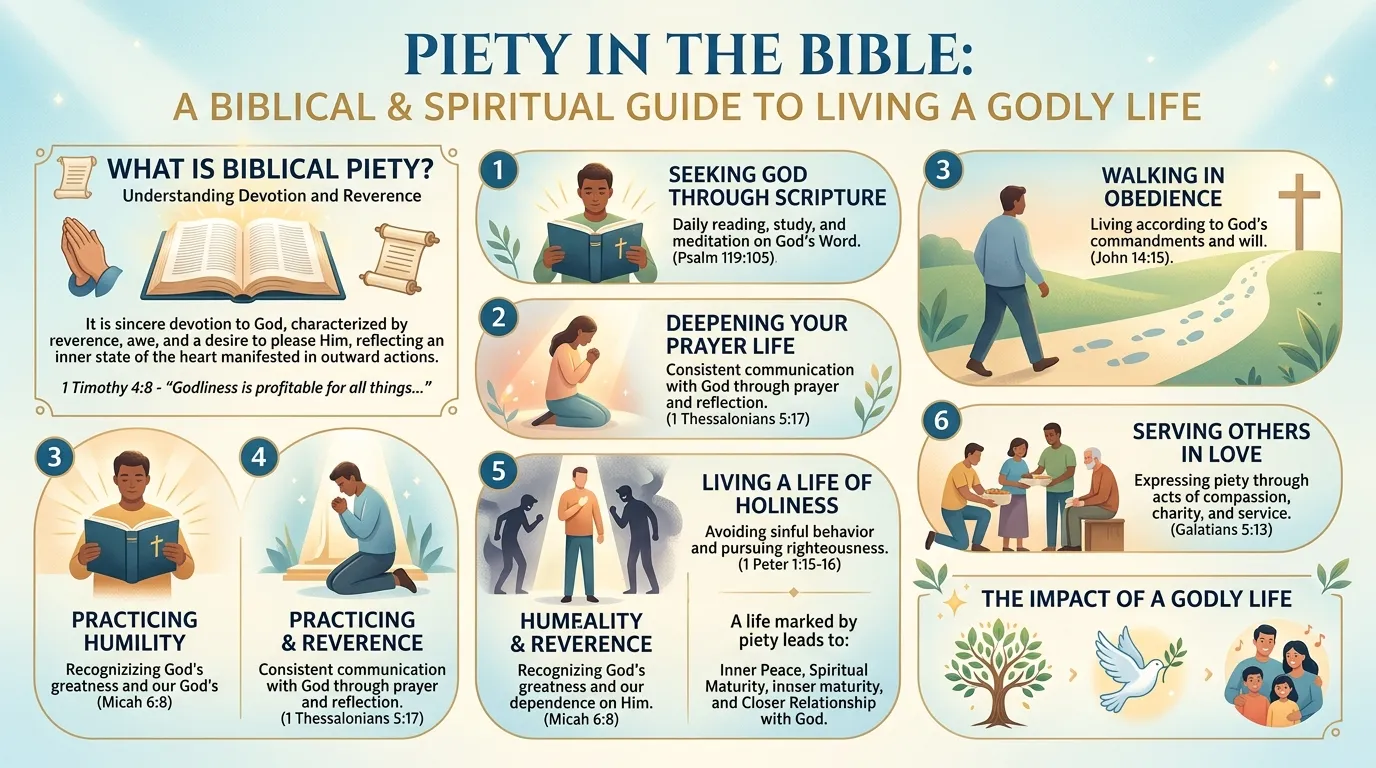
There is a quiet virtue the modern world has nearly forgotten, and the Bible refuses to let it go. The old word is piety — and before you picture something stiff and joyless, hear what it actually means. Piety is devotion made habitual: the steady, unshowy love of God worked into the grain of an ordinary life. Not the fireworks of a conference high, but the pilot light that never goes out. Scripture’s word for it is eusebeia — godliness, reverence, the life shaped by the fear of the Lord. And the Bible insists this quiet virtue is the good life: “godliness with contentment is great gain” (1 Timothy 6:6).
Eusebeia: What the Word Carries
The Greek eusebeia combines eu (well) and sebomai (to revere, worship) — literally “well-reverencing.” It describes a life properly oriented toward God: reverent in worship, obedient in conduct, devout in habit. It’s the New Testament’s umbrella word for the whole godly life — used fifteen times, mostly in the pastoral letters, where Paul makes it the goal of ministry: the church’s teaching aims at “godliness” (1 Timothy 6:3), its leaders must model it, its members must pursue it.
Crucially, eusebeia is relational, not merely ritual. The pagans used the word for proper observance of religious duties; the apostles filled it with knowing God. “His divine power has granted to us all things that pertain to life and godliness, through the knowledge of him who called us” (2 Peter 1:3). Godliness flows from knowledge of Him — not information about God but living acquaintance with Him. Piety is what happens when theology becomes friendship: doctrine caught fire in devotion.
The Gymnasium of Godliness: Train Yourself
Paul’s most practical word on piety is also his most physical: “Train yourself for godliness; for while bodily training is of some value, godliness is of value in every way, as it holds promise for the present life and also for the life to come” (1 Timothy 4:7-8). Train yourself — the Greek is gymnazo, the root of “gymnasium.” Godliness is athletic: it requires regimen, repetition, sweat. Nobody drifts into piety; it is built the way muscle is built — by deliberate, repeated exercise.
Paul even grants bodily exercise “some value” — he’s no ascetic despising the body — but godliness’ value is total: “in every way,” for “the present life and the life to come.” The fit body serves you for decades; the godly soul serves you forever. Every other investment expires; piety compounds eternally. This reframes spiritual disciplines entirely: prayer, Scripture, fasting, fellowship, generosity — these are not duties to endure but training to embrace, the workout regimen of the soul.
And like physical training, godliness has progressive structure. Peter lays out the regimen: “supplement your faith with virtue, and virtue with knowledge, and knowledge with self-control, and self-control with steadfastness, and steadfastness with godliness, and godliness with brotherly affection, and brotherly affection with love” (2 Peter 1:5-7). Faith is the starting point; love is the summit; godliness is the high camp — the stage where devotion has become character and character is ripening into love. Piety is not the whole climb, but no one reaches the summit without passing through it.
Cornelius: Piety in a Pagan Uniform
Scripture’s great case study in piety is a Roman centurion. “At Caesarea there was a man named Cornelius… a devout man who feared God with all his household, gave alms generously to the people, and prayed continually to God” (Acts 10:1-2). Devout — the word is eusebes, the adjective of our noun: Cornelius was pious. Note the three marks Luke records: he prayed continually (devotion upward), he gave generously (devotion outward), his whole household feared God (devotion reproduced).
And God noticed: “Your prayers and your alms have ascended as a memorial before God” (Acts 10:4). The quiet virtue reached heaven’s attention — and heaven responded with the gospel itself, sending Peter to preach Christ to Cornelius’ house. Piety doesn’t save (Cornelius still needed the gospel), but piety positions — the devout heart is the prepared soil. There’s a lesson for every seeker: keep praying, keep giving, keep seeking — God keeps accounts of quiet devotion, and He answers.
The Piety God Rejects: Performance Without Heart
Scripture is as fierce against false piety as it is tender toward the true. Jesus’ sharpest warnings target performative devotion: “Beware of practicing your righteousness before other people in order to be seen by them” (Matthew 6:1) — then He dismantles showy giving, showy praying, showy fasting, one by one. The problem isn’t the practices; it’s the audience. Piety performed for people is theater; piety offered to the Father “who sees in secret” is worship.
Isaiah’s indictment still stings: “this people draw near with their mouth and honor me with their lips, while their hearts are far from me” (Isaiah 29:13). Hearts far, lips near — the exact definition of impiety wearing piety’s clothes. And James gives the positive test that exposes every counterfeit: “Religion that is pure and undefiled before God the Father is this: to visit orphans and widows in their affliction, and to keep oneself unstained from the world” (James 1:27). True piety has two inseparable marks: compassion (toward the vulnerable) and purity (from the world’s stain). Devotion without mercy is noise; morality without devotion is husk. Piety holds both.
The prophet Micah compresses the whole ethic: “He has told you, O man, what is good; and what does the LORD require of you but to do justice, and to love kindness, and to walk humbly with your God?” (Micah 6:8). Walk humbly with your God — that is piety in a phrase: not sprinting ahead, not lagging behind, but walking with — the unhurried, daily companionship of the soul with its Maker.
The Quiet Rewards of the Pious Life
Piety’s promises are not loud, but they are deep. Intimacy: “The friendship of the LORD is for those who fear him” (Psalm 25:14) — reverence opens a friendship the irreverent never taste. Stability: the godly life “holds promise for the present life” (1 Timothy 4:8) — not exemption from trouble, but ballast within it. Contentment: “godliness with contentment is great gain” (1 Timothy 6:6) — the pious heart has learned the secret of enough. Legacy: Cornelius’ household followed his devotion; piety reproduces in children, friends, and all who watch a quiet life glow.
And the final promise is eschatological: the pious “will shine like the sun in the kingdom of their Father” (Matthew 13:43). The pilot light becomes the sunrise. Every unseen prayer, every secret gift, every humble walk — all of it is seen, all of it is kept, and all of it will be revealed in glory.
Piety at Home: The Domestic Altar
Piety’s first proving ground is not the church but the kitchen table. Moses commanded Israel: “these words that I command you today shall be on your heart. You shall teach them diligently to your children, and shall talk of them when you sit in your house, and when you walk by the way, and when you lie down, and when you rise” (Deuteronomy 6:6-7). When you sit, when you walk, when you lie down, when you rise — piety is not a Sunday compartment but the atmosphere of the home: God’s words in the ordinary hours, faith in the furniture.
The Bible’s pious households show the pattern. Timothy’s “sincere faith” dwelt first in his grandmother Lois and his mother Eunice (2 Timothy 1:5) — two generations of domestic piety producing a pastor. The Shunammite woman built a prophet’s chamber on her roof (2 Kings 4:10) — hospitality as household devotion. Aquilas and Priscilla hosted “the church in their house” (1 Corinthians 16:19) — the living room as sanctuary. None of these were professionals; all were pious — and their homes became outposts of the kingdom.
Practical domestic piety is unglamorous and unstoppable: a verse at breakfast, prayer before the meal (not rushed), confession and forgiveness practiced between family members (the home is where “be kind to one another, tenderhearted, forgiving one another” (Ephesians 4:32) gets its hardest workout), and the visible, unembarrassed love of God in parents that children absorb like language. You don’t need a family altar with candles; you need a family culture with Christ. The piety practiced at home is the piety that lasts — because it’s the piety that’s real.
How is piety different from legalism?
Legalism is devotion to rules as a way of earning standing; piety is devotion to God flowing from standing already given. The legalist asks “what must I do?”; the pious asks “whom do I love?” Same practices, opposite engines — one runs on fear, the other on friendship. “We love because he first loved us” (1 John 4:19) is piety’s fuel.
Can busy people be pious?
Cornelius commanded a Roman cohort — busier than most of us — and prayed continually. Piety is not leisure; it’s orientation: the heart turned Godward within whatever life requires. Short, frequent prayers; Scripture in small doses taken seriously; generosity as habit; the humble walk maintained in the margins. The pilot light needs little fuel — just never let it go out.
Piety is the quiet virtue with the loudest promise: the well-reverenced life, trained like an athlete, tender like Cornelius, humble like Micah’s walker — holding, in the end, “promise for the present life and also for the life to come.” For the concept across traditions, see piety.