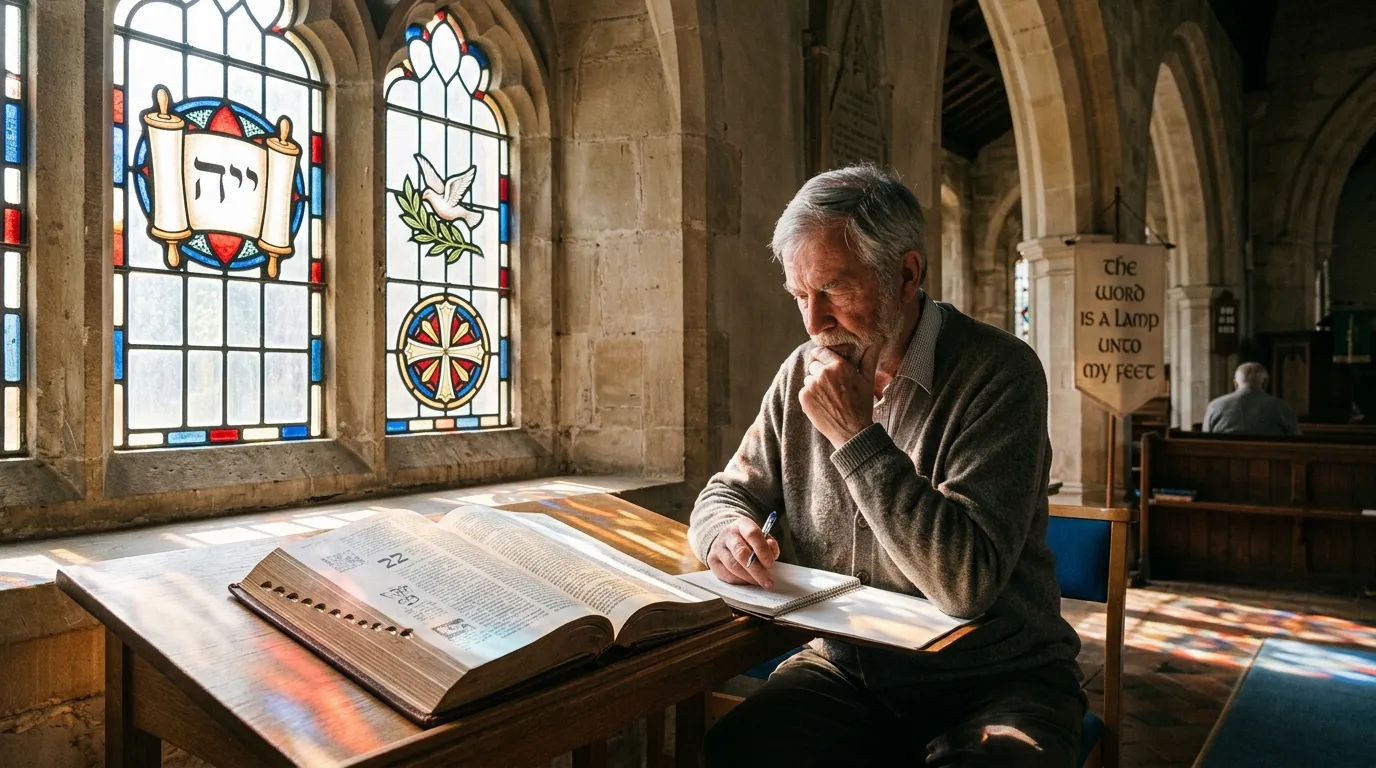
The Bible never assigns an official meaning to the number 22. That needs to be said first, because much of what circulates online about “biblical numerology” treats speculation as doctrine. Scripture explains some numbers clearly — seven for completion, twelve for God’s people, forty for testing — and leaves others unexplained. Twenty-two belongs to the second group. But it is not an uninteresting group. The number 22 appears in Scripture in a striking pattern, and the pattern is worth noticing as long as we hold it with open hands.
The pattern begins with the alphabet. Biblical Hebrew has twenty-two letters, and the biblical writers clearly delighted in that number. They built some of their most artful compositions on it. If you want to understand what 22 “means” in the Bible, the alphabet is where to start — not because the number is magic, but because the writers used it the way a poet uses a sonnet’s fourteen lines: as a form that gives shape to meaning.
Twenty-Two Letters, Twenty-Two Stanzas
Psalm 119, the longest chapter in the Bible, is an acrostic built on the Hebrew alphabet. It has twenty-two stanzas, one for each letter, and each stanza has eight verses, every one of which begins with that stanza’s letter. The psalm is a meditation on God’s word — its beauty, its power, its sufficiency — and its form is part of its message. Twenty-two stanzas say: this praise is complete, from aleph to tav, A to Z. Nothing has been left out. The whole alphabet is exhausted in praise of the word.
Lamentations does the same thing in grief. Its first four chapters are acrostics, each with twenty-two verses following the alphabet’s order. Here the form carries a different weight: the alphabet that sang God’s word in Psalm 119 now weeps over Jerusalem’s ruin, from aleph to tav. The completeness of the alphabet becomes the completeness of the sorrow — there is no letter left unused, no grief left unexpressed. The same twenty-two that framed praise now frames lament. The number holds both.
Other acrostics use the pattern too: Psalm 111, Psalm 112, Proverbs 31’s portrait of the excellent wife. The biblical writers returned to the twenty-two-letter form the way hymn writers return to familiar meters — because the form itself had become meaningful. Twenty-two meant “the whole thing, from beginning to end.”
Twenty-Two Elsewhere in Scripture
The number surfaces in other places, and each occurrence invites the same question: coincidence, or design? The book of Revelation has twenty-two chapters — a fact that has led some readers to wonder whether John structured his apocalypse with the alphabet’s completeness in mind. The closing vision of the New Jerusalem comes in chapter 21, and chapter 22 brings the final invitation and warning: the whole story, from the first letter to the last.
In the Old Testament, there are twenty-two generations commonly counted from Adam to Jacob in some reckonings, though genealogies vary. King Ahab’s son Ahaziah? No — care is needed here. The honest approach is to distinguish the clear cases (the acrostics, where the authorial intent is undeniable) from the suggestive ones (chapter counts, which may reflect later editorial decisions rather than original design). Both are interesting. Only the first is certain.
Some teachers have connected 22 with disorder or disorganization, often by combining numbers (11 × 2) or by appealing to events associated with the number. These connections are speculative. They may be devotionally stimulating, but they should never be presented as what the Bible teaches. The Bible teaches what the acrostics show: twenty-two as the shape of completeness, the whole alphabet pressed into the service of praise and grief.
The Honest Limits of Number Symbolism
A word of theological caution is necessary, because the hunger to find meaning in numbers can easily become superstition. The Bible warns against divination and the attempt to extract secret messages from creation apart from God’s revealed word. Seeing 22 on a clock, a receipt, or a license plate is not, by itself, a message from God. It might prompt you to pray, to open Scripture, to remember God’s completeness — and those are good responses. But the number is the prompt, not the message.
The Reformers and the church fathers alike would counsel the same thing: let the clear passages govern the unclear ones. What is clear is that God is complete, His word is complete, and His purposes will be completed. If the number 22 reminds you of those truths — because the alphabet has twenty-two letters and the psalmist used every one of them — then the reminder has served its purpose. The moment the number becomes an oracle, it has become an idol.
There is also a pastoral dimension. People who ask about the meaning of 22 are often going through something — a season of searching, a desire for guidance, a sense that God might be speaking. The kindest response is not a numerological decoder ring but an invitation: bring the searching to Scripture itself. Read Psalm 119 slowly. Sit with Lamentations. Let the twenty-two stanzas do their work. The God who ordered the alphabet is not hiding in numbers. He has spoken in sentences.
Ahab’s Twenty-Two Years: The Number Wears No Halo
Here is a useful corrective to any temptation to romanticize the number. First Kings tells us that Ahab, son of Omri, “reigned over Israel in Samaria twenty-two years” — and then adds the devastating assessment: “Ahab did more to provoke the Lord, the God of Israel, to anger than all the kings of Israel who were before him.” Twenty-two years of Baal worship, of Naboth’s vineyard seized and its owner murdered, of prophets hunted. The same number that frames Psalm 119’s praise also measures the reign of Israel’s worst king.
The juxtaposition is instructive. Numbers in the Bible do not carry moral auras. Twenty-two is not holy because the alphabet has twenty-two letters; it is simply the count of the letters, and the same count can attach to a wicked reign without contradiction. This is why the church has always been wary of numerology as a system: the moment a number becomes inherently lucky or unlucky, holy or sinister, we have left exegesis and entered superstition. Ahab’s twenty-two years are the Bible’s own warning label on the practice.
Revelation’s Twenty-Two Chapters: Design or Coincidence?
The book of Revelation has twenty-two chapters, and readers have long wondered whether this is deliberate — a final book shaped to the alphabet’s number, closing the canon with the same completeness the acrostics expressed. It is an attractive idea: Genesis opens with creation, Revelation closes with new creation, and the twenty-two chapters echo the twenty-two letters, the whole counsel of God from aleph to tav.
Attractive, but unprovable. Chapter divisions were added to the Bible in the thirteenth century, long after John wrote. John himself structured Revelation around sevens — seven churches, seven seals, seven trumpets, seven bowls — and the sevenfold pattern is unmistakable and authorial. The twenty-two chapters are a medieval accident laid over an ancient design. That does not make the coincidence meaningless for devotional reflection, but it does mean no doctrine can be built on it. The sevens are John’s; the twenty-two chapters are Stephen Langton’s.
This distinction — between what the author intended and what later readers notice — is the key to all responsible number study. Psalm 119’s twenty-two stanzas are authorial: the psalmist chose the form. Revelation’s twenty-two chapters are editorial: a later scholar chose the divisions. Both can prompt thought. Only the first can bear interpretive weight.
Questions Worth Asking
Does seeing the number 22 repeatedly mean something?
Not in any way the Bible authorizes. It may be coincidence, or it may be God’s providence nudging you to pay attention — but the content of the message, if there is one, will come from Scripture, not from the digits. Let the number prompt you to open the Bible, not to decode your circumstances.
Is biblical numerology legitimate?
In its careful form — observing patterns the biblical authors clearly intended, like the sevens of Revelation or the twelves of Israel’s tribes — yes. In its speculative form — assigning fixed meanings to every number and treating sightings as messages — it quickly becomes superstition, and Scripture warns against divination.
What is the safest takeaway from the number 22?
The alphabet acrostics: God’s word deserves our complete praise, our complete honesty in grief, and our complete attention. Twenty-two letters, all of them used, none of them wasted. That is a pattern worth imitating whether or not you ever notice the number again.
What 22 Can Teach Without Overclaiming
So what may be said, responsibly, about the number 22 in the Bible? That it is the number of the Hebrew alphabet, and that the biblical writers used the alphabet’s full span as a literary form for expressing completeness — in praise (Psalm 119), in grief (Lamentations), in wisdom (Proverbs 31). That Revelation’s twenty-two chapters bring the Bible’s story to its close. And that these patterns invite reflection on God’s completeness without authorizing anyone to treat the number as a code.
The acrostics remain the strongest evidence and the best teachers. They show poets so saturated in God’s word that they organized their art around its alphabet, spending twenty-two stanzas to say what could have been said in one: Your word is everything. Your grief is fully known. Wisdom covers the whole of life. That is what twenty-two means in the Bible — not a secret, but a shape. The shape of a completeness that still invites us in, from aleph to tav, from beginning to end.
For the curious, the mathematical and cultural properties of the number 22 make interesting background reading — though Scripture’s own use of the number, in the alphabet acrostics, remains the surer guide.










