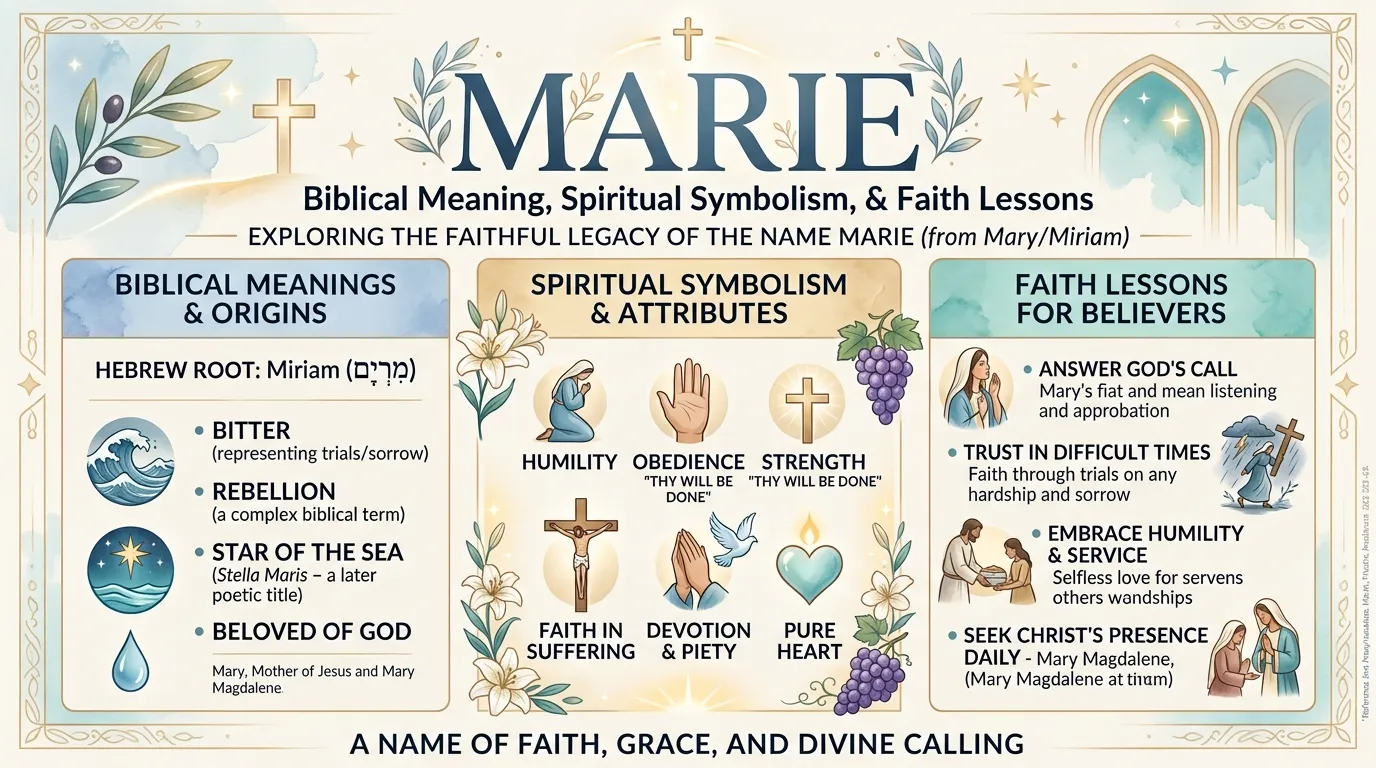
The name Marie does not appear in most English translations of the Bible. Yet ask almost any Christian what the name means, and they will point to one woman: Mary of Nazareth, the mother of Jesus. Marie is simply the French and Latin form of Mary, and through that single connection the name carries one of the richest spiritual legacies any name can hold. It is the name of a teenage girl in a small Galilean town who heard an impossible announcement and answered with a yes that changed history.
That is why so many people wonder about the Marie name meaning in the Bible. They are not really asking about linguistics. They are asking whether the name is connected to Scripture, what it teaches about God, and whether it can encourage the person who carries it. The answer is yes on all three counts — not because the name appears in a concordance, but because the story behind it is at the very center of the Christian faith.
A Name That Crossed Languages
To understand Marie, follow the name’s journey. The Hebrew name is Miryam, the name of Moses’ sister in the Old Testament. In Greek, the language of the New Testament, it became Mariam and Maria. Latin kept Maria, and French shaped it into Marie. English speakers inherited both Mary and Marie, the latter arriving through French influence. So when someone asks whether Marie is a biblical name, the honest answer is that it is the same name as Mary’s, wearing a different language’s clothing.
What did Miryam mean? Scholars debate this. Some connect it to the Hebrew word for bitterness or rebellion, others to “beloved” or “wished-for child.” The uncertainty is worth noting because the Bible itself rarely explains the meaning of Mary’s name. Scripture is far more interested in what Mary did than in what her name meant. That is the first lesson the name teaches: God defines people by their faith, not by their etymology.
The Girl in Nazareth
Everything we know about Mary comes from a few short passages, and they are extraordinary. In Luke 1, the angel Gabriel visits a young woman in Nazareth — a town so insignificant that Nathanael would later sneer, “Can anything good come out of Nazareth?” Mary is betrothed to Joseph, which means her life is mapped out: marriage, family, obscurity. Then Gabriel greets her with words no one had ever heard before: she will conceive by the Holy Spirit and bear the Son of God.
Mary’s response is the hinge of the whole story. She asks one practical question — “How will this be, since I am a virgin?” — and when Gabriel answers, she says, “Behold, I am the servant of the Lord; let it be to me according to your word.” In a single sentence, she surrenders her reputation, her marriage plans, and her safety. A pregnant unmarried girl in first-century Judea faced public shame and the possible end of her engagement. Mary counted the cost and said yes anyway. The name Marie, ever after, has carried that yes.
The Magnificat: Her Theology
Mary was not only obedient; she was theologically deep. When she visits her relative Elizabeth, she sings what the church calls the Magnificat, and it is one of the most profound passages in the New Testament: “My soul magnifies the Lord, and my spirit rejoices in God my Savior.” In a dozen verses she weaves together the whole Old Testament story — God’s mercy to Abraham, His scattering of the proud, His lifting of the humble, His filling of the hungry.
Notice what she does not say. She does not boast about being chosen. She calls herself God’s servant and marvels that He has looked on her “humble estate.” The woman at the center of the incarnation understood exactly where the glory belonged. Anyone named Marie inherits this pattern: favor is not a trophy, it is a stewardship. God chose an unknown girl precisely because unknown girls are the kind of people He loves to use.
Watching the Whole Story
Mary does not disappear after the nativity. She appears at the wedding in Cana, where her quiet nudge — “Do whatever he tells you” — sets Jesus’ first miracle in motion. She appears at the cross, where Jesus, in His dying moments, entrusts her to the beloved disciple. And she appears in the upper room in Acts 1, praying with the disciples as they wait for the Spirit. From the cradle to the cross to the church’s birth, Mary is present, watching, pondering.
Luke says twice that Mary “treasured up” the things she witnessed and “pondered them in her heart.” That is a spiritual discipline worth imitating. Mary did not understand everything — she was once so bewildered by the twelve-year-old Jesus in the temple that she scolded Him. But she kept paying attention. Faith, in Mary’s pattern, is not the absence of questions. It is the refusal to walk away while the questions are still unanswered.
What the Name Teaches Today
So what does Marie mean for someone choosing it for a daughter, carrying it themselves, or simply curious about it? It teaches that God uses the overlooked. Nazareth was nothing, Mary was no one by the world’s standards, and the angel’s greeting — “favored one” — would have sounded absurd to her neighbours. Yet God’s favor does not follow the world’s rankings. It follows willing hearts.
It teaches that obedience can be costly and still be right. Mary’s yes led to whispers, danger, a flight to Egypt, and finally the sword that Simeon promised would pierce her own soul as she watched her son die. The Christian life does not promise that obedience will be comfortable. It promises that obedience will be held by God.
And it teaches humility as the shape of greatness. In a culture that tells girls to make themselves the center of the story, Mary points the other way: magnify the Lord, not yourself. The Magnificat is the charter of every Marie — a life that makes God look large.
Marie and the Old Testament Miryams
The name did not begin with the mother of Jesus. The first Miryam in Scripture is Moses’ sister, the prophetess who led Israel’s women in song after the crossing of the Red Sea. She is called a prophetess, she leads worship, and — in a sobering episode — she is disciplined by God for challenging Moses’ authority. Her story adds texture to the name: leadership and song, but also a warning that gifting does not exempt anyone from humility.
There are other Marys in the New Testament too: Mary Magdalene, the first witness of the resurrection; Mary of Bethany, who anointed Jesus’ feet; Mary the mother of James; Mary the mother of John Mark. The name keeps appearing at decisive moments — at the tomb, at the anointing, in the upper room. It became, in the early church, the name most associated with women who stayed close to Jesus when staying close was costly. Marie inherits that whole cloud of witnesses, not just one woman.
The Woman the Name Remembers at the Cross
One scene deserves its own meditation, because it shows what the name costs. At the crucifixion, Mary stands near the cross — John names her explicitly among the women present. Simeon’s prophecy, spoken over the infant Jesus in the temple, has come true: “a sword will pierce through your own soul also.” She watches her son die slowly, publicly, unjustly. And in His final moments, Jesus sees her and provides for her: “Woman, behold, your son!” — entrusting her to the beloved disciple.
This is the name’s hardest lesson. Mary’s yes in Nazareth led, thirty-three years later, to Golgotha. Obedience did not protect her from pain; it led her into the deepest pain a mother can know, transfigured by being shared with God’s own suffering. Anyone who takes Marie as a name of faith should know this: the God who calls is worthy of the cost, but the cost is real. The Magnificat’s joy and the cross’s sorrow belong to the same life, the same woman, the same yes.
Common Questions
Is Marie a biblical name?
Marie itself does not appear in English Bibles, but it is the French form of Mary (Hebrew Miryam), one of the most important names in Scripture. In that sense it is thoroughly biblical.
What does Marie mean?
As a form of Mary, its original meaning is debated — proposals include “bitterness,” “beloved,” and “wished-for child.” The Bible does not settle the question, which suggests the meaning of the life matters more than the meaning of the syllables.
Is there a saint or feast connected to the name?
Many Christian traditions honor Mary with feast days throughout the year, and Marie has long been one of the most common names given in her honor. The name’s spiritual weight comes from the biblical Mary herself.
The story of the woman behind the name is told most fully in Luke’s Gospel, and the historical and theological background of Mary of Nazareth helps show why this one life reshaped how Christians understand obedience, humility, and grace.










